Introduction
Theory: Culturally Responsive Teaching theory
http://www.brown.edu/academics/education-alliance/teaching-diverse-lear…
Age Group: Pre-Service Teachers
http://www.oxforddictionaries.com/us/definition/american_english/preser…
Topic: The achievement gap
Introduction
How can culturally responsive teaching close the achievement gap?
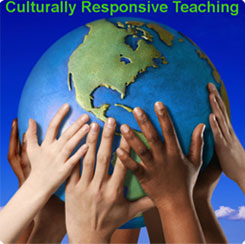
What is culturally responsive teaching?
Culturally responsive teaching uses the cultural knowledge, prior experiences, and performance styles of diverse students to make learning more appropriate and effective for them; it teaches to and through the strengths of these students (Gay, 2000).
A culturally responsive classroom would have the following characteristics:
- It acknowledges the legitimacy of the cultural heritages of different ethnic groups, both as legacies that affect students' dispositions, attitudes, and approaches to learning and as worthy content to be taught in the formal curriculum.
- It builds bridges of meaningfulness between home and school experiences as well as between academic abstractions and lived sociocultural realities.
- It uses a wide variety of instructional strategies that are connected to different learning styles.
- It teaches students to know and praise their own and each others' cultural heritages.
- It incorporates multicultural information, resources, and materials in all the subjects and skills routinely taught in schools (p. 29)
Gay, G. (2000). Culturally Responsive Teaching: Theory, Research, & Practice. New York: Teachers College Press.
Task

Main Task
Write an essay reflecting on how a culturally responsive classroom can close the achievement gap.
Before you write your essay, complete tasks 1-6.
Task 1 -Read about culturally responsive pedagogy and practice.
http://www.nccrest.org/professional/culturally_responsive_pedagogy-and…
Then, Click on the link and read the examples of lessons created to bring culturally responsive teaching to life in the classroom.
http://www.nea.org/home/16727.htm
Task 2 - What is the achievent gap? Click on the link below and read the article.
http://www.edweek.org/ew/issues/achievement-gap/
Task 3 -In order to learn about the statistics of the achievement gap,
click on the link below and read the Executive Summary from the National Assessments of Education Progress (NAEP). Why do you think minority students are falling behind?
http://nces.ed.gov/nationsreportcard/pubs/studies/2009455.aspx
Task 4 - Click on the link and read the article about the academic gap facts and figures.
http://www.tc.columbia.edu/news.htm?articleID=5183
Task 5 - Watch the following video.
http://www.teachertube.com/video/75655
Discuss how can teachers provide equal oportunities to succeed to all of their students.
Task 6 - Listen to Depeche Mode "Get the balance right".
Think of ways that teachers can be a tool to "Get the balance right".
[video:http://www.youtube.com/watch?v=KI1J44j0MU4 align:right]
Evaluation
Individual Evaluation based on essay
Write a 3-4 page essay that answers the following questions:
What is culturally responsive teaching? Give examples in the classrooms.
What is the achievent gap?
Why do you think minority students are falling behind?
How can culturally responsive teaching close the achievement gap?
Rubric

Conclusion
As pre-service teachers, it is essential to make connections and reflect how different theories can be applied in the classroom.
After completing the tasks, pre-service teachers should know the facts about the achievement gap and how minority students are affected. They will be able to reflect on how a culturally responsive classroom can help close the achievement gap.
Credits
References
Oakes, J., & Lipton, M. (1999). Teaching to change the world. Boston [Mass.: McGraw-Hill College.
Gay, G. (2000). Culturally Responsive Teaching: Theory, Research, & Practice. New York: Teachers College Press.
NAEP Studies - Achievement Gaps. (n.d.). NAEP Studies - Achievement Gaps. Retrieved June 14, 2014, from http://nces.ed.gov/nationsreportcard/pubs/studies/2009455.aspx