
Introduction
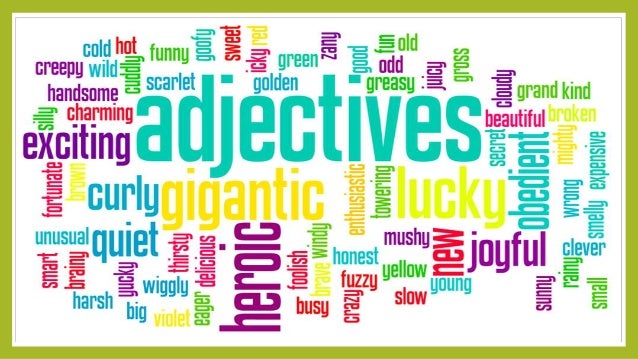
Adjectives
What is an adjective?
Adjectives are words that describe or modify other words, making your writing and speaking much more specific, and a whole lot more interesting. Words like small, blue, and sharp are descriptive, and they are all examples of adjectives. Because adjectives are used to identify or quantify individual people and unique things, they are usually positioned before the noun or pronoun that they modify. Some sentences contain multiple adjectives.
examples:
- They live in a big, beautiful
- Since it’s a hot day, Lisa is wearing a sleeveless
- The mountaintops are covered in sparkling
- On her birthday, Brenda received an antique vase filled with fragrant
Task
Types of Adjectives
Remember that adjectives can modify as well as describe other words, and you’ll find it much easier to identify different types of adjectives when you see them.
Articles
There are only three articles, and all of them are adjectives: a, an, and the. Because they are used to discuss non-specific things and people, a and an are called indefinite articles. For example:
- I’d like a
- Let’s go on an
Neither one of these sentences names a specific banana or a certain adventure. Without more clarification, any banana or adventure will do.
The word the is called the definite article. It’s the only definite article, and it is used to indicate very specific people or things:
- Please give me a banana. I’d like the one with the green stem.
- Let’s go on an adventure. The Grand Canyon mule ride sounds perfect!
Possessive Adjectives
As the name indicates, possessive adjectives are used to indicate possession. They are:
- My
- Your
- His
- Her
- Its
- Our
- Their
Possessive adjectives also function as possessive pronouns.
Demonstrative Adjectives
Like the article the, demonstrative adjectives are used to indicate or demonstrate specific people, animals, or things. These, those, this and that are demonstrative adjectives.
- These books belong on that
- This movie is my favorite.
- Please put those cookies on the blue plate.
Coordinate Adjectives
Coordinate adjectives are separated with commas or the word and, and appear one after another to modify the same noun. The adjectives in the phrase bright, sunny day and long and dark night are coordinate adjectives. In phrases with more than two coordinate adjectives, the word and always appears before the last one; for example: The sign had big, bold, and bright letters.
Be careful, because some adjectives that appear in a series are not coordinate. In the phrase green delivery truck, the words green and delivery are not separated by a comma because green modifies the phrase delivery truck. To eliminate confusion when determining whether a pair or group of adjectives is coordinate, just insert the word and between them. If and works, then the adjectives are coordinate and need to be separated with a comma.
Numbers Adjectives
When they’re used in sentences, numbers are almost always adjectives. You can tell that a number is an adjective when it answers the question “How many?”
- The stagecoach was pulled by a team of six
- He ate 23 hotdogs during the contest, and was sick afterwards.
Interrogative Adjectives
There are three interrogative adjectives: which, what, and whose. Like all other types of adjectives, interrogative adjectives modify nouns. As you probably know, all three of these words are used to ask questions.
- Which option sounds best to you?
- What time should we go?
- Whose socks are those?
Indefinite Adjectives
Like the articles a and an, indefinite adjectives are used to discuss non-specific things. You might recognize them, since they’re formed from indefinite pronouns. The most common indefinite adjectives are any, many, no, several, and few.
- Do we have any peanut butter?
- Grandfather has been retired for many
- There are no bananas in the fruit bowl.
- I usually read the first few pages of a book before I buy it.
- We looked at several cars before deciding on the best one for our family.
Attributive Adjectives
Attributive adjectives talk about specific traits, qualities, or features – in other words, they are used to discuss attributes. There are different kinds of attributive adjectives:
- Observation adjectives such as real, perfect, best, interesting, beautiful or cheapest can indicate value or talk about subjective measures.
- Size and shape adjectives talk about measurable, objective qualities including specific physical properties. Some examples include small, large, square, round, poor, wealthy, slow and
- Age adjectives denote specific ages in numbers, as well as general ages. Examples are old, young, new, five-year-old, and
- Color adjectives are exactly what they sound like – they’re adjectives that indicate color. Examples include pink, yellow, blue, and
- Origin adjectives indicate the source of the noun, whether it’s a person, place, animal or thing. Examples include American, Canadian, Mexican, French.
- Material adjectives denote what something is made of. Some examples include cotton, gold, wool, and
- Qualifier adjectives are often regarded as part of a noun. They make nouns more specific; examples include log cabin, luxury car, and pillow cover.
Process
Order of adjectives
How to order adjectives in English
In many languages, adjectives denoting attributes usually occur in a specific order. Generally, the adjective order in English is:
- Quantity or number
- Quality or opinion
- Size
- Age
- Shape
- Color
- Proper adjective (often nationality, other place of origin, or material)
- Purpose or qualifier
Evaluation
1. Choose the best answer for each sentence.
- The house is __________________.
- large and white
- white and large
- large white
- They live in a __________________ house.
- large and white
- white and large
- large white
Answers: A – large and white B – large white
2. Which sentence uses the correct order of adjectives?
- We took a ride on a blue, old Chinese bus.
- We took a ride on a Chinese, old, blue bus.
- We took a ride on an old, blue Chinese bus.
Answer: C
3. Which sentence uses the correct order of adjectives?
- I’d like three good reasons why you don’t like spinach.
- I’d like a good three reasons why you don’t like spinach.
- I’d like good reasons three why you don’t like spinach.
4. Which sentence uses the correct order of adjectives?
- I like that really big red old antique tractor in the museum.
- I like that really big old red antique tractor in the museum.
- I like that old, red, really big antique tractor in the museum.
Answer: B
5. Which sentence uses the correct order of adjectives?
- My brother rode a beautiful big black Friesian horse in the parade.
- My brother rode a beautiful Friesian big black horse in the parade.
- My brother rode a big, black, beautiful Friesian horse in the parade.
Answer: A
6. For each of the following sentences, choose the correct order of adjectives to fill in the blank.
- My grandmother lives in the ________________________ house on the corner
- little blue, green and white
- little blue and green and white
- little, blue, green, and white
- The store carries an assortment of _____________________ objects.
- interesting new, old and antique
- new, old, interesting and antique
- interesting, old and new and antique
- We went for a two-week cruise on a __________________________ ocean liner.
- incredible brand-new, huge Italian
- incredible, huge, brand-new Italian
- Italian incredible, brand-new, huge
Conclusion
adjectives are useful for daily discourse
Credits
Teacher Page
name:Michelle Jane M. Garciso
age:20
school:Mindanao State University