
Introduction
Civil Rights Movement-
This WebQuest explores the largest social movement of the 20th century, including the Brown decision, the challenge to social segregation, voting rights, Black Power, and the movement's legacy
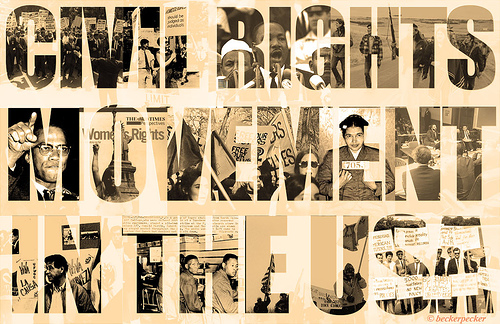
"The Civil Rights Movement was a mass popular movement to secure for African Americans equal access to and opportunities for the basic privileges and rights of U.S. citizenship. Although the roots of the movement go back to the 19th century, it peaked in the 1950s and 1960s. African American men and women, along with whites, organized and led the movement at national and local levels. They pursued their goals through legal means, negotiations, petitions, and nonviolent protest demonstrations (see pacifism and nonviolent movements). The civil rights movement was largest social movement of the 20th century in the United States. It influenced the modern women's rights movement and the student movement of the 1960s.
The Civil Rights Movement centered on the American South. That was where the African American population was concentrated and where racial inequality in education, economic opportunity, and the political and legal processes was most blatant. Beginning in the late 19th century, state and local governments passed segregation laws, known as Jim Crow laws; they also imposed restrictions on voting qualifications that left the black population economically and politically powerless. The movement therefore addressed primarily three areas of discrimination: education, social segregation, and voting rights."
Davis, J. E. (2014). Civil Rights Movement. Grolier Multimedia Encyclopedia. Retrieved Decmber 1, 2014 from Grolier Online http://gme.grolier.com/article?assetid=0063993-0
[video:https://www.youtube.com/watch?v=ta6UmkqzZA0 align:center autoplay:1]
Task

Hello class,
Today we are going to take a closer look at the largest domestic social movement of the 20th century! The point of this WebQuest is for you to gain knowledge about the various events that took place during the Civil Rights Movement. With an assigned partner, you will use the internet and text resources provided to define key terms and gather information about 10 historical events (see "Process" tab). You will then use this information to draw conclusions, make informed decisions, and create new knowledge, using the prompts provided. We will begin class tomorrow with a 15 minute debriefing/discussion, before moving on to the final phase of this activity (again, see "Process" tab), to be completed in class in groups of three.
-
In this WebQuest, you will act as a reporter, researching themes and events of the Civil Rights Movement with your assigned partner. Although I am permitting you to work in pairs today, each student is responsible for submitting their own copy of the assignment at the end of class.
- You will have the entire class period to complete Steps #1 & 2 of this three-pronged task -- remember, we are on a block schedule today, which means that you have 86 minutes of classtime today! This should provide you with plenty of time! In the event that you do not finish, however, you may complete as homework, submitting your final product to me no later than 8 AM tomorrow! If you must complete as homework, see me before you depart for the day, and I will provide you with a PDF of this assignment.
- It is absolutely imperative that Step #1 & 2 (explained in detail in the "Process" tab) be completed and handed in by tomorrow's 8 AM deadline, as you will otherwise be unable to participate in Step #3, tomorrows in-class group activity! Late submission will automatically earn you an alternate, independent in-class assignment tomorrow. No exceptions!
- This WebQuest assignment is to be hand-written in pencil or blue/black ink, single-sided and single-spaced, on college-ruled binder paper, with approximately 1" margins. Don't forget to include your name, date, period, and assignment title. Lastly, neatness matters in that if I cannot read it, I cannot grade it!
[video:https://www.youtube.com/watch?v=lkXFb1sMa38 align:center]
(You are not required to watch this video! It's just for funzies !)
Process

STEP #1-
In pairs (with the partner you have been assigned), you will look up and define (in your own words!) the key terms listed below. Use your textbook and the following websites to locate terms:
http://www.merriam-webster.com/dictionary
http://www.thefreedictionary.com/
1. Segregation
2. Integration
3. Discrimination
4. Racism
5. Suffrage
6. Boycott
7. Reform
8. Jim Crowe Laws
9. Protest
10. Civil Rights
11. Civil Disobedience
12. Disenfranchisement
13. Ku Klux Klan
14. Black Panthers
15. Freedom Riders

STEP #2-
Next, you and your partner will research the events listed below with the links provided. Using the information gathered, construct a short blurb for each event. These blurbs need not exceed five sentences, but each must encompass the following contextual information to ensure a comprehensive understanding of each event and its impact on the advancement of the Movement as a whole:
- What happened?
- Who was involved?
- When did it happen?
- Where did it take place?
- Why did it happen?
- How did it happen?
- How did it affect other people?
1). Brown v. Board of Education (1954)
http://www.pbs.org/wnet/supremecourt/rights/landmark_brown.html
http://www.nps.gov/brvb/historyculture/index.htm
https://www.youtube.com/watch?v=vQrrC0Jb7nI
http://americanhistory.si.edu/brown/history/index.html
2). The murder of Emmett Till
https://www.youtube.com/watch?v=FqW4WkPxJ5Y
http://www.biography.com/people/emmett-till-507515
http://law2.umkc.edu/faculty/projects/ftrials/till/tillhome.html

3). Rosa Parks and the Montgomery Bus Boycott
http://www.ushistory.org/us/54b.asp
http://www.history.com/topics/black-history/rosa-parks
https://www.youtube.com/watch?v=JKCsZc37esU
http://students.spsu.edu/asemenov/timeline.html
4). Little Rock Nine
http://www.history.com/topics/black-history/central-high-school-integration
http://www.encyclopediaofarkansas.net/encyclopedia/entry-detail.aspx?entryID=723
http://www.history.com/topics/black-history/civil-rights-movement/videos/little-rock-nine-rev
5). Bloody Sunday (Selma to Montgomery March)
http://www.blackpast.org/aah/bloody-sunday-selma-alabama-march-7-1965
http://www.nps.gov/nr/travel/civilrights/al4.htm
https://www.youtube.com/watch?v=00xojzOYdz8
http://mlk-kpp01.stanford.edu/index.php/encyclopedia/encyclopedia/enc_selma_to_montgomery_march/

6). Burmingham, Alabama, Church Bombing
http://www.english.illinois.edu/maps/poets/m_r/randall/birmingham.htm
http://crdl.usg.edu/events/birmingham_bombing/
http://www.cnn.com/2013/06/13/us/1963-birmingham-church-bombing-fast-facts/
http://www.washingtonpost.com/wp-srv/national/longterm/churches/archives1.htm
7). Greensboro Sit-Ins
http://www.sitins.com/index.shtml
https://www.youtube.com/watch?v=VDHBzB-eO1g
https://www.youtube.com/watch?v=zU2lfkz5-MU

8). March on Washington
http://www.history.com/topics/black-history/march-on-washington
https://www.youtube.com/watch?v=smEqnnklfYs
http://life.time.com/history/march-on-washington-photos-from-an-epic-civil-rights-event/#1
http://www.pbs.org/black-culture/explore/march-on-washington/interesting-facts/#.VIPR0zHF_ns
http://www.cnn.com/2013/06/05/us/march-on-washington-fast-facts/
9). The Children's March of '63
http://mlk-kpp01.stanford.edu/index.php/encyclopedia/encyclopedia/enc_childrens_crusade/
https://www.youtube.com/watch?v=5c113fq3vhQ
http://www.cbsnews.com/news/the-children-who-marched-into-civil-rights-history/
http://civilrightsteaching.org/605/

10). Assassination of Martin Luther King, Jr.
http://en.wikipedia.org/wiki/Assassination_of_Martin_Luther_King,_Jr.
http://www.chicagotribune.com/news/nationworld/politics/chi-chicagodays-kingriots-story-story.html
http://time.com/3524581/the-night-mlk-was-murdered-a-photographers-story/

STUDENTS: If you are finished with Steps #1 & 2, submit to me! If you are NOT done with Steps #1 & 2, see me before leaving class so I may provide you with a PDF of this assignment, and complete as homework. Remember that this WebQuest assignment is due to me no later than 8 AM tomorrow. Failure to submit by 8 AM means that you will be unable to participate in the in-class group activity tomorrow; instead, you will work out of the text, independently completing an alternate assignment. Thus, it is highly recommended that you complete and turn in the above by the deadline!!!
STEP #3-
The final phase of this activity will be completed in-class tomorrow, following a 15 minute debriefing of today's WebQuest assignment. I will place you in groups of three, and each group will be randomly assigned one of the events researched today. I will provide each group with a large piece of butcher paper, coloring utensils, glue sticks, magazines, etc., as well as supplementary readings on each of the topics presented. I will also permit laptop use. With the materials provided, each group will create a summary and visual representation of their assigned event. Upon completion, we will attach your individual sheets to create a GIGANTIC timeline of Civil Rights events, which will be displayed on the classroom wall! This timeline will remain present during our unit exam so it is highly recommended that you do a neat and thorough job, as it may benefit you immensely come test time!
Evaluation
|
Conclusion

Great job, class!!! Thank you for your cooperation!
Through this activity, you should have gained a deeper understanding of several distinct events in the African-American Civil Rights Movement. You have learned new vocabulary, researched 10 pivotal historical events, researched one specific event in great detail, and created a visual representation and summary of your assigned moment in history. You also practiced teamwork like rockstars! After compiling all the class events, we will create a GIGANTIC timeline of the Civil Rights Movement to display on our classroom wall! You will need to take the information that you acquired through your research and apply it to the other lessons that you will be learning about in the future.
In addition to facilitating a comprehensive understanding of the Civil Rights Movement and fostering teamwork, successful completion of this assignment fulfills the following state content standards for history and social science:
11.10 Students analyze the development of federal civil rights and voting rights.
1. Explain how demands of African Americans helped produce a stimulus for civil rights, including President Roosevelt’s ban on racial discrimination in defense industries in 1941, and how African Americans’ service in World War II produced a stimulus for President Truman’s decision to end segregation in the armed forces in 1948.
2. Examine and analyze the key events, policies, and court cases in the evolution of civil rights, including Dred Scott v. Sandford, Plessy v. Ferguson, Brown v. Board of Education, Regents of the University of California v. Bakke, and California Proposition 209.
3. Describe the collaboration on legal strategy between African American and white civil rights lawyers to end racial segregation in higher education.
4. Examine the roles of civil rights advocates (e.g., A. Philip Randolph, Martin Luther King, Jr., Malcom X, Thurgood Marshall, James Farmer, Rosa Parks), including the significance of Martin Luther King, Jr.’s “Letter from Birmingham Jail” and “I Have a Dream" speech.
5. Discuss the diffusion of the civil rights movement of African Americans from the churches of the rural South and the urban North, including the resistance to racial desegregation in Little Rock and Birmingham, and how the advances influenced the agendas, strategies, and effectiveness of the quests of American Indians, Asian Americans, and Hispanic Americans for civil rights and equal opportunities.
6. Analyze the passage and effects of civil rights and voting rights legislation (e.g., 1964 Civil Rights Act, Voting Rights Act of 1965) and the Twenty-Fourth Amendment, with an emphasis on equality of access to education and to the political process.
Please hand Steps #1 &2 in by 8 AM tomorrow!

Additional sources to peruse if you're so inclined! They may be particularly useful when constructing your portion of the class timeline:
http://www.pbs.org/wnet/aaworld/timeline/civil_01.html
http://www.visionaryproject.org/timeline/
http://www.nps.gov/nr/travel/civilrights/
http://www.pbs.org/black-culture/explore/civil-rights-movement/
Teacher Page
Ms. Ceanne Smith
TEL 7170
Spring 2015
[img_assist|nid=25452|title=history|desc=|link=none|align=center|width=411|height=480]