
Introduction
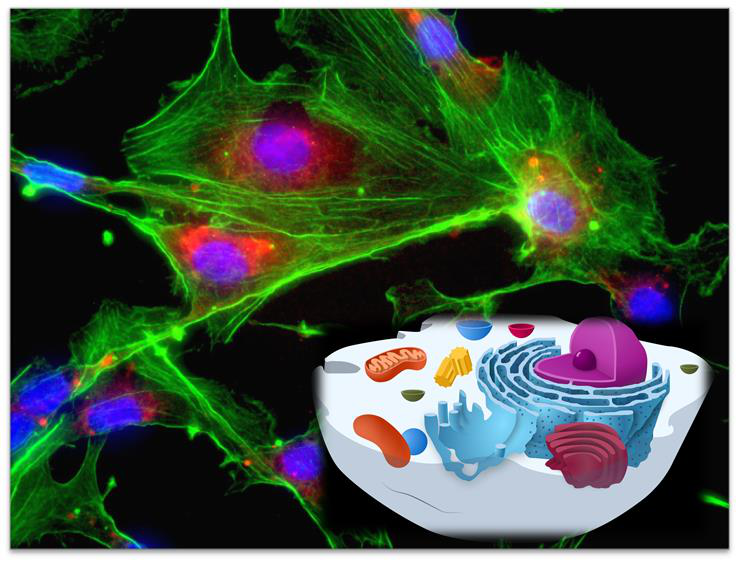
I. AN INTRODUCTION TO CELL BIOLOGY
Cell biology integrates principles from many disciplines, including chemistry, physics, genetics, biochemistry and physiology, for a more complete understanding of cell function. It is a branch of science which deals with the study of the cell, its structure and function. it includes the understanding and differentiation between the prokaryotic and eukaryotic cell. It explores the different organelles within the cell with their functions and explains the importance of them and the cell as a whole.
For a wider understanding of Cell biology, kindly browse the provided link below:
Task
What are Cell Organelles?
The cellular components are called the cell organelles. These cell organelles include both membrane and non-membrane bound organelles, present within the cells and are distinct in their structures and functions.
TASK 1. MATCH ME NAE NAE
Direction: Watch the short video provided. Afterwards, be able to identify the different organelles found inside the cell and their functions through answering the matching type below. Kindly submit the answers on the email address (joy.bongalos@cbsua.edu.ph).
Watch:
Match the organelles in column A with their corresponding functions in column B.
A B
1. Plasma Membrane a. Control center of the cellular activities and is the storehouse of the cell’s DNA
2. Cytoplasm b. Responsible for transporting, modifying, and packaging proteins and lipid to targeted destinations
3. Nucleus c. Protein synthesis in all living cells that ensure the survival of the cell
4. Endoplasmic Reticulum d. Stores the food or a variety of nutrients that a cell might need to survive
5. Mitochondria e. "Powerhouse of the cell" as they produce energy-rich molecules for the cell
6. Plastids f. Essential components of the cell, where all the cell organelles are embedded
7. Ribosome g. Responsible for the cell’s metabolic activities.
8. Golgi Apparatus h. The transport system of the cell, involved in transporting materials throughout the cell
9. Vacuoles i. Helps in the process of photosynthesis and pollination, Imparts color for leaves, flowers and fruits and stores starch, proteins and fats.
10. Chloroplasts j. Sites of photosynthesis
PROKARYOTIC VS. EUKARYOTIC CELL
The primary distinction between these two types of organisms is that eukaryotic cells have a membrane-bound nucleus and prokaryotic cells do not.
TASK 2. LABEL ME UP
Direction: Below is an image of the Eukaryotic and Prokaryotic cell, draw their image and label each parts with arrows. Take a picture of your work and save as pdf file. Once done, submit your answer on the email address (joy.bongalos@cbsua.edu.ph).

TASK 3. LETS SUM IT UP!
Direction: Access the link below to be able to answer the following guide questions. Submit in the mentioned email address above.
Reading 1. https://www.sciencedirect.com/topics/agricultural-and-biological-sciences/cell-biology
Reading 2. https://sciencing.com/why-are-cells-important-for-living-organisms-12251197.html
Reading 3. https://www.ncbi.nlm.nih.gov/books/NBK6609/
GUIDE QUESTIONS:
1. Why study Cell biology?
2. Describe cell and cites it's importance.
3. What are the different types of cells and how are they different?
4. How does the structure of a cell relate to its function?
5. How does life result from cellular structures and functions?
Process
Here are the necessary guides to be follow to be able to understand the topic and accomplish the task in the web quest properly.
1. Be guided with the uploaded link in this site to accomplish the tasks correctly.
2. Always follow and read carefully the directions given.
3. All the required answers must be submitted in PDF file.
4. Don't hesitate to ask, send a personal email to the teacher if you have any concern or question regarding the task or the subject.
5. Participation will highly appreciated.
Evaluation
BE GUIDED WITH THE FOLLOWING RUBRIC IN GRADING TASKS OR PERFORMANCE.
| EXCELLENT (4) | GOOD (3) | SATISFACTORY (2) | NEEDS IMPROVEMENT (1) | |
| KNOWLEDGE INTEGRATION |
Clearly explained the main idea of the text and impart more knowledge regarding the topic.
|
Explained the main idea of the text and impart some knowledge regarding the topic. | Explained some idea of the text and impart less knowledge regarding the topic. | Did not explain the main idea of the text. |
| SUPPORTING DETAILS |
Included all the important facts to support the main idea and no unimportant information.
|
Included most of the important facts to support the main idea and included one unimportant fact. | Included some of the important facts to support the main idea and some unimportant facts to support the main idea. | Included no important facts that support the main idea. |
| CREATIVITY |
The answers are systematically created, with more supporting ideas.
|
The answers are systematically created, with some supporting ideas. | The answers are created with less supporting ideas. | The answers are created with no supporting ideas. |
Conclusion

CELLS
A cell is a mass of cytoplasm that is bound externally by a cell membrane. Usually microscopic in size, cells are the smallest structural units of living matter and compose all living things. Most cells have one or more nuclei and other organelles that carry out a variety of tasks.
Differentiate Prokaryotic Cell to Eukaryotic Cell
Prokaryotic cells and eukaryotic cells are the two types of cells that exist on Earth. There are several differences between the two, but the biggest distinction between them is that eukaryotic cells have a distinct nucleus containing the cell's genetic material, while prokaryotic cells don't have a nucleus and have free-floating genetic material instead.

ORGANELLES AND THEIR FUNCTION
Kindly click the link below, it will gives you a clear understanding about the distinctions and functions of the different organelles.
https://courses.lumenlearning.com/wm-nmbiology1/chapter/summary-organelles/
Teacher Page
Dear students: Hope you enjoy our journey about exploring cell biology. Understanding all about cell, its characteristics, components and functions of those that depends in their structures. Hope you fully understand those concepts and be able to apply all your learning through performing different tasks and or sharing what you know to others. Understanding what composes of a single thing means understanding a whole concept. Thanks and God bless.