
Introduction
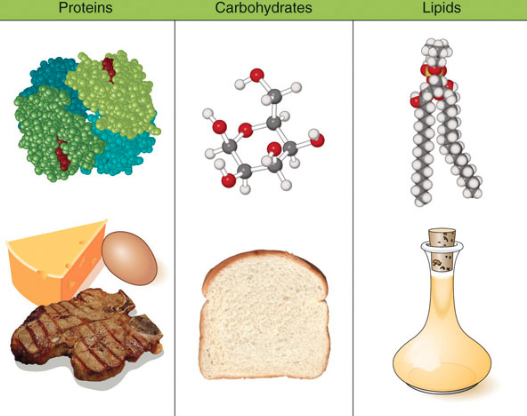
Macromolecules can be found EVERYWHERE! In fact, you probably ate some last night or this morning! There are 4 main macromolecules (carbohydrates, lipids, proteins, and nucleic acids). In this webquest you will investigate the properties of 3 of those macromolecules and how to run scientific tests to find them. You will be working as an investigator to use your knowledge to solve a mystery!
Macromolecules are identified in all the processed foods you eat, this information is given in the food labels, just like the one shown bellow.
Get Your Nutrition Facts Straight

The Nutrition Facts food label gives you information about which nutrients (say: NEW-tree-ents) are in the food. Your body needs the right combination of nutrients, such as vitamins, to work properly and grow.
The Nutrition Facts food label is printed somewhere on the outside of packaged food, and you usually don't have to look hard to find it. Fresh food that doesn't come prepackaged sometimes has nutrition facts, too.
Most nutrients are measured in grams, also written as g. Some nutrients are measured in milligrams, or mg. Milligrams are very tiny — there are 1,000 milligrams in 1 gram.
Other information on the label is given in percentages. Food contains fat, protein, carbohydrates, and fiber. Food also contains vitamins, such as A and C, and minerals, such as calcium and iron. Nutrition specialists know how much of each one kids and adults should get every day to have a healthy diet. The percent daily value on a food label tells you how this food can help someone meet these daily goals.
On food labels, they base the percentages on a 2,000-calorie adult diet. So looking at the label above for two crackers, a grownup would see that they provide less than 1 gram of fiber, only 3% of the person's daily needs. So that means he or she would have to eat other foods to get 100% of the fiber needed each day. Similarly, the person would see that the crackers provide nothing toward the daily goals for vitamin A, vitamin C, calcium, or iron.
Serving Size
The nutrition label always lists a serving size, which is an amount of food, such as 1 cup of cereal, two cookies, or five pretzels. The nutrition label tells you how many nutrients are in that amount of food.
Serving sizes also help people understand how much they're eating. If you ate 10 pretzels, that would be two servings.
Servings per Container or Package
The label also tells you how many servings are contained in that package of food. If there are 15 servings in a box of cookies and each serving is two cookies, you have enough for all 30 kids in your class to have one cookie each. Math comes in handy with food labels!
Calories and Calories From Fat
The number of calories in a single serving of the food is listed on the left of the label. This number tells you the amount of energy in the food. The calories in a food can come from fat, protein, or carbohydrate. People pay attention to calories because if you eat more calories than your body uses, you will gain weight.
Another important part of the label is the number of calories that come from fat. People check this because it's good to limit fat intake to about 30% or less of the calories they eat.
Total Fat
The total fat is the number of fat grams contained in one serving of the food. Fat is an important nutrient that your body uses for growth and development, but you don't want to eat too much. The different kinds of fat, such as saturated, unsaturated, and trans fat, will be listed separately on the label.
Cholesterol and Sodium
These numbers tell you how much cholesterol and sodium (salt) are in a single serving of the food. They are included on the label because some people should limit the amount of cholesterol and salt in their diets. Cholesterol and sodium are usually measured in milligrams.
Total Carbohydrate
This number tells you how many carbohydrate grams are in one serving of food. Carbohydrates are your body's primary source of energy. This total is broken down into grams of sugar and grams of dietary fiber.
Protein
This number tells you how much protein you get from a single serving of the food. Your body needs protein to build and repair essential parts of the body, such as muscles, blood, and organs. Protein is often measured in grams.
Vitamin A and Vitamin C
These list the amounts of vitamin A and vitamin C, two important vitamins, in a serving of the food. Each amount is given as a percent daily value. Other vitamins may be listed on some labels.
Calcium and Iron
These list the percentages of calcium and iron, two important minerals, that are in a serving of the food. Again, each amount is given as a percent daily value and other minerals may be listed on the label.
Calories per Gram
These numbers show how many calories are in one gram of fat, carbohydrate, and protein. This information is the same for every food and is printed on the food label for reference.
Now that you know a little more about food labels, you can read up on what you're eating!
Process
- Part 1: What are the Macromolecules?
Explore the resources given and write a paragraph summarizing what are Carbohydrates, Proteins, and Lipids and where to find them.
- Watch this video about Macromolecules (also called Biomolecules): https://www.youtube.com/watch?v=YO244P1e9QM
- Only Read the Introduction Section: https://www.khanacademy.org/science/biology/macromolecules/introduction-to-macromolecues/a/introduction-to-macromolecules
Part 3. Create a table to identify the specific amount of carbohydrates, lipids (fats), and proteins are contained in your favorite snack. Figure out if that snack complements your daily nutritional needs.
Answer the following questions:
1. Is your snack healthy? Explain in a paragraph using the nutritional facts of the table you filled out.
|
Type of macromolecule |
Amount given in grams |
Amount given in percentage |
How much more you are missing to complete your daily requirement? |
|
Carbohydrate |
|
|
|
|
Protein |
|
|
|
|
Lipid |
|
|
|
- Part 3:
How to test for Macromolecules
- Explore the resources given and write out a chart (like the one shown below) on the same sheet of paper as your summary from Part 1.
- PDF: https://www.cpet.ufl.edu/wp-content/uploads/2013/03/Identifying-Macromolecules-Lab.pdf
|
Macromolecule |
Testing Indicator |
Positive Results |
Negative Results |
|
Carbohydrate |
|
|
|
|
Protein |
|
|
|
|
Lipid |
|
|
|
- Part 4: Somebody entered the school cafeteria and stole all the snacks, the cafeteria lady called for the 10th graders help since they are macromolecule experts. The school principal and Ms. Lamothe think that the suspects might still have food residues in their hands. Solve the case. Compare the test results of the snack taken from the scene of the crime to the residues found on each suspect. Decide which suspect committed the crime and explain which macromolecule helped solve the mystery (this should be written on the same paper as Parts 1&2)
SNACK TEST RESULTS:
|
Indicator Used |
Resulting Color of Solution |
|
Biuret Solution |
Violet/Black |
|
Benedict’s Solution |
Blue |
|
Sudan Red |
Dark Red |
SUSPECT 1 RESULTS:
|
Indicator Used |
Resulting Color of Solution |
|
Biuret Solution |
Blue |
|
Benedict’s Solution |
Orange |
|
Sudan Red |
Dark Red |
SUSPECT 2 RESULTS:
|
Indicator Used |
Resulting Color of Solution |
|
Biuret Solution |
Blue |
|
Benedict’s Solution |
Blue |
|
Sudan Red |
Bright Red/Orange |
SUSPECT 3 RESULTS:
|
Indicator Used |
Resulting Color of Solution |
|
Biuret Solution |
Violet/Black |
|
Benedict’s Solution |
Blue |
|
Sudan Red |
Dark Red |
Evaluation
All the four parts of the Webquest should be delivered in a word document to my email: mlamothe@dowalschool.net.
This work must be finished today before 4:00 pm.
Include the name of the project: Identifying Macromolecules.
Name, grade, section and date.
Conclusion
In this webquest you learned about 3 of the 4 major macromolecules. You also learned that these biomolecules can be found every around us, especially in the food we eat. In addition you learned about the scientific practices of testing an unknown and how indicators work. If you would like to investigate this topic further, fields such as biochemistry would be the category to research.