Introduction
- A noun is a word that names something, such as a person, place, thing, or idea.
- In a sentence, nouns can play the role of subject, direct object, indirect object, subject complement, object complement, appositive, or modifier.
- Proper nouns refer to specific names and are capitalized (Yellowstone), while common nouns are general and lowercase (park).
- Singular nouns name one thing (cat); plural nouns name more than one thing (cats); and possessive nouns indicate ownership (cat’s toy).
- Concrete nouns refer to physical objects perceived by senses (doorbell); abstract nouns refer to intangible concepts (freedom); and collective nouns refer to groups considered as one entity (team).
- Countable nouns can be pluralized (two apples), while uncountable nouns represent masses or concepts (water).
Nouns are everywhere in our writing. But what are the different types of nouns, and how do you use them? Here, we’ll explain what nouns are using rules and examples to demonstrate.
Task
1. To gauge their understanding of nouns in sentences, learners will identify the noun in the sentence.
2. Sorting common nouns into groups such as people, places, or things assesses students' ability to classify the noun.
Process
ACTIVITY NUMBER 1
NAME__________________________ DATE:____________
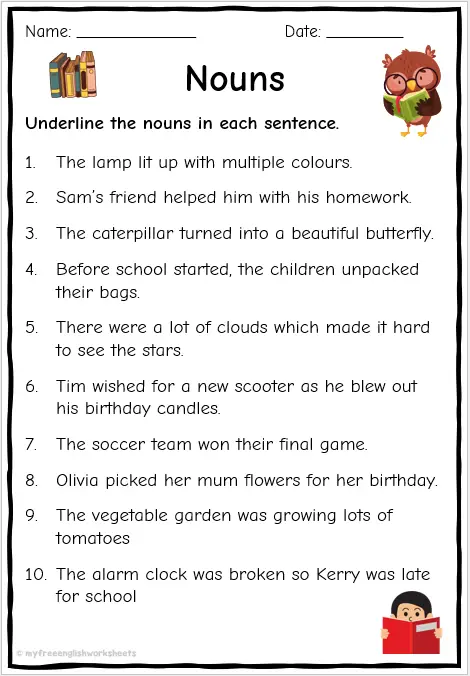
Instruction: Underline the nouns in each sentence
1. The lamp lit up with multiple colors.
2.Sam's friend helped him with his homework.
3. The caterpillar turned into a beautiful butterfly
4. Before school started, the children unpacked their bags.
5. There were a lot of clouds which made it hard to see the stars.
6. Tim wished for a new scooter as he blew out his birthday candles.
7. The soccer team won their final game.
8. Olivia picked her mum flowers for her birthday.
9. The vegetable garden was growing lots of tomatoes.
10. The alarm clock was broken so Kerr was late for school.