
Introduction
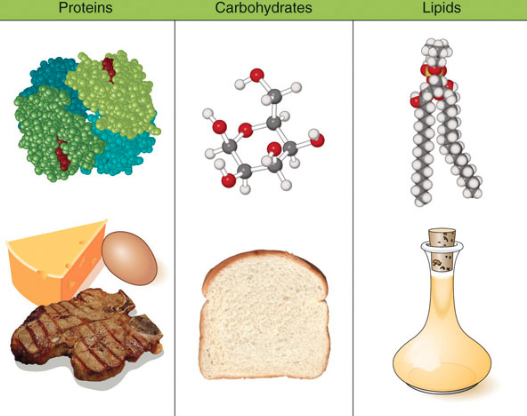
Macromolecules can be found EVERYWHERE! In fact, you probably ate some last night or this morning! There are 4 main macromolecules (carbohydrates, lipids, proteins, and nucleic acids). In this webquest you will investigate the properties of 3 of those macromolecules and how to run scientific tests to find them. You will be working as an investigator to use your knowledge to solve a mystery!
Task
Our school needs your help!! Last night someone broke into the school cafeteria and stole money out of the cash register!! Fortunately, 3 suspects were caught on camera around the time the crime was committed. Whoever the bandit was must have also been hungry, because he or she took a snack out of the school’s kitchen! So one of the suspects must have residue on their hands from picking up the food item. You will need to learn about the different macromolecules and how to test for them. If you can match the residue found on one of the suspect’s hands to the food item stolen from the kitchen, then you can solve the mystery!!! Your task will be in 3 parts:
1-write a paragraph summarizing what macromolecules are
2-Create a table of the tests used to identify macromolecules
3-Write a conclusion statement explaining who you think committed the crime.
Process
- Part 1: What are the Macromolecules
- Explore the resources given and write a paragraph summarizing whatCarbohydrates, Proteins, and Lipidsare and where to find them.
- Only Read the Introduction Section: https://www.khanacademy.org/science/biology/macromolecules/introduction-to-macromolecues/a/introduction-to-macromolecules
- Watch this video about Macromolecules (also called Biomolecules): https://www.youtube.com/watch?v=YO244P1e9QM
- Explore the resources given and write a paragraph summarizing whatCarbohydrates, Proteins, and Lipidsare and where to find them.
- Part 2: How to test for Macromolecules
- Explore the resources given and write out a chart (like the one shown below) on the same sheet of paper as your summary from Part 1.
- PDF: https://www.cpet.ufl.edu/wp-content/uploads/2013/03/Identifying-Macromolecules-Lab.pdf
|
Macromolecule |
Testing Indicator |
Positive Results |
Negative Results |
|
Carbohydrate |
|
|
|
|
Protein |
|
|
|
|
Lipid |
|
|
|
- Part 3: Solve the case. Compare the test results of the snack taken from the scene of the crime to the residues found on each suspect. Decide which suspect committed the crime and explain which macromolecule helped solve the mystery (this should be written on the same paper as Parts 1&2)
SNACK TEST RESULTS:
|
Indicator Used |
Resulting Color of Solution |
|
Biuret Solution |
Violet/Black |
|
Benedict’s Solution |
Blue |
|
Sudan Red |
Dark Red |
SUSPECT 1 RESULTS:
|
Indicator Used |
Resulting Color of Solution |
|
Biuret Solution |
Blue |
|
Benedict’s Solution |
Orange |
|
Sudan Red |
Dark Red |
SUSPECT 2 RESULTS:
|
Indicator Used |
Resulting Color of Solution |
|
Biuret Solution |
Blue |
|
Benedict’s Solution |
Blue |
|
Sudan Red |
Bright Red/Orange |
SUSPECT 3 RESULTS:
|
Indicator Used |
Resulting Color of Solution |
|
Biuret Solution |
Violet/Black |
|
Benedict’s Solution |
Blue |
|
Sudan Red |
Dark Red |
Evaluation
|
Criteria |
0 points |
1 point |
2 points |
3 points |
|
Part 1: Paragraph |
Student does not provide a summary of the information found in Part 1 |
Student provides summary of part 1, but does not define ALL of the macromolecules |
Student defines all of the macromolecules in a summary paragraph, but does NOT provide examples of where to find them. |
Student defines all of the macromolecules AND provides examples of where to find them. |
|
Part 2: Table |
Student does not provide a completed chart from Part 2 |
Student provides a chart with some of the boxes filled in, but it is incomplete |
Student provides a completed chart, but some of the boxes are incorrect |
Student provides a completed chart that is completely correct |
|
Part 3: Concluding Statement |
Student does not provide a concluding statement in regards to Part 3. |
Student provides a concluding statement but does not include the name of the specific macromolecule |
Student provides a concluding statement but the macromolecule given is incorrect |
Student provides a concluding statement with the correct macromolecule |
|
Organization |
Student does not provide a paper with 3 clearly identified sections for each part of the task |
--- |
--- |
Student provides a paper with 3 clearly identified sections for each part of the task |
Conclusion
In this webquest you learned about 3 of the 4 major macromolecules. You also learned that these biomolecules can be found every around us, especially in the food we eat. In addition you learned about the scientific practices of testing an unknown and how indicators work. If you would like to investigate this topic further, fields such as biochemistry would be the category to research.
Credits
Works Cited:
Identifying Molecules In Nutrient (Lab). <https://www.cpet.ufl.edu/wp-content/uploads/2013/03/Identifying-Macromo…;.
Introduction to macromolecules. <https://www.khanacademy.org/science/biology/macromolecules/introduction…;.
Sisters, Amoeba. Biomolecules. 11 Febuary 2016. <https://www.youtube.com/watch?v=YO244P1e9QM>.
Teacher Page
- Introduction
- The purpose of this webquest is to introduce the concept of macromolecules and where to find them. This webquest is also designed to give students practice with testing an unknown.
- Learners
- HS Biology or MS Life Science (Advance Classes)
- Standards
- SB1. Students will analyze the nature of the relationships between structures and functions in living cells.
- C. Identify the function of the four major macromolecules (i.e. carbohydrates, proteins, lipids, nucleic acids)
- SB1. Students will analyze the nature of the relationships between structures and functions in living cells.