
Introduction
Hello students this is mission control.
For this assignment you will get to explore planets of our solar system.
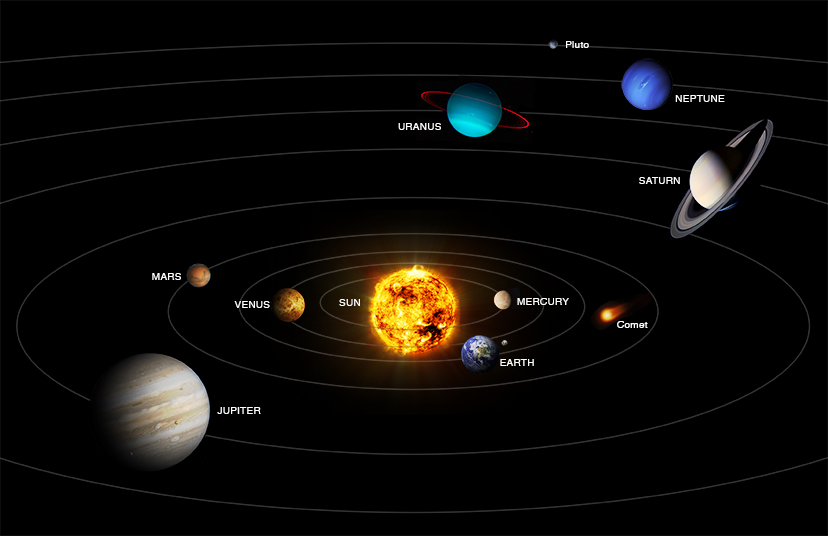
OUR SOLAR SYSTEM
Our solar system consists of eight planets which circle around the Sun. Many Astronomers like to think of the solar system in two parts. The Inner Solar System consists of Mercury, Mars, Venus and Earth. These planets are closest to the sun and referred to as terrestrial planets because they all have solid rocky surfaces. The Outer Solar System is made up of Jupiter, Saturn, Uranus and Neptune which are referred to as the gas giants because they although they may have a rocky centre they are almost entirely formed out of various gases. Out past Neptune you can find Pluto which was considered a planet up until 2006 when scientists discovered it did not meet the classification requirements of a planet. (Erickson 2014)
In August 2006, the IAU (International Astronomical Union) voted on a definition of planet:
1. Had to be spherical from its own gravity
2. Had to be in orbit around the sun (not around another planet)
3. Had to have cleared its orbital path of debris
The solar system also contains comets, moons, dust, gases and other dwarf planets similar to Pluto.
TASK - Watch this video to get an brief overview of our solar system
[video:https://www.youtube.com/watch?v=5c_lL6I3OaA]
Task
OK LETS BEGIN !

We need your assistance to help NASA learn about what the atmosphere is like on other planets and wether it is possible for us to land on their surfaces and explore them
You need to get in teams of 3/4 students.
2 of you will be astronauts and the others reporters for a special NASA report styled televission show.
STEP ONE : Each team rolls two dice and the team with the highest score gets first pick at choosing a planet to explore.
STEP TWO : After watching the videos related to that particular planet you will use your iPads to record an interview with the astronauts who went there for a report style televission show. The questions for the interview are listed at the bottom of this page. If you class doesn't have recording devices the interviews could be performed live infront of the class. (Time 1 hour)
Here is a link showing you how to record videos using your I-pad.
http://www.imore.com/record-trim-videos-ipad
This next step is disigned to be done in the next lesson as a continuation.
STEP THREE : After watching the other teams videos you will construct a digital brochure about one of the other planets that they explored.(Time 1 hour)
Here is a link to the website where you can create your digital brochure.
https://www.lucidpress.com/pages/examples/free-brochure-maker-online
NOTE : For the purpose of this exercise we are able to use a rocket ship that travels at the speed of light to reach any of the planets quickly. Otherwise traveling even as fast as 28,000 mph it would take us roughly 9.5 years to reach Pluto ! Also we have special rocket ships and space suits that can withstand the any temperature or atmosphere - this will allow you to explore surfaces such as Venus that reach over 400 degrees !
QUESTIONS FOR THE NASSA REPORT STYLE TELEVISSION INTERVIEW
1. What was the temperature on the surface - what was the weather like ?
2. What was the atmosphere made up of - name the elements ?
3. What did you see as you explored the planet - discribe the landscape what you could see?
4. Then add your own 3 questions for the astronaughts.
CLICK ON THE VIDEO OF THE ROCKET WHEN YOU ARE READY TO START THE MISSION - GOOD LUCK AND SAFE TRAVELS
Process
OK SPACE EXPLORERS IT'S TIME TO___
CHOOSE YOUR DESTINATION :
(planets listed in order from the sun)

TASK - Watch the video links for your choosen planet as well as follow the link and read about your planet here :
http://www.kidsastronomy.com/solar_system.htm
Remember that you need to find out the nessarsarry infomation to complete the special NASA report style interview.
MERCURY

[video:http://www.youtube.com/watch?v=6KY-oB2i9lo]
[video:http://www.youtube.com/watch?v=AdbVizaV9C4]
VENUS

[video:http://www.youtube.com/watch?v=h8KrQuPklAw]
[video:http://www.youtube.com/watch?v=TR-IWhZZDJY]
MARS

[video:http://www.youtube.com/watch?v=EmUvTH7sveg]
[video:http://www.youtube.com/watch?v=5CR2nxl-Cp4]
JUPITER

[video:http://www.youtube.com/watch?v=c-RR5mTSKmQ]
[video:https://www.youtube.com/watch?v=s56pxa9lpvo]
SATURN

[video:http://www.youtube.com/watch?v=MS9D9CzwPQU]
[video:http://www.youtube.com/watch?v=s-X9GmccXhs]
URANUS

[video:http://www.youtube.com/watch?v=G7f1nuwRq_E]
[video:http://www.youtube.com/watch?v=1EWTku7Fr0Y]
NEPTUNE

[video:http://www.youtube.com/watch?v=EmUvTH7sveg]
[video:http://www.youtube.com/watch?v=Gx6yNSlxc_c]
PLUTO
(Classified as a Dwarf Planet) Sorry guys and girl you cannot choose Pluto as it does not meet the definition citeria to be classified as a planet. Read and watch the following links to find out why.

[video:http://www.youtube.com/watch?v=D9FGePDvwjA]
[video:http://www.youtube.com/watch?v=JEI469cOIwM]
NOTE : You may find that you want to discover even more about your choosen planet ask you teacher about using Google or using your schools Libary for research.
Evaluation
EVALUATION
After you have uploaded your digital brochures have a look the ones that the other teams made.
TASK - In your Science books write down a paragraph on each of the planets from the information contained in the brouchures.(Time 1 hour) This is designed to be done as a separate lesson.

Conclusion
This is Mission Control to Space Shuttle 1. Thankyou for helping NASA discover more about other planets through your brave space explorations. This has been one small step for man, one giant step for mankind.
Mission Complete.

Credits
References
Erickson, K. (2014) NASA Solar System Exploration. Retrieved from http://solarsystem.nasa.gov/planets/profile.cfm?Object=SolarSys
ACARA. (2013). Science: General capabilities. Retrieved from http://www.australiancurriculum.edu.au/Science/General-capabilities
Coffman, T. (2013). Chapter 5: Creating a webquest. In T. Coffman, Using Inquiry in the Classroom (pp.59-73). Rowman & Littlefield Education, UK.
IMAGES
New Zealand Ministry of Education: Te Kete Ipurangi. (n.d.). The garden analogy. [Image]. Retrieved from http://assessment.tki.org.nz/var/tki-assess/storage/images/media/images/the-garden-analogy/17937-1-eng-NZ/The-garden-analogy.jpg
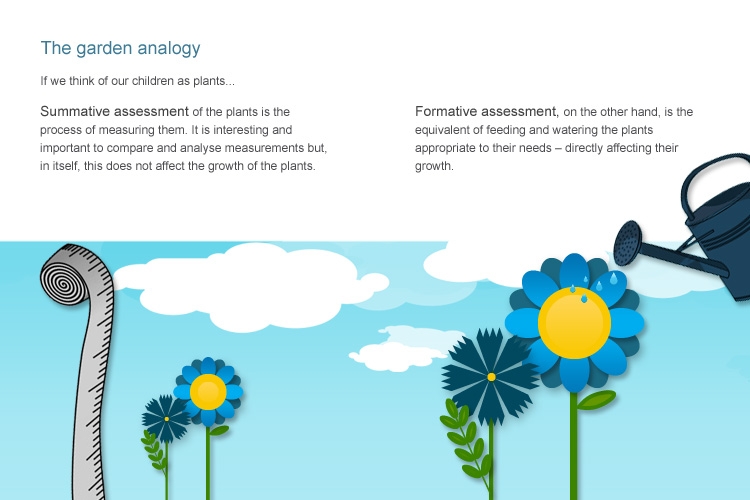
Image References
http://fc08.deviantart.net/fs70/i/2012/209/0/7/space_man_by_chelseaferr…

http://imtmworldwide.com/wp-content/uploads/2014/03/Rocket-Ship-Launchi…

http://at-cdn-s01.audiotool.com/2014/02/23/documents/v3K1GUCcTqfspsXYVS…
http://i.space.com/images/i/000/000/402/i02/venus-planet-profile-101111…

http://i.space.com/images/i/000/000/400/i02/mercury-planet-profile-1011…

http://mail.colonial.net/~hkaiter/aa_newest_images/insidemars-planet-pr…

http://dc400.4shared.com/img/RolC8N5p/s7/13ba5794758/jupiter-planet-pro…

http://projects.cbe.ab.ca/fishcreek/PolskyDOTcom/Science-Planet_Informa…

http://i.space.com/images/i/000/000/408/i02/uranus-planet-profile-10111…

http://i.space.com/images/i/000/000/406/i02/neptune-planet-profile-1011…

http://www.ancient-code.com/wp-content/uploads/2013/03/pluto-planet-pro…

Teacher Page
This Web Quest is designed to be student centred and utilise the inquiry learning method for a Grade 5 Science class. Inquiry learning is a an active style of learning where the students explore a topic through questions and activities guided by their teacher. The central focus in inquiry learning is that the students assume the lead role in their own learning whilst being assisted by their teacher to higher order thinking through questioning and reflection (Coffman 2013)
This unit is designed to be done in four class session each running for one hour each.
Lesson One :
Introducing the Solar System. Have the students read through the Web Quest give a demo lesson on using their iPads to record video. In this lesson they can also work out the teams they will be working in and watch the videos relating to their choosen planet.
Lesson Two:
Recording and the television interviews.
Lesson Three:
Watch the recorded interviews and then have the groups make their digital brochures.
Lesson Four:
Get the students to explore the other teams digital brochures and write a paragraph about each of the planets in their science books.
Australian Curriculum relation :
The Earth is part of a system of planets orbiting around a star (the sun) (ACSSU078)
- identifying the planets of the solar system and comparing how long they take to orbit the sun
- modelling the relative size of and distance between Earth, other planets in the solar system and the sun
- recognising the role of the sun as a provider of energy for the Earth