
Introduction
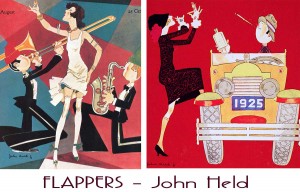
 Flappers, Prohibtion, Jazz...
There are so many images and ideas assoicated with the 1920's that spawned Louis Armstrong and Al Capone. It can be impossible to keep up. There were some ideas that were shockingly born during this time; Women Suffrages, the rise of Communism, Prohibition, as well as the intriguing underworld and all the mysteries behind it.
Our job will be to explore this time of propersity and partying to understand the various components of the times.
Task
Your Task
Working with your assigned partner, you will "choose" one of the topics listed below and research its significant components using various websites and books from our class' database and library. Using your research, you will create either a Slide Show from Goggle Docs, a Power Point Presentation or a Prezi that you will present to the class about your topic. In addition to your Presentation, you will write an accompanying research piece that highlights and analyzes your topic with citations following the MLA format. In both your presentation and written piece you must have a works cited page. You will need to use at least two different sources for your research, preferably one electronic and one written.The topics are as follows:
Music and Dance
Fashion
Gender Roles during the Twenties
Social Classes and their Lifestyles
Slang
Pop Culture (Fads..)
Historical Events
Influential People
Entertainment
Process
The Process
1. With your Assigned Partner, "Choose" your research topic. Make a brainstorming list of various ideas concerning your topic. (You may use your KWL Chart as a resource).
2. Individually use our class list of websites and in-class library to study and analyze each of the various sources. Choose two sources that you feel best fits your particular topic. Cite each of your sources and take notes using our Class Chart. Choose significant (major) ideas as well as details to use for support for your research notes. You should have at least two pages upon completion.
3. With your partner analyze your research notes, and synthesize them, marking off more of the significant aspects as well as information that would serve as supporting details. Then create a rough draft of your research to be used for the application of your paper and presentation.
4. Find visuals to accompany the main points of your research to be used in the creation of your presentation. Each visual should reflect the key aspects of your research and what you would like to highlight in your presentation.
5. Find connections from your reserach pertaining topic that reflects our modern day, since many of the Roaring Twenties are still relevant in today's times. For each of the connections, explain its role in the twenties and how it is depicted in 2015.
6. Create discussion questions to be used in your presentation as part of the class'involvement. Each question needs to address a specific issue that highlights key components of your topic, and be modeled after the DOK levels of questioning.
Evaluation
Name/Names _________________________ Period _____
RUBRIC FOR THE 1920’S RESEARCH PROJECT
|
Categories |
criteria |
points |
|
Knowledge: Project answers the research questions about an event, fad, or person and how it impacted the 1920s |
Excellent information, excellent explanation |
10 |
|
|
Good information, good explanation |
9 |
|
|
Satisfactory information and explanation |
8 |
|
|
Fair information but with little explanation |
7 |
|
|
Limited information or explanation presented |
6 |
|
|
Demonstrates little knowledge or explanation of topic |
5 (or less___) |
|
|
|
|
|
Artwork Exhibit Displays accuracy through summaries and artwork in a creative and neat manner |
Excellent product (all requirements met with extra effort above and beyond) |
10 |
|
|
Good product (most of requirements met with great effort ) |
9 |
|
|
Decent Product (most of requirements met with good effort) |
8 |
|
|
Average Product (some requirements missing with good effort) |
7 |
|
|
Product is missing some requirements with little effort |
6 |
|
|
Product is most of the requirements with little effort |
5 (or less____) |
|
|
|
|
|
Organization: Project includes introduction, information linked in a clear way, and a conclusion |
Excellent organization |
10 |
|
|
Good organization |
9 |
|
|
Decent organization |
8 |
|
|
Average organization |
7 |
|
|
Some effort in organization |
6 |
|
|
Little effort in organization |
5 (or less_____) |
|
|
|
|
|
Class Presentation: |
Excellent presentation with great volume and eye contact |
5 |
|
|
Good presentation with good volume and/or eye contact |
4 |
|
|
Decent presentation with ok volume and/or eye contact problems |
3.5 |
|
|
Presentation problems with both volume and eye contact |
3 |
|
|
|
|
|
Checklist & Rubric (if working in a group each person needs to turn one in): |
Turned in and completed |
5 |
|
|
|
|
|
|
Total Points |
/40 |
Conclusion
Teacher Page
Common Core Standards to be Used for Project:
Reading: Informational Text » Grade 11-12
CCSS.ELA-LITERACY.RI.11-12.1 Cite strong and thorough textual evidence to support analysis of what the text says explicitly as well as inferences drawn from the text, including determining where the text leaves matters uncertain.
CCSS.ELA-LITERACY.RI.11-12.2 Determine two or more central ideas of a text and analyze their development over the course of the text, including how they interact and build on one another to provide a complex analysis; provide an objective summary of the text.
CCSS.ELA-LITERACY.RI.11-12.3 Analyze a complex set of ideas or sequence of events and explain how specific individuals, ideas, or events interact and develop over the course of the text.
Craft and Structure:
CCSS.ELA-LITERACY.RI.11-12.4 Determine the meaning of words and phrases as they are used in a text, including figurative, connotative, and technical meanings; analyze how an author uses and refines the meaning of a key term or terms over the course of a text (e.g., how Madison defines faction in Federalist No. 10).
Research to Build and Present Knowledge:
CCSS.ELA-LITERACY.W.11-12.7 Conduct short as well as more sustained research projects to answer a question (including a self-generated question) or solve a problem; narrow or broaden the inquiry when appropriate; synthesize multiple sources on the subject, demonstrating understanding of the subject under investigation.
CCSS.ELA-LITERACY.W.11-12.8 Gather relevant information from multiple authoritative print and digital sources, using advanced searches effectively; assess the strengths and limitations of each source in terms of the task, purpose, and audience; integrate information into the text selectively to maintain the flow of ideas, avoiding plagiarism and overreliance on any one source and following a standard format for citation.
CCSS.ELA-LITERACY.W.11-12.9
Draw evidence from literary or informational texts to support analysis, reflection, and research.
CCSS.ELA-LITERACY.W.11-12.6Use technology, including the Internet, to produce, publish, and update individual or shared writing products in response to ongoing feedback, including new arguments or information.
Write informative/explanatory texts to examine and convey complex ideas, concepts, and information clearly and accurately through the effective selection, organization, and analysis of content.
CCSS.ELA-LITERACY.W.11-12.2.A
Introduce a topic; organize complex ideas, concepts, and information so that each new element builds on that which precedes it to create a unified whole; include formatting (e.g., headings), graphics (e.g., figures, tables), and multimedia when useful to aiding comprehension.
CCSS.ELA-LITERACY.W.11-12.2.B Develop the topic thoroughly by selecting the most significant and relevant facts, extended definitions, concrete details, quotations, or other information and examples appropriate to the audience's knowledge of the topic.
CCSS.ELA-LITERACY.W.11-12.2.C Use appropriate and varied transitions and syntax to link the major sections of the text, create cohesion, and clarify the relationships among complex ideas and concepts.