
Introduction
Why do things fall to the ground? Why should we wear helmets when we ride our bikes or wear seatbelts when we are in a car? How do parachutes work? These are all questions that can be answered by understanding how forces work.
A simple definition of force is any push or pull. A force acting on an object, producing either a push or a pull, usually results in some interaction between the objects such as a collision and may change the object's position. Forces are all around us every day. In fact, there are forces acting on you as you read this text. Gravity, one type of force, is pulling you towards the center of the Earth and your body is pulling the center of the earth towards it. Luckily, your chair is pushing upward with equal force to keep you from falling. The force of the chair that counteracts the force of gravity is called the normal force.
This webquest is an opportunity for you to learn about these forces and improve your research skills. With this webquest, you will learn:
1. Firstly, how to use the internet to learn more about a subject, answer questions you may have about science and learn more about topics we have already discussed in class.
2. Secondly, how to collaborate with a team to create an engineering solution.
3. Thirdly, about Newton's three famous laws of motion and how we use them every day.
4. Lastly, to use what you have learned about forces and Newton's Laws to create a device to protect an egg from beaking when dropped.
Task

Welcome to Operation Egg Drop. You are competing against five other teams in your class to create an egg protection device that will keep an egg from breaking. The team whose egg device achieves the highest drop height before the egg breaks, wins 30 bonus points per teammember.
Your design should only use reused household materials and should be safe to drop from the roof of the LCA building. It will have to withstand multiple drops to reach the highest test height.
Process
Pre-Design Research
Before you can start working on your design, you will need to understand how forces work. Use the websites listed below to learn about Newton's Three Laws of Motion. Use your graphic organizer to take notes and complete the mini-tasks for each law. Use http://www.learnersdictionary.com to find the definition of difficult words such as those that are underlined here.
Introduction to Forces and Newton's Laws
Watch the Video: http://www.pbslearningmedia.org/asset/idptv11_vid_d4kfom/
a. What forces are mentioned in the video?
b. What examples did they use in the video to explain forces and Newton's laws.
c. Before you learn more, what forces play a role in the design of your egg protection device?
Newton's First Law of Motion (45 min)
 Watch the Video:
http://teachertech.rice.edu/Participants/louviere/Newton/law1.html
http://www.physicsclassroom.com/mmedia/newtlaws/il.cfm
a. What is Newton's First Law of Motion?
b. What is inertia?
c. What is an inbalanced force?
d. A spaceship is flying through space, propelled from Earth by rocket boosters. When the fuel in the rocket boosters runs out, what will happen to the spaceship?
i. It will run out of energy and slow down.
ii. It will speed up.
iii. It will keep moving forward at the same speed forever.
e. Draw a diagram of an object experiencing Newton's First law using vectors as we practiced in class.
f. How does this law apply to your egg protector design? What ideas does it give you for making the protector better?
Newton's Second Law of Motion (45 min)
http://teachertech.rice.edu/Participants/louviere/Newton/law2.html
a. What is Newton's second law?
b. What is the equation for this law and what are the three variables?
c. What is the acceleration of gravity in m/s2?
d. Which will accelerate faster if we apply the same force to each (throw each)? Put the following in order from fastest to slowest to accelerate using the same force (F).
Golf Ball, Baseball, Soccer Ball, Bowling Ball
e. How does Newton's Second Law apply to your design?
Newton's Third Law of Motion (30 min)
http://teachertech.rice.edu/Participants/louviere/Newton/law3.html
Newton's Third Law in Football:
http://science360.gov/obj/video/d0e16d27-05d4-4511-9394-2758aa066981/sc…
a. What is Newton's Third Law?
b. A truck crashes into a car on the highway. Which vehicle experiences more force? The car or the truck?
c. Try it out. Fetch a balloon from the exploration bin in the back of the classroom and blow it up and pinch the end. Release it. What happens? Why does this happen? How does Newton's Third law explain this phenomenon?
c. How does the third law effect your design?
Test Your Knowledge
http://teachertech.rice.edu/Participants/louviere/Newton/laws.html
http://physicalsciencerocks.wordpress.com/2014/06/09/newtons-first-law/

Design and Test
Use the following design guidelines to create an egg protector applying your knowledge of Newton's Laws.
Design Guidelines
- Use only recycled/reused materials from home. Do not buy materials!
- Do not use materials forbidden by school policy (crazy glue for example)
- Have enough materials to build a test prototype and a final version
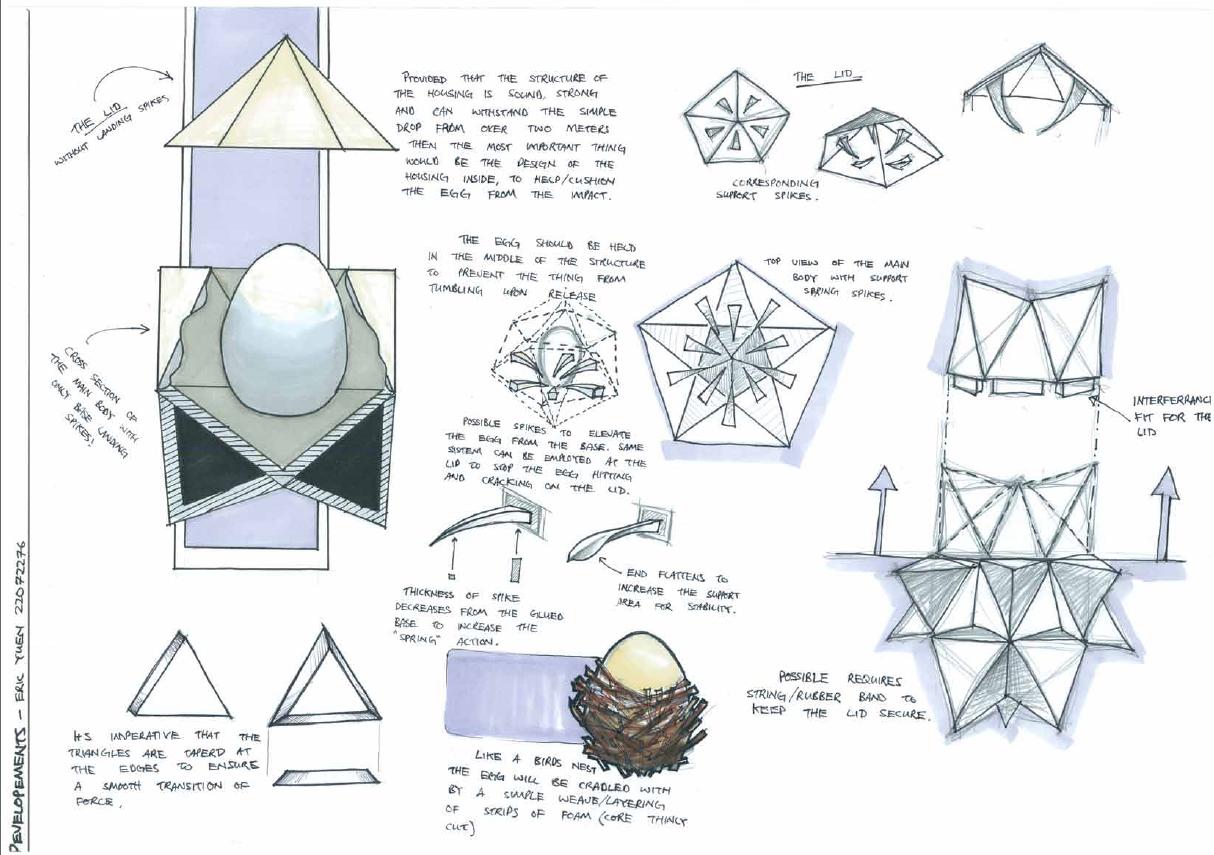
1. Use the page labeled design schematic to draw a sketch of your design. Label the materials used.
2. On the next page draw three free body diagrams in the space provided including all force vectors:
- -One for the device before you release it to fall
- -One for the device during freefall
- -One for the device at the moment of impact
3. Construct your device using your design and submit it for testing day.
Reflection
After testing, discuss the following questions with your team and write a short analysis of your device's performance.
Questions
- To what height did your egg protector successfully protect the egg before it failed? How did it rank?
- Look at the device and identify what part or parts failed (broke). Write a few complete sentences about these parts and how they may have caused the egg to break.
- If you were going to build a second version, what would you change and why?
Evaluation
| 1 - Beginning | 2 - Basic | 3 - Exemplary | |
| Research Tasks |
-incomplete sentences -incorrect answers -demonstrates little effort |
-complete sentences -50% of questions incorrect -some understanding |
-complete sentences -80% or more questions correct -thorough understanding |
| Design Diagrams |
-missing or no correct vectors included -little detail -cannot understand design from drawing |
-vectors present but not completely correct -some detail -can understand design from drawing |
-vectors are present and 80% correct -detailed including annotation -easy to understand and interpret |
| Design |
-demonstrates little to no understanding Newton's laws -little effort demonstrated -design could not survive lowest drop |
-demonstrates basic understanding of Newton's laws including deliberate use of a strategy to overcome adverse forces -basic effort is demonstrated -design failed within average height |
-demonstrates understanding of Newton's laws including deliberate use of diverse strategies to overcome adverse forces -exemplary effort demonstrated in construction and design -design outperformed the majority |
| Post-Test Analysis (Post Mortem) |
-demonstrates little to no understanding Newton's laws and their role in the failure -little effort demonstrated |
-demonstrates basic understanding of Newton's laws and their role in the failure of the device. -basic effort is demonstrated |
-demonstrates understanding of Newton's laws and their role in the survival and ultimate failure of the device. -exemplary effort demonstrated in construction and design |
Conclusion
Congratulations, no matter how well your design performed, you are still walking away from this experience with a wealth of new knowledge and understanding about the world around you. Additionally, you have acquired key skills required for engineering, team collaboration and problem solving, which will serve you well as you continue your studies. I hope you enjoyed the experience and are inspired to continue to learn and master physical science!
Teacher Page
In addition to introducing students to Newton's Laws, this webquest can be used as a summative assessment tool measuring mastery of the following standards:
California Science Standards
2 Forces | Unbalanced forces cause changes in velocity. As a basis for understanding this concept:
a. Students know a force has both direction and magnitude.
b. Students know when an object is subject to two or more forces at once, the result is the cumulative effect of all the forces.
c. Students know when the forces on an object are balanced, the motion of the object does not change.
d. Students know how to identify separately the two or more forces that are acting on a single static object, including gravity, elastic forces due to tension or com pression in matter, and friction.
e. Students know that when the forces on an object are unbalanced, the object will change its velocity (that is, it will speed up, slow down, or change direction).
f. Students know the greater the mass of an object, the more force is needed to achieve the same rate of change in motion.
g. Students know the role of gravity in forming and maintaining the shapes of planets, stars, and the solar system.