
Introduction
A WebQuest for first year, stage 1 Higher Education/University students
Subject: Ethical learning
Designed by: Michelle Commens
Unit/lesson name: Child Protection (Part 2)
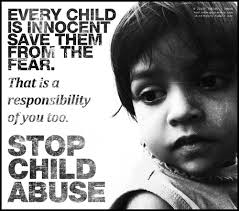
(Stop Child Abuse, 2015)
Introduction:
Promoting a safe & positive learning environment for students:
- Confidentiality and be respectful of information.
- Show respect when discussing child protection elements with colleagues and/or other agencies.
- Focus on learning rather than exploring personal experiences.
- Self-care: Participants may choose to leave the room and take a break if material is distressing.
Useful contacts;
Lifeline: 13 11 14

Bravehearts;
1800 272 831
Adults Surviving Child Abuse (ASCA): 1300 657 380

The early Childhood field needs YOUR help! 2015 statistics tell us that 1 in 5 Australian children are sexually assaulted in some way before their 18th birthday; that’s 59,000 children each year and more than 1000 a week
(http://www.braveheartsadventures.org.au/pages/about.php)
Furthermore, in 2012–13 there was a staggering 135,000 children, (a rate of 26.1 per 1,000 children), receiving child protection services. Aboriginal and Torres Strait Islander children were 8 times as likely as non-Indigenous children to be receiving child protection services (Australian Government, 2012-13).
Educators need to be aware of the different types of abuse and the indicators of that abuse. As a mandatory reporter it is essential that you are able to confidently complete the Online Mandatory Reporter Guide.
Take a moment to view the following child abuse introduction clip; Jot down what thoughts and feeling does this clip evoke?
[video:https://www.youtube.com/watch?v=dH2MVPzhfEA align:left]
Task
Task:
Students will research the different types of abuse and the range of indicators. This will be a peer paired brainstorming exercise from your knowledge and readings. You will use bubbl-us or wordle to present your ideas.
Students will gain in depth knowledge through the number of websites and produce an individual scenario; describe the family, identifying the type of abuse and its indicators then apply this through completing the online Mandatory Reporter Guide. Each student will post their findings on the Moodle Forum for further discussion. How can we reduce/banish child abuse, in all its forms? How can the wider community help?
Learning outcomes:
After completing this Web Quest, the learner will be able to:
- Follow relevant legislation and centre policy to protect the rights of the children.
- Identify the types of abuse and the indicators of the abuse.
- Able to confidently complete the Online Mandatory Reporter guide successfully.
Process
Process and resources:
1. In pairs, you will firstly, research the different types of abuse and secondly outline the indicators for each type of abuse. The following websites will assist your research:
- http://www.community.nsw.gov.au/docs_menu/preventing_child_abuse_and_neglect/what_is_child_abuse.html
- http://www.community.nsw.gov.au/docs_menu/preventing_child_abuse_and_neglect/what_is_child_abuse/signs_of_abuse.html
- http://www.asca.org.au/About/Resources/Types-of-child-abuse.aspx
- https://www.childwise.org.au/page/39/fact-sheets
- http://sdm.community.nsw.gov.au/mrg/resources/definition/tree_selection_help.html
- http://www.community.nsw.gov.au/docswr/_assets/main/documents/spot_stop_english.pdf
You both will need to decide on how to convey your findings to the rest of the class. It must be technologically based and easy to read. You can document this brainstorming of information via bubbl-us or wordle. https://bubbl.us/ http://www.wordle.net/
The link below demonstrates in 6 simple steps how to create your own brainstorming bubble/web. Go ahead and start creating your own ‘bubble’
http://www.wikihow.com/Brainstorm-Using-Bubbl.Us
The two links below will demonstrate how you can use the Wordle program (one is in real time and the other is a PDF).
https://www.youtube.com/watch?v=xhL5D9nz5aI
https://resourcelinkbce.files.wordpress.com/2011/07/introduction-to-wordle.pdf
2. Each student will complete this part of the Web Quest on an individual basis. You are required to produce a ‘mock’ family based scenario with the child enduring several different types of abuse; describe the family and identify the type of abuse and its indicators.
Example of a mock family scenario reads like the following;
The K family has recently moved from Adelaide to Sydney. The family consists of Winnie, her partner Alex, and Winnie’s two children, Faye (aged 8) and Chang (aged 5). Winnie and her children have been living with Alex for the past 12 months. Alex works long hours and then goes to the pub after each work day. He often returns home drunk, shouting verbal abuse to Winnie and the children. He has struck Winnie several times, resulting in black eyes and lacerations on her cheek. Winnie has no family and friends in Sydney and is socially isolated. As a result, she spends a lot of time in bed or watching television. Faye and Chang often arrive at school in dirty smelly clothing and steal other children’s food at lunch time.
Now identify the types of abuse and the indicators.
3. Then apply your identified abuse and indicators to the online Mandatory Reporter Guide. You will need to follow this link to the “Keep Them Safe” website. http://www.keepthemsafe.nsw.gov.au/home
(Keep Them Safe, 2015)
4. Once you have completed the on line report and you reach the “final decisions” page, click “generate the final decision report”. This will allow you to save and print off the PDF of your report. Close PDF, and click on “Restart” (top right hand of screen). Your ‘mock’ report then will disappear.
5. Finally, each student will post their family scenario and upload their final decision report on the Moodle platform through the forum link. Each student will need to discuss one another’s report and see if anything can be added or modified. Finally, respond to the following questions; How can we reduce/banish child abuse, in all its forms? And how can the wider community help? These questions will be used as a bouncing board for part 3 of our child protection unit.
Evaluation
Evaluation:
|
|
Beginning 1 |
Developing 2 |
Accomplished 3 |
Exemplary 4 |
Score |
|
Research of types & indicators of child abuse (Pair work) |
You did not appear to understand what information was to be included. As a result you presented limited-basic and/or did not cover all types and indicators of child abuse. The use of the websites is not evident in your work.
|
Demonstrates good knowledge of the different types and indicators of child abuse. You have accessed a range of websites within your research. |
Demonstrates sound knowledge and was able to accurately identify most types and indicators of child abuse. You have accessed most of the websites within your research. |
Comprehensive detailed research responses. All types and indicators of child abuse researched clearly and accurately with evidence of accessing all websites. |
|
|
Participated in group/pair work |
Low participation. |
Moderately participated. |
Mostly participated. |
Participated fully in a collaborative manner. |
|
|
Creativity with the use of technology – Wordle, Bubbl-us, MRG tool and Moodle forums |
You have met the basic requirements. However, limited creativity with your chosen technology. |
You have met most of the elements and used some original creativity ideas with your chosen technology. |
You have clearly demonstrated all necessary requirements in a creative manner using most forms of technology. |
You have concisely and clearly conveyed all necessary requirements in a highly creative manner and used all forms of technology.
|
|
|
Research and understanding of your scenario. Able to identify the type and indicators of child abuse (Individual work) |
You did not appear to understand what information was to be included. Limited and/or basic knowledge.
|
You understood what was to be included, but details are lacking or offered a basic review Demonstrates good knowledge. |
You have included all required information in an organized manner. Demonstrates sound knowledge.
|
Your information is complete and well-written. You have also included some extra relevant information. Comprehensive detailed responses. |
|
|
Ability to access, navigate & understand the process of the Online Mandatory Reporter Guide (MRG) (Individual work) |
Not able or has not accessed the online MRG tool and therefore has limited understanding. |
Has accessed and displays basic understanding of the online MRG. |
Appropriate and sound use and understanding of the MRG guide. |
Competent use & understanding of the MRG tool. |
|
|
Forum participation: Upload scenario and mandatory reporter’s final report on Moodle & participated in discussions (Individual work) |
Uploaded incomplete or basic report. Limited evidence of peer collaboration within the discussion forum.
|
Uploaded sound report. Some evidence of peer collaboration within the discussion forum. |
Uploaded clear and accurate report. Peer collaboration within the discussion forum evident, discussing a range of different student scenarios. |
Uploaded a comprehensive and accurate report. Peer collaborated at a high level with a range of peers within the discussion forum, looking at a range of scenarios. |
|
|
Conventions and clarity |
Many spelling mistakes & punctuation errors. Paragraphs don’t logically or clearly flow. Lack of APA reference style. |
Some spelling mistakes & punctuation errors. Some paragraphs don’t logically or clearly flow. Work mostly APA reference style. |
Information has no spelling mistakes & punctuation errors. Most paragraphs logically and clearly flow. Work almost always APA reference style. |
Information written in a clear, easy to read professional manner. Free of spelling & punctuation errors. Work is always APA reference style. |
|
Conclusion
Conclusion
Congratulations on successfully completing this WebQuest. You should now have a firm understanding of the different types of child abuse and their indicators. In addition, you will be confident in accessing and completing the Online Mandatory Reporters Guide when you deem it necessary. Next week, we will commence our part 3 of this Child Protection topic; We will be discussing responding appropriately to disclosures or suspected risk of harm as well as looking at agencies which can assist the family, child and early learning centre. Finally, we will look at useful resources and story books which could assist a child who is at harm. Here is a sneak look at the organisation Bravehearts, who have some excellent educational ideas in teaching 3-8 year old children about staying safe. Scroll down and view the short video clip. We will discuss more of their positive work next week.
[video:https://www.youtube.com/watch?v=-x5jr2JHsr0 align:center]
Article 34 - You have the right to be free from sexual abuse
Article 37 - No one is allowed to punish you in a cruel or harmful way.
Article 36 - You have the right to protection from any kind of exploitation.
Article 39 - You have the right to help if you've been hurt, neglected or badly treated

(Happy Children, 2015)
Credits
Credits & References:
Australian Government (2012-2013) Australian institute of health and welfare. Child protection aust 2012-2013. Retrieved 4/4/15 from
http://www.aihw.gov.au/WorkArea/DownloadAsset.aspx?id=60129548164
Happy Children [Image]. (2015). Retrieved from
http://www.lbclehighton.org/children-s-ministries.html
Keep Them Safe [image]. (2015). Retrieved from
http://www.csh-itab.com.au/navnsw/child_protection.html
MACE. SMC. AUST. (2013, July 9). Child Abuse in Australia [Video file]. Retrieved from https://www.youtube.com/watch?v=dH2MVPzhfEA
Stop Child Abuse [image]. (2015). Retrieved from
https://storify.com/Jackie_Godinez_/child-abuse-prevention
UNIICEF. UN Convention of the Rights of the Child, In Child Friendly Language. Retrieved 5/4/15 from http://www.unicef.org/rightsite/files/uncrcchilldfriendlylanguage.pdf
Teacher Page
We all benefit by being generous with our work. Permission is hereby granted for other educators to copy this WebQuest, update or otherwise modify it, and post it elsewhere provided that the original author's name is retained along with a link back to the original URL of this WebQuest. On the line after the original author's name, you may add Modified by (your name) on (date). If you do modify it, please let me know and provide the new URL.