
Introduction
Hello Global Studies Students! Complete this webquest for Mini-Lesson Three (The Great Leap Forward) and Four (The Cultural Revolution).
Directions: Click on "Process". Complete each "task" with your scholar partner.
Show your work to Mrs. Compton or Mrs. Halber when you've finished!
Process
Communist Revolutions Unit
Mini-Lesson Three and Four Webquest!
Created by Mrs. Compton
High School for Environmental Studies
Directions:Complete the assignments for each task with your scholar partner on a separate sheet of paper. You do not have to write the questions, but please identify which task each part of your assignment corresponds to. Show your work to Mrs. Compton or Mrs. Halber when you're finished.
Introduction Task: Brainpop
Go to this Brainpop. Login is "environhs" and the password is "brainpop". Watchthe video. Answer the following:
- How is communism different from capitalism?
- What is true in a "pure communist society"?
- What is the reality?
- Who created communism?
- What is a totalitarian government? How did this go against Marx's idea of communism?
- What is a "centralized economy" and what is the problem with it?
- What are some reasons that communist economies struggle?
- What is socialism?
Task One: Read the following...
Like the Communist Soviet Union, China under Mao became a one-party, totalitarian state. All the power was held by the Communist Party. Mao planned to show the world how Communism could help China transform itself into a mighty world power.
Mao’s first steps were to keep his promises to his peasant supporters by redistributing the land. Landowners were forced to give up their land, which was given out to peasants in the region. Those who refused to cooperate, almost one million people, were killed. Following the model of the Soviet Union, China set up a five-year economic plan. During this time, from 1953 to 1957, most private industry came under state control. Quotas were set for the production of goods. During the first five-year plan, China’s output of steel, cement, electricity, and coal rose greatly. As in the Soviet Union, China required farmers to work collectively. Collectivization on a huge scale called for China’s second five-year plan.
1. How was Communist China under Mao similar to the Communist Soviet Union?
2. Why did peasants, or farmers, like Mao?
3. Describe the goals of the Five Year Plans.
Task Two: Examine images
Go to this website. Examine the images (click on "Part One", then "Part Two", and so on). Based on what you see, what were the Five Year plans trying to accomplish? How do you know? Then, go to this website. Scroll to page 12. Why did Mao need to implement the five year plan? Then, go to page 13. What were the social reforms that Mao made?
Task Three: Read the following and answer the questions.
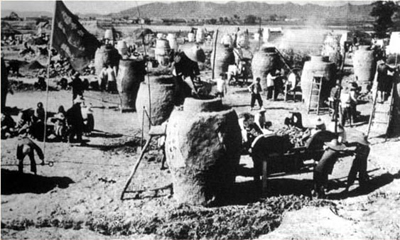 China’s second five-year plan, called the Great Leap Forward, neglected modern technology in favor of small-scale industries and primitiveequipment. Look at the image on the left. This shows small furnaces that the Chinese people were forced to build on fields that had once grown food. These furnaces failed to increase industrial output, and led to famine, as they were built on farmland and contaminated the soil so food could not be grown.
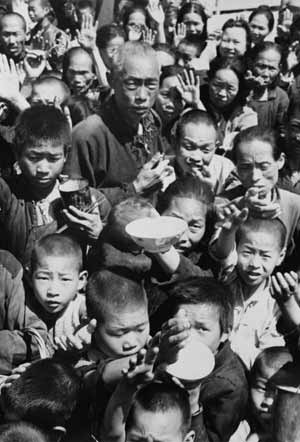
Because of the Great Leap Forward, industrial output dropped and around 30 million people died of famine. This makes the Great Leap Forward the deadliest famine in the history of the world.
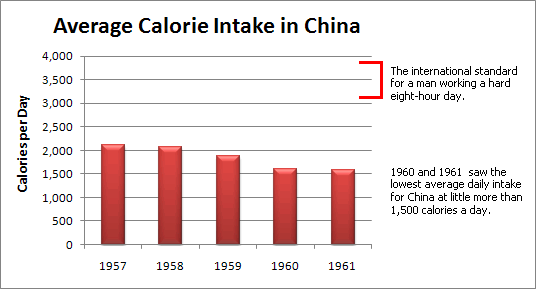
The failure of the Chinese economy led to political fighting among the Communists in charge of the country. As with Stalin’s totalitarian government, China’s Communist regime created a nation in which terror was the real ruler.
4. What was the goal of the Great Leap Forward? Did it accomplish this? What was the result?
Task Four: Examine posters
Examine the images on this website.
Describe what you see. What can you infer about the Great Leap Forward based on these images?
Task Five: Read the following and answer the questions.
After the Great Leap Forward, China was in bad shape. Mao Zedong had told the Chinese people that their efforts were going to catch them up with the West (or Europe and America). Instead, parts of the countryside were ruined, and millions of people starved. Rather than catching up with the rest of the world, the Great Leap Forward had pushed China backwards. Leaders in the Communist Party started fighting with each other, and challenging Mao’s authority. So Mao and his wife, Jiang Qing, launched the Cultural Revolution. This was an attempt to get people committed to the Revolution, and to Mao, as well as to direct their anger about the Great Leap Forward towards Mao’s enemies in the Communist Party.
5. Why did Mao feel it was necessary to have the Cultural Revolution?
Task Six: Research
Go to this website. Find the answers to the following questions.
6. Who were the Red Guards? Describe their purpose.
7. Who was targeted during the Cultural Revolution?
8. What was the outcome of the Cultural Revolution.
Task Seven: Poster Examination
Go to this website. Describe the images. What are some common themes? Who were the posters meant for? What was the purpose?
Task Eight: Image Examination
Go to this website. Click on the slideshow. Examine the images. What actions do you see? How do the images compare to the posters?
Task Nine: Evaluation
Based on what you've seen, do you think Mao was a hero or a villian? Explain your answer using evidence from the webquest.