
Introduction
Hello!
|
In this lesson, you will learn about tsunamis, their causes, and the effects they have on the people and surrounding areas. Understanding cause and effect is an important skill that applies to many content areas so this is an important element of this lesson. To gain a further understanding of tsunamis and key vocabulary, you will complete a 4-square activity. Technology is an engaging method of learning for students and YouTube will be used to present information. Admit and exit slips serve as a way for teachers to gauge your prior knowledge and new knowledge gained as a result of instruction (i.e. pre/post assessment) and will be implemented in this lesson. |
There will be four activities today that may assist you with learning about tsunamis!
The four activities are:
1. Admit Slip
2. Watch a video about tsunamis
3. Four Square Worksheet
4. Exit Slip
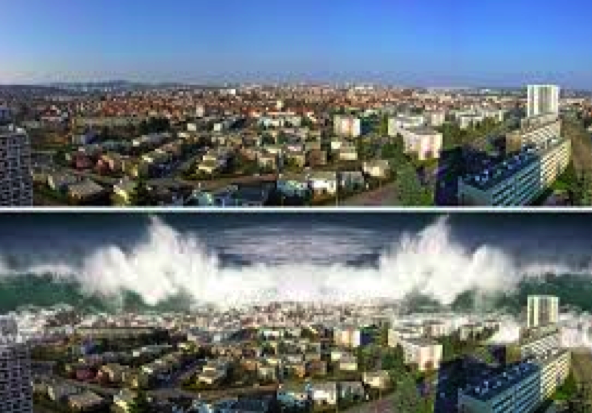
This is what a tsunami look like.
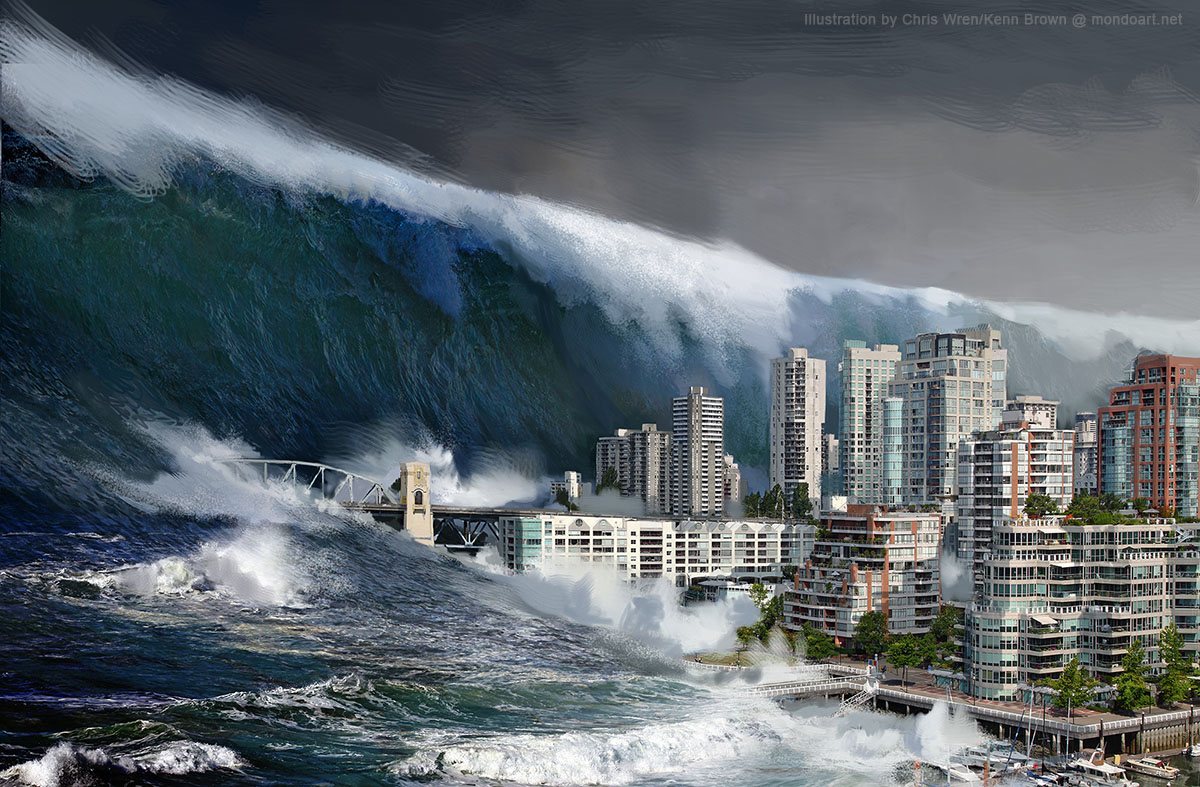
Let's get started!!!! Click on "Task" tab.
Task
Before we start learning about tsunamis, please read questions below and write down your answers. If you do not know the answer then you can write down the guess or you can leave it blank.
Activity #1:
ADMIT SLIP
1. What do you already know about tsunamis?
2. What do these words mean?
▪ Tsunami: _________________________
▪ Amplitude: _______________________
▪ Earthquake: ______________________
3. How do tsunamis effect people?
After writing down your answers, please click on 'process' tab.
Process
Activity #2:
Watch this video, click on this link: https://www.youtube.com/watch?v=HJW6KC8AGyg
Note: The video has built in subtitles. Please turn on the sound.
Activity #3:
After watching the video, please read this book to learn more about tsunamis. You also can use this book to do your four corner worksheet. You can find the worksheet on bottom of this page.
The book:
WHAT IS A TSUNAMI?
By: Sheri Garnand, Kristi Akers, and Karina Johnson
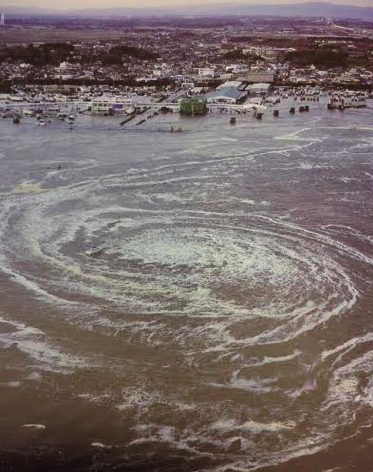
What is a Tsunami?
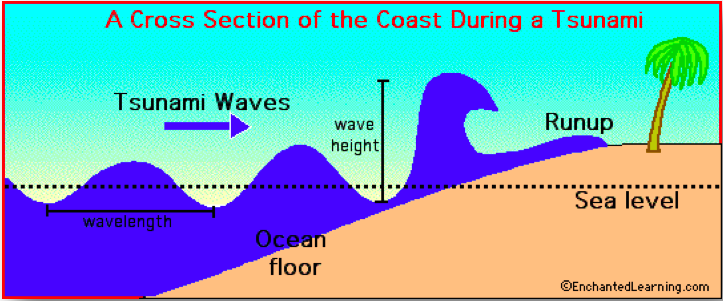
A tsunami is like a tidal wave. The wavelength of a tsunami wave is much longer than a normal tidal wave. Waves can be over 100 feet.
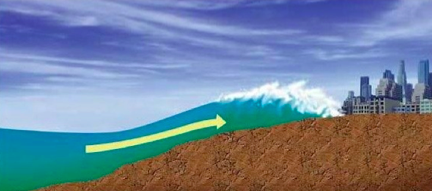
How is it created?
A tsunami is a lot of waves created by a large amount of wind, water tides and displaced water from under water explosions.
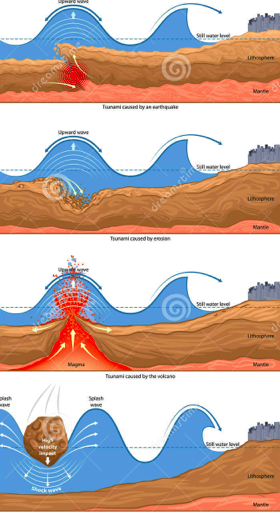
When does it occur?
Larger tsunami happens about 6 times per 100 years. They happen when there are earthquakes or major explosions underwater also from landslides.
Where do tsunamis happen?
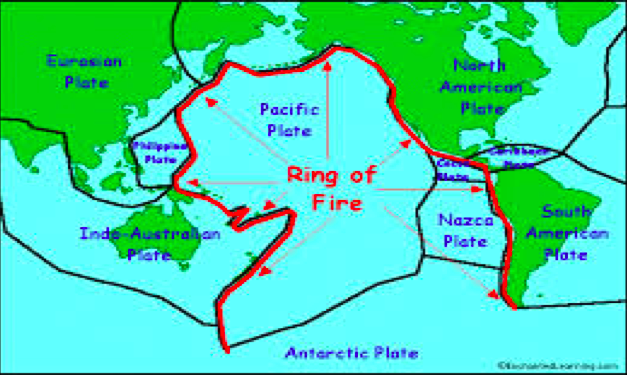
Tsunamis are most common in the Pacific Ocean, Australia, and Indonesia. These areas have a high number of earthquake zones.
How do you spot a Tsunami?
WAVE SPEED- typical wave is 4.8-60, Tsunami is 480-600 miles per hour.
WAVE PERIOD- typical wave is 5-20 seconds apart, Tsunami is 10 minutes to 2 hours apart.
WAVE LENGTH- typical wave is 330-660 feet apart, Tsunami is 60-300 miles apart.
How does Tsunami affect people?
Tsunamis can wipe out homes, stores, schools, roads, and modes of transportations. People can be left homeless for many months or even worse be killed.
Interesting Facts!
-About 80% of tsunamis happen within the Pacific Ocean.
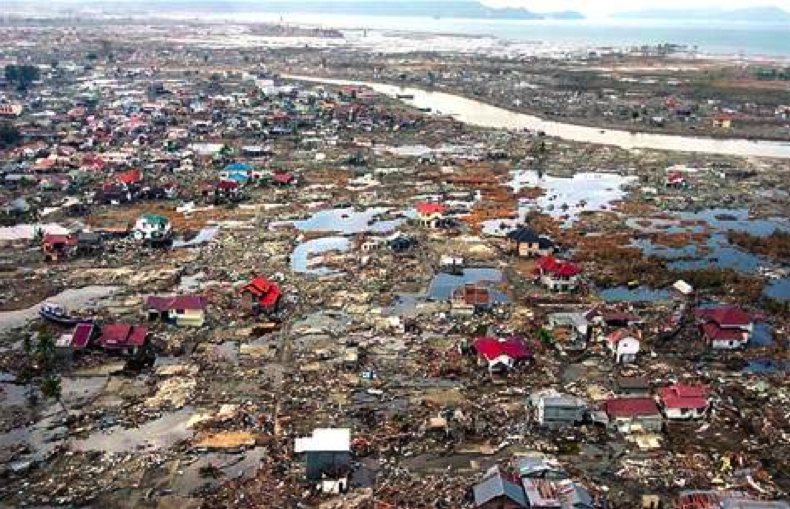
-The Indian Ocean tsunami that hit Indonesia in 2004 killed over 200,000 people.
How do Tsunamis effect our physical environment?
Tsunamis can drown forests and kill plants. Animals can be left without homes on land and in the ocean, plus the ocean can be polluted from the land where the tsunami came from.
Activity #3:
Tsunami Four Square Worksheet
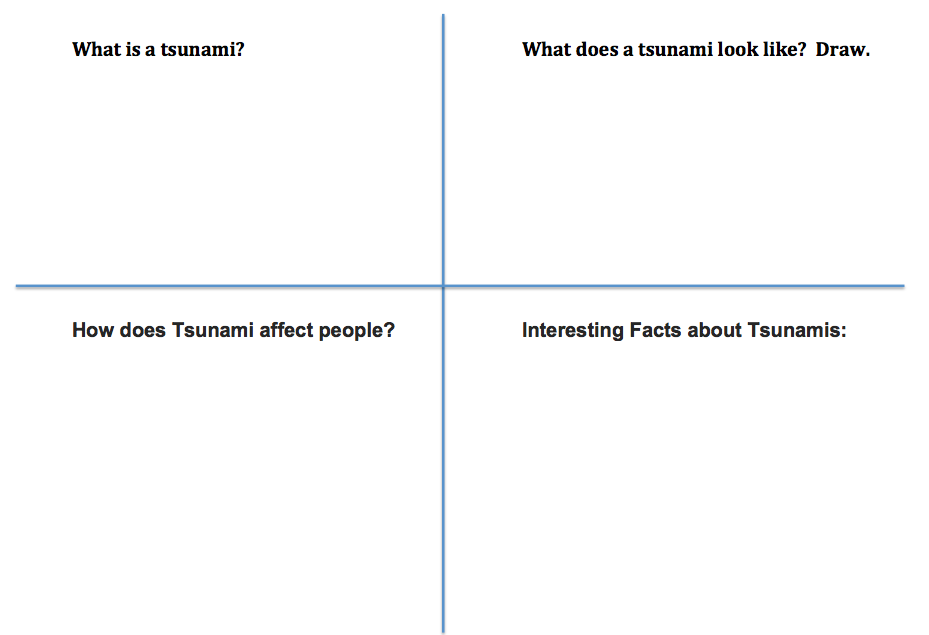
When you are finished with the four corner worksheet, please click on 'evaluation' tab.
Evaluation
Activity #4:
Now, let's see how much you've learned about tsunamis.
Exit Slip
Please read questions below and write down your answers. If you do not know the answer then you can write down the guess or you can leave it blank.
1. What have you learned about tsunamis?
2. What do these words mean?
Tsunami: ________________________________________________
Amplitude: _______________________________________________
Earthquake: ______________________________________________
3. How do tsunmais effect people?
You are DONE! Hope you learned something about tsunamis!
Credits
Glogster EDU. (2015, January 23). (a. Glogster, Producer) Retrieved 2007, from Glogster EDU: http://edu.glogster.com
Simon, S. (2012). Seymour Simon's Extreme earth records. San Francisco, CA: Chronicle Books, LLC.
Teacher Page
Grade Level: 5th grade
|
Subject Area: Science |
| |
Rationale: | |
In this lesson, students will learn about tsunamis, their causes, and the effects they have on the people and surrounding areas. Understanding cause and effect is an important skill that applies to many content areas so this is an important element of this lesson. To gain a further understanding of tsunamis and key vocabulary, students will complete a 4-square activity cooperatively with peers. Technology is an engaging method of learning for students and thus iPads will be used to present information via YouTube videos and Glogster. Admit and exit slips serve as a way for teachers to gauge students’ prior knowledge and new knowledge gained as a result of instruction (i.e. pre/post assessment) and will be implemented in this lesson. | |
| |
State Curriculum Standards: Content Standard: Earth/Space Science (grade 5) Science will use scientific skills and processes to explain the chemical and physical interaction (i.e., natural forces and cycles, transfer of energy) of the environment, Earth, and the universe that occur over time.
A. Materials and Processes that Shape A Planet 2.0.A.a Identify and describe events such as tornadoes, hurricanes, volcanic eruptions, earthquakes, and flooding which change surface features rapidly. 2.0.A.c Recognize that the natural force of gravity causes changes in Earth’s surface features as it pulls things toward Earth, as in mud and rock slides, avalanches, etc.
Language Arts: Vocabulary Acquisition and Use L4 Determine or clarify the meaning of unknown and multiple-meaning words and phrases based on grade 5 reading and content, choosing flexibly from a range of strategies. (SC, 5)
L4.a Use context (e.g., cause/effect relationships and comparisons in text) as a clue to the meaning of a word or phrase. (SC, 5) L4.c Consult reference materials (e.g., dictionaries, glossaries, thesauruses), both print and digital, to find the pronunciation and determine or clarify the precise meaning of key words and phrases. (SC, 5)
L5 Demonstrate understanding of figurative language, word relationships, and nuances in word meanings. (SC, 5)
L5.a interpret figurative language, including similes and metaphors, in context. (SC, 5) L5.c Use the relationship between particular words (e.g., synonyms, antonyms, homographs) to better understand each of the words. (SC, 5)
L6 Acquire and use accurately grade-appropriate general academic and domain-specific words and phrases, including those that signal contrast, addition, and other logical relationships (e.g., however, although, nevertheless, similarly, moreover, in addition).
| |
Instructional Objective(s): |
Assessment |
The students will be able to:
|
|