
Introduction
Emotional Disturbances
Emotional Disturbance as defined by Individuals with Disabilities Education Act (IDEA)
A condition exhibiting one or more of teh following characteristics over a long period of time and to a marked degree that adversely affects a child's performance:
(A) An inability to learn that cannot be explained by intecllectual, sensory, or health factors
(B) An inability to build or maintain satisfactory interpersonal relationships with peers and
teachers.
(C) Inappropriate types of behavior or feelings under normal circumstances
(D) A general pervasive mood of unhappiness or depression
(E) A tendency to develop physical symptoms or fears associated with personal or school
problems.
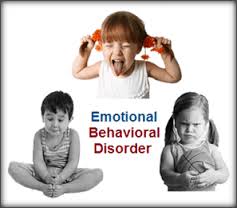
http://www.parentcenterhub.org/repository/emotinaldisturbance/
Task
Characteristics
Hyperactivity(short attention span, impulsiveness)
Aggression or self-injurious behavior
Withdrawal (not interacting with others, excessive anxiety)
Immaturity (inappropriate behavior/crying, poor coping skills)
Learning difficulties (performing below academic grade level)
The most serious emotional disturbances exhibit:
Distorted thinking
Excessive anxiety
Bizarre motor acts
Abnormal mood swings

Causal Factors
There are no actual known causes of emotional disturbance. Several factors have been suggested
such as:
Heredity
Brain disorder
Diet
Stress
Family Functioning.
Although through research these things seem to be contributing factors, but not the direct cause
of emotional disorder.
http://www.parentcenterhub.org/repository/emotionaldisturbance/
Process
Instructional Implications
Children with emotional disturbances are often left without guidance as those that have issues such as learning disabilities, ADHD, or other psychological disorders. This stems from the overlapping of characteristics of other emotional disorders and are wrongly classified.
A process called wraparound planning shows great promise in supporting students with emotional disorders. This is a collaborative process and involves all of the service providers of the student; mental health services, rehabilitation services, and guidance counselor. This program is devised to focus on the strengths and interests of the student and utilize the community resources at the same time.
Students with emotional disorders tend to cause more problems in the classroom depending on how much difficulty they have with a task. Decreasing this issue can be accomplished by allowing the student to choose a task to complete rather than forcing a specific task to be completed first. This allows the student to have some "control" over the situation and decreases the opportunity for negative behavior.
Be careful in making assumptions about students with emotional disorders as there are different causes for their disorders; some may be due to being abused in some way, but not all. It is best to be empathetic in any situation so the trust can be built which will make a lasting impact on the student.
http://www.projectidealonline.org/v/emotionaldisturbance/
Assistive Technology
There are 3 levels of assistive technology; low-tech, mid-tech, and high-tech. Students with
emotional disorders may use technology from each of these levels depending on their
individual needs.
Low-tech: point sheets and behavior charts; these items should be placed around
the classroom to motivate the student and can be organized to individual needs
and age appropriateness.
Mid-tech:The Motivaider; similar to a time to help students stay focused and
gain a sense of independence. An i-pod or other tablet is another tool which helps
with concentration. These tools can provide a wide variety of applications that will
assist the students in various ways.
High-tech: WII game system can be used to increase social skills and gross motor
skills. The WII games mostly require a lot of movement which can be beneficial
in allowing the student to be "free moving" rather than so rigidly confined. This
in turn will allow the student to be less frustrated and decrease negative behavior.
http://sbaxter4teach.blogspot.com/2014/02/assistive-technology-for-students-with_11.html

Evaluation
Accomodations and Modifications
Extend the amount of time that a student is given to complete a particular task.
- Break down assignments into smaller ones. As students finish each mini-assignment, build in reinforcement for task completion. Wait to distribute the next assignment until students have been successful with the current one.
- Reduce the number of practice items that a student must complete, once the student has demonstrated mastery.
- Follow low-interest activities with high interest activities so that students get breaks from difficult or less interesting activities from time to time.
- Plan short review lessons or readiness activities to help orient the student to a particular learning task
- Set up goals aimed at social interactions
- Use role-playing situations
- Use seating arrangement to encourage social interaction
- Set up personalized goals and strategies, so that the child can find success.
- Clearly post rules
- Stay consistent in expectations
- Set limits and Boundaries
- Use behavior contracts
- Use a highly structured environment
- Develop a cue word for the child to note inappropriate behavior
- Establish a quiet cool off area
- Teach self-talk to relieve stress and anxiety
- Teach and put in place self-monitoring and self-control techniques
- Provide time for relaxation techniques
- Be aware of your speech and non-verbal cues when talking to the student
Conclusion
Resources for Teachers and Parents
DO2Learn: Educational Resources for Special Needs
http://do2learn.com/sitemap/index.htm
Center for Effective Collaboration and Practice
Students with Emotional Disturbance: Educational Environments and Services
http://cecp.air.org/resources/20th/edenviro.asp
Resources for Parents
Center on Positive Behavioral Interventions and Supports - Provides information along
with technical support about behavioral systems. These in turn assist states and districts
in designing effective schools.
American Academy of Child and Adolescent Psychiatry (AACAP) Dedicated to improving
the quality of life for children and their families dealing with emotional disturbance.
Credits
Credits
http://www.parentcenterhub.org/repository/emotinaldisturbance/
http://www.parentcenterhub.org/repository/emotionaldisturbance/
http://www.projectidealonline.org/v/emotionaldisturbance/
http://sbaxter4teach.blogspot.com/2014/02/assistive-technology-for-students-with_11.html