
Introduction
THE HISTORY OF PLANETARY MOTION
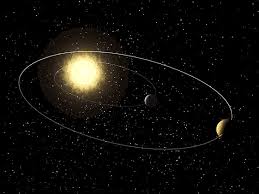
Planetary motion and the motion of various heavenly bodies is a deep topic which has fascinated humans since our beginning and is still undergoing research. New discoveries are regularly made in this field and we will attempt to give a brief overview.
Task
You are a journalist 
and you have to write an article about a scientist (you choose) who made important discoveries in understanding how planetary motion could be explained.
In your exploration through the history of planetary motion, you have several assignments to complete:
- Use the internet to research information about the scientist's life
- Use everything you have found (also pictures) to write a journal article for an immaginary scientific magazine "The Scientist"
- Create a presentation to tell your classmates about the scientist and his discoveries
This will be a group work so you have to create your group (max 4 people).
Process
PART 1
Watch the videos on the padlet page the address of which can be found here :
http://padlet.com/luisella_bertolaso/planetarymotion4e
PART 2
In the video, six really famous scientists were mentioned:
ERATOSTHENES
COPERNICUS
THICO BRAHE
KEPLER
GALILEO
NEWTON
You and your partners have to choose one of them and show your decision on this padlet page (wall)
http://it.padlet.com/alefari11/historyplanetmotion
Here you have to:
- post an immage of the one you have chosen
- write the name of the scientist
- write the names of the components of the group

THE FIRST GROUP TO WRITE ON THE PAGE IS THE FIRST THAT WILL CHOOSE THE FAVOURITE SCIENTIST - YOU CAN'T CHOOSE A SCIENTIST THAT HAS BEEN ALREADY CHOSEN BY ANOTHER GROUP
PART 3
Once you and your partners have chosen your scientist, surf the net and find some interesting links about the subject.
For example, here is a website that is full of information :
http://www.famousscientists.org/
Save the address (URL) of the web pages you found interesting and post them on a symbaloo page. You can name the symbaloo page with the name of your scientist. This page will be useful when you present your work.
PART 4
 It's time to write the article (max 600-1000 words) for "The Scientist Magazine".
In it, you have to include the following information:
- your scientist's life
- his works
- why he is so famous
PART 5
We have arrived almost at the end...
Now, you have to prepare a presentation (max 15 min) with all materials you found in your web research.
The works of all 5 groups will be presented from MARCH 3rd, 2016 in this order:
1) ERATOSTHENES's group
2) COPERNICUS's group
3) THICO BRAHE's group
4) KEPLER's group
5) GALILEO 's group
6) NEWTON's group
All group members are expected to speak
Evaluation
ORAL PRESENTATION RUBRIC
| CATEGORY | 4 | 3 | 2 | 1 | SCORE |
| PREPAREDNESS | Student is completely prepared and has obviously rehearsed. | Student seems pretty prepared but might have needed a couple more rehearsals. | The student is somewhat prepared, but it is clear that rehearsal was lacking. | Student does not seem at all prepared to present | |
| PRESENCE | Very believable that student is giving presentation to their boss and board of directors. | Somewhat believable that student is giving presentation to their boss and board of directors | Inconsistent to whether or not student was giving presentation to their boss and board of directors. | Student did not act like they were giving this presentation to their boss and board of directors | |
| POSTURE/EYE CONTACT | Stands up straight, looks relaxed and confident. Establishes eye contact with everyone in the room during the presentation. | Stands up straight and establishes eye contact with everyone in the room during the presentation. | Sometimes stands up straight and establishes eye contact. | Slouches and/or does not look at people during the presentation | |
| VOLUME | Volume is loud enough to be heard by all audience members throughout the presentation. | Volume is loud enough to be heard by all audience members at least 90% of the time | Volume is loud enough to be heard by all audience members at least 80% of the time | Volume often too soft to be heard by all audience members | |
| LISTENS TO OTHER PRESENTATION | Listens intently. Does not make distracting noises or movements. | Listens intently but has one distracting noise or movement | Sometimes does not appear to be listening but is not distracting | Sometimes does not appear to be listening and has distracting noises or movements |
WRITTEN TASK : ARTICLE RUBRIC
| TOPIC | 4 | 3 | 2 | 1 | SCORE |
|
Organization (Overall order, flow, and transitions) |
Information is presented in effective order. Excellent structure of paragraphs and transitions enhances readability and comprehension | Information is logically ordered with paragraphs and transitions | Information is scattered and needs further development. | Details and examples are not organized, are hard to follow and understand | |
|
Quality of Information/ Bibliography or Sitography |
Supporting details are specific to topic and provide the necessary information. | Some details don’t support the report topic | Details are somewhat sketchy. | Unable to find specific details | |
| Lead | Introductory paragraph is clearly stated, has a sharp, distinct focus and enhances the impact of the report | Introductory paragraph is clearly stated with a focus | Introductory paragraph is vague | Introductory paragraph is not apparent. | |
| Conclusion | Concluding paragraph summarizes and draws a clear, effective conclusion and enhances the impact of the report. | Concluding paragraph follows and summarizes the report discussion and draws a conclusion. | Concluding paragraph is only remotely related to the report topic. | Concluding paragraph is not apparent. | |
| Grammar & Spelling | No spelling or grammatical errors. | Fewer than 3 grammatical or spelling errors. | Three to five grammatical or spelling errors | Numerous grammatical and/or spelling errors. | |
| Title | really catchy and making use of techniques to involve the reader | quite involving and well chosen | involving but could be improved | plain |
Conclusion
CONGRATULATIONS!!! 
You have used your knowledge to write a scientific article.
You have also used your speaking ability to share it with your classmates.
Who knows? This may be the beginning of a new career. We are proud of your hard work!