
Introduction
Today you will be evaluating and exploring the efforts of 20th century muckrakers.
Click through the materials on the following page and answer the accompanying questions in your OneNote.

Task
Station 1: Jacob Riis, How the Other Half Lives
1)Watch the linked video from the 0:00 - 6:13 and answer the questions.1 and 2 on your worksheet.
https://www.youtube.com/watch?v=EACoIbokOcc
2) Look at the following pictures and quote and answer questions 3 and 4 on your worksheet.


/https://public-media.smithsonianmag.com/filer/50/30/50301c88-deec-4aca-9946-a10e645a13e6/be072618.jpg)


"Poverty always goes along with dirt and disease, and the Hebrew quarter is not an exception. The diseases these people suffer from are not due to intemperance or immoratlity, but to ignorance, want of suitable food, and the foul air in which they live and work. "
~Jacob Riis, How the Other Half Lives
Station 2: Upton Sinclair, The Jungle
1) Read the following excerpt and answer question 1 on your worksheet.
|
The Jungle by Upton Sinclair |
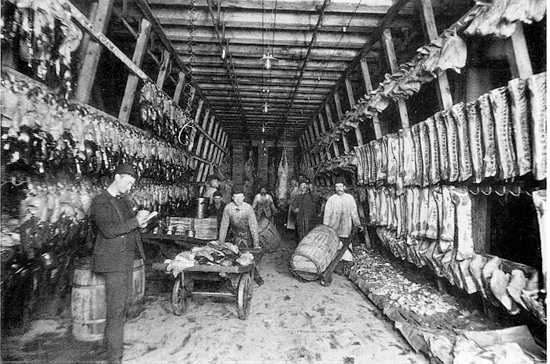
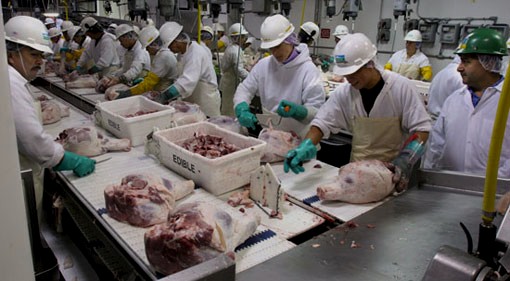
"There was no heat upon the killing-floor. The men might exactly as well have worked out of doors all winter. For that matter, there was very little heat anywhere in the building, except in the cooking-rooms and such places—and it was the men who worked in these who ran the most risk of all, because whenever they had to pass to another room they had to go through ice-cold corridors, and sometimes with nothing on above the waist except a sleeveless undershirt. In summer time the chilling-rooms were counted deadly places, for rheumatism and such things; but when it came to winter the men envied those who worked there—at least the chilling rooms were kept at a precise temperature, and one could not freeze to death. On the killing-floor you might easily freeze, if the gang for any reason had to stop for a time. You were apt to be covered with blood, and it would freeze solid; if you leaned against a pillar you would freeze to that, and if you put your hand upon the blade of your knife, you would run a chance of leaving your skin on it. The men would tie up their feet in newspapers and old sacks, and these would be soaked in blood and frozen, and then soaked again, and so on until by night time a man would be walking on great lumps the size of feet of an elephant. Now and then, when the bosses were not looking, you would see them plunging their feet and ankles into the steaming hot carcass of the steer, or darting across the room to the hot-water jets. The cruelest thing of all was that nearly all of them—all of those who used knives—were unable to wear gloves, and their arms would be white with frost and their hands would grow numb, and then of course there would be accidents. Also the air would be full of steam, from the hot water and the hot blood, so that you could not see five feet before you; then, with men rushing about at the speed they kept up on the killing-floor, and all with butcherknives, like razors, in their hands—well, it was to be counted as a wonder that there were not more men slaughtered than cattle."
"There would be meat stored in great piles in rooms; and the water from leaky roofs would drip over it, and thousands of rats would race about on it. It was too dark in these storage places to see well, but a man could run his hand over these piles of meat and sweep off handfuls of the dried dung of rats."
~Upton Sinclair The Jungle
2) Look at the following pictures and answer questions 2 and 3 on your worksheet.


|
|
Station 3: Ida Tarbell, History of Standard Oil Company
Examine the political cartoons and the excerpt and answer question 1 on your worksheet


2) Read the follow excerpt from Ida Tarbell and answer question 2 on your worksheet.
"Now it takes time to secure and to keep that which the public has decided it is not for the general good that you have. It takes time and caution to perfect anything which must be concealed. It takes time to crush men who are pursuing legitimate trade. But one of Mr. Rockefeller's most impressive characteristics is patience."
~Ida Tarbell The History of Standard Oil Company
Station 4: Modern Day Muckraker?
Read the two following articles on the pros and cons of WikiLeaks from the Huffington Post. Then take a minute to answer the question on your worksheet.
Article #1
Why WikiLeaks Is Good for Democracy
May 25, 2011
Bill QuigleyLaw Professor, Loyola University New Orleans
“Information is the currency of democracy.” — Thomas Jefferson.
Since 9-11, the US government, through Presidents Bush and Obama, has increasingly told the US public that “state secrets” will not be shared with citizens. Candidate Obama pledged to reduce the use of state secrets, but President Obama continued the Bush tradition. The Courts and Congress and international allies have gone meekly along with the escalating secrecy demands of the U.S. Executive.
By labeling tens of millions of documents secret, the US government has created a huge vacuum of information.
But information is the lifeblood of democracy. Information about government contributes to a healthy democracy. Transparency and accountability are essential elements of good government. Likewise, “a lack of government transparency and accountability undermines democracy and gives rise to cynicism and mistrust,” according to a 2008 Harris survey commissioned by the Association of Government Accountants.
Into the secrecy vacuum stepped Private Bradley Manning, who, according to the Associated Press, was able to defeat “Pentagon security systems using little more than a Lady Gaga CD and a portable computer memory stick.”
Manning apparently sent the information to WikiLeaks — a non profit media organization, which specializes in publishing leaked information. WikiLeaks in turn shared the documents to other media around the world including The New York Times and published much of it on its website.
Despite criminal investigations by the US and other governments, it is not clear that media organizations like WikiLeaks can be prosecuted in the U.S. in light of First Amendment. Recall that the First Amendment says:
“Congress shall make no law respecting an establishment of religion, or prohibiting the free exercise thereof; or abridging the freedom of speech, or of the press; or of the right of the people peaceably to assemble, and to petition the government for a redress of grievances.”
Outraged politicians are claiming that the release of government information is the criminal equivalent of terrorism and puts innocent people’s lives at risk. Many of those same politicians authorized the modern equivalent of carpet bombing of Baghdad and other Iraqi cities, the sacrifice of thousands of lives of soldiers and civilians, and drone assaults on civilian areas in Afghanistan, Pakistan and Yemen. Their anger at a document dump, no matter how extensive, is more than a little suspect.
Everyone, including WikiLeaks and the other media reporting the documents, hopes that no lives will be lost because of this. So far, that appears to be the case as McClatchy Newspapers reported November 28, 2010, that “U.S. officials conceded that they have no evidence to date that the [prior] release of documents led to anyone’s death.”
The US has been going in the wrong direction for years by classifying millions of documents as secrets. WikiLeaks and other media which report these so-called secrets will embarrass people, yes. WikiLeaks and other media will make leaders uncomfortable, yes. But embarrassment and discomfort are small prices to pay for a healthier democracy.
Wikileaks has the potential to make transparency and accountability more robust in the US. That is good for democracy.
Article #2
The Truth About Transparency - Why Wikileaks Is Bad for All of Us
May 25, 2011
Derrick Ashong Musician, Social Entrepreneur
...There is a difference between holding government accountable for its decisions and holding government officials hostage to their words. When I first heard about the latest impending Wiki leak last week, I couldn’t help but wonder what was the purpose? I was impressed last Spring when I first saw their footage of the 2007 murder of a journalist & Iraqi civilians. I questioned the impact on U.S. informants and intelligence assets of their release of military documents on the Afghan War, and whether Wikileaks might be crossing an important line — but I wasn’t yet prepared to question their motives in doing so.
With this release I am questioning both the value and motives of WikiLeaks itself. Is there a genuine public good in publishing the internal communiques of diplomats and world leaders? Some of my friends argue a vigorous “yes.” One posted on my Facebook page that we need to always keep government accountable. Another tweeted me that “exposing lies & hypocrisy is always a good thing.”
But is that really what’s happening here? Exposing the cover-up of civilian murders in Iraq is clearly important work. Publishing private emails of diplomats strikes me as... sort of petty. Mind you I’m sure there were “lies & hypocrisy” present in those cables. If we could go over the last 250,000 emails any of us sent I’d wager there would be plenty of both to go around. After all, what you tell your classmates about what you really think of that one professor, or the candid thoughts you share with a colleague about the intellectual “gifts” (or lack thereof) of a potential client may not always sound as sweet in the morning sun.
Yet that ability to both give and solicit candid assessments of people and circumstances is a prerequisite to doing the work of diplomacy. Most of us wouldn’t speak the same way in front of our boss as we would with our best friend. When world leaders like Mahmoud Ahmadinejad or Hugo Chavez make brazen and inflammatory statements, we take umbrage not only at the content of their comments but with the accompanying and typically unnecessary bombast. The nature of diplomatic relations, is that they require a sensitivity in not only what is said, but in how it’s said.
By breaching the privacy of diplomatic cables WikiLeaks has compromised the fundamental nature of what diplomats do — they translate the feelings, passions, prejudices, inadequacies, ambitions and aspirations of real people in positions of power into language that at its best, prevents us from blowing each other up. The “diplomatic set” is arguably a big part of why we don’t have more conflict in our world.
The saddest thing to me about this latest Wikileaks disclosure is that it diminishes the value of “whistle-blowing” itself. As I tweeted yesterday “you blow the whistle to spread the truth, not to hear the sound.” By publishing these emails not only has Wikileaks compromised the privacy of state department officials and the trust within important diplomatic networks, it has also undermined its own credibility as a resource for people who have genuinely important information to share with the global community.
There is a distinction between truth tellers and high tech gossip-peddlers. Unfortunately it looks like this time Wikileaks has crossed that line too.
Station 5: Be the Muckraker
Look at the final question in your worksheet and reflect. Answer the question as fully as you can.