
Introduction
Thanksgiving Day is traditionally a day for families and friends to get together for a special meal. Thanksgiving Day is a time for many people to give thanks for what they have. Thanksgiving Day is a national holiday celebrated in Canada and the United States. It is celebrated on the fourth Thursday of November in the United States.
In this project you will learn some facts from the history of this holiday, traditions connected with it. You have to make a presentation using a multi-media medium about this holiday. To fulfill what we have planned for, you have to answer all the questions. So, let's surf the Net and gather as much information as possible about this American holiday.

Task

Thanksgiving is a national holiday celebrated in the USA and Canada. How much do you already know about it?
Step 1 A traditional Thanksgiving meal
Read the descriptions of typical Thanksgiving dishes and find the answers to the questions. Discuss the answers with your partner.
Step 2 Thanksgiving traditions
After reading the text do True-False task.
Process
Step 1: A traditional Thanksgiving meal
Read the descriptions of typical Thanksgiving dishes and find the answers to these questions. Discuss the answers with your partner.
Everyone knows the general history of Thanksgiving dinner: the Wampanoag tribe of Native Americans helped the pilgrims at Plymouth survive their first year in the New World, and they all celebrated together in the Autumn of 1621 with a holiday feast.
But do you know the history of the Thanksgiving dishes themselves? Why do we eat sweet potatoesand not French fries? Pumpkin pie instead of strawberry shortcake? Cranberry sauce instead of cherry marmalade?
Each delicious member of the traditional Thanksgiving dinner has arrived for a reason, and when you give thanks this year for the many blessings in your life, don’t forget to allow some gratitude that these elements of cuisine have come together to make one perfect holiday meal. The history of the Thanksgiving meal is a very American story, one that is filled with adventure, new discoveries and – of course – smart marketing.
TURKEY Native to the New World, wild turkeys were a staple of the local diet when the pilgrims arrived in 1620, and this tasty poultry was most definitely present on the table at the first Thanksgiving. That same century the birds were taken to Europe where they were confused with the guinea fowl, which had arrived on the continent by way of the country of Turkey, hence the name. Interestingly, Native Americans called this bird “peru.”

DRESSING/STUFFING Stuffing has been eaten since at least the time of the Romans, and probably before. In Europe during the Middle Ages, stuffing was known as “farce,” from the French word farcir, which means “to stuff.” The word “stuffing” first appeared in print in 1538 and held fast until the 1880s, when the Victorians decided that they didn’t so much like that word and changed it to “dressing.” Today “stuffing” is usually found inside the bird while “dressing” refers to a separate pan of the bread, vegetable and spice mixture. Recipes vary regionally; cornbread dressing is popular in the South, those with an Italian background probably add sausage to their recipe, while German-Americans prefer to mix in dried fruit, potatoes or apples.

CRANBERRY SAUCE The first English settlers to the new world called this bright berry a “craneberry,” due to its flowers that resemble the head of a crane. Native Americans already knew about the berry’s health-promoting properties and often mixed it with pemmican, a dried meat mix, to preserve it for eating during the long New England winters. Cranberry sauce gained in popularity after General Ulysses S. Grant ordered it served to his troops during the siege of Petersburg, Virginia during the Civil War, and in 1912 it became available commercially under the name “Ocean Spray.” If you listen carefully at the end of “Strawberry Fields Forever,” you can hear John Lennon repeating the phrase, “cranberry sauce.”

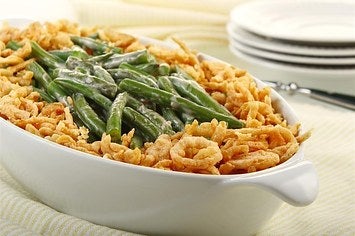
GREEN BEAN CASSEROLE Topped with crunchy fried onions, this side dish was invented by Campbell’s test kitchen in order to promote their soups in 1955, when smothering vegetables in a rich, creamy sauce was a popular trend.
Sweet Potatoes Columbus brought this orange root vegetable to the New World from the Caribbean island of St. Thomas, and Virginia saw the first stateside cultivation in 1648 (the white potato was not introduced for another hundred years). The addition of a buttery marshmallow topping dates back to the 1920s and 30s, when marshmallows – previously an expensive, handmade treat – became widely available commercially. Please note: sweet potatoes are not yams.

GREEN JELL-O SALAD Gelatin was invented in the late 1800s by Charles Briggs Knox, who hated to see his wife work so hard boiling calves’ feet to make aspic for gelatin dishes. After his death she went on to become one of the most successful businesswomen in New York. Congealed salads were the height of food fashion in the 1930s, and were called “salads” due to the bits of fruits and nuts inside the jiggley stuff, which gave it a salad-like appearance. Inexpensive and easy to make, Jell-O salads have since become a staple of potluck dinners across the nation.

Pumpkin PIE The pilgrims probably didn’t have pumpkin pie per se at the first Thanksgiving because they didn’t have an oven to bake the crust in. This squash, which dates back 9,000 years to Mexico, had been cultivated by the Native Americans for centuries, roasted or boiled for survival. The pilgrims might have made stewed pumpkin by filling the shell with a mixture of orange flesh, milk, honey and spices and baking it in ashes, but the first pumpkin pie did not appear until 1670.

PECAN PIE The pecan tree grew in Texas and New Mexico long before any humans arrived, as is evident from the fossil record. Some Native American tribes relied on its meat as a major food resource for almost a third of the year, and they introduced this hard-shelled nut to the French settlers of New Orleans, who quickly made it into “New Orleans Pie.” A simple dessert made with nuts, corn syrup, eggs and vanilla, the pecan pie was popularized by the manufacturers of Karo corn syrup earlier this century and remains a holiday dessert staple.
1. Which dish with an exotic background got a sweet addition in the 20th century?
2. Which sweet dish has ancient origins?
3. Which food helped make a brand of soup more popular?
4. Which food is made from different ingridients, depending on the origins of the people cooking it?
5. Which food is very good for you and can be stored for a long period?
6. Which food made one woman very rich?
7. Which food got its name by mistake?
8. Which food probably wasn't eaten at the first Thanksgiving meal because of lack of technology?
Step 2 Thanksgiving Traditions
Apart from food, the biggest Thanksgiving traditions are football and parades. In ancient harvest festivals, people usually celebrated with games and sports, so you could argue the football tradition has very deep roots. The traditional American Thanksgiving football game was usually between the Detroit Lions and the Green Bay Packers, but as football has become more popular, there are now more games on Thanksgiving day.
The tradition of Thanksgiving parades goes back to the early 20th century, when people began to associate Thanksgiving with the beginning of the Christmas shopping season. In order to attract customers, stores like Macy's sponsored elaborate parades like the Macy's Thanksgiving Day Parade.
Some people choose to express their gratitude by giving back to the community. Volunteer activities, such as helping out at a soup kitchen or at a shelter, are popular ways to spend Thanksgiving Day.
Since 1947, the National Turkey Federation has gifted a live Thanksgiving turkey to the White House, along with two butchered turkeys [source: Raloff]. It's not known exactly when United States presidents began pardoning the White House Thanksgiving turkey, but the tradition is thought to be connected to Abraham Lincoln sparing a turkey named "Jack" from becoming the main dish in a holiday meal. Today, the Annual Turkey Ceremony takes place in advance of Thanksgiving, and the public has the opportunity to name the spared turkey, who lives its remaining days at the Kidwell Farm, a petting zoo in Virginia.
Finally, because Thanksgiving is the fourth Thursday of November and thus falls on a different date each year, the president of the United States issues a yearly proclamation to establish the date of the celebration. In 1863, President Abraham Lincoln began the tradition, and every president since has issued a Thanksgiving Day proclamation.
You have read about some typical traditions in North America at Thanksgiving. And now decide whether you think the statement below are true (T) or false (F).
1. Many people watch tennis at Thanksgiving every year.
2. Thanksgiving parades are often sponsored by shops.
3. Washing neighbours' cars is the most popular way to help others in the community at Thanksgiving.
4. The Whitr House is given three turkeys each Thanksgiving - two are killed and one is pardoned and isn't cooked.
5. The turkey which is kept is given a name chosen by the president's family.
6. The president announces the official date of Thanksgiving every year.
Evaluation
Step 1.
1. Sweet potatoes
2. Pecan pie
3. Green bean casserole
4. Dressing / Stuffing
5. Cranberry (sauce)
6. Green Jell-O salad
7. Turkey
8. Pumpkin pie
Step 2.
1. F - many people watch football (American football)
2. T
3. F - some people participate in volunteer activities, such as helping out at a soup kitchen or at a shelter.
4. T
5. F - the name is chosen by the public.
6. T
Conclusion
After passing this Web Quest students will form a conscious attitude towards the English-speaking culture, respect and understanding of the importance of the cultures of other countries. This holiday is certainly not common in Russia, but the knowledge of it will help broaden the outlook about the America. It is really important, because if you want to learn English you have to know something about their culture and traditions.

Credits
Teacher Page
Цели проекта:
Формирование осознанного отношения к культуре англоязычных стран, уважение и понимание значимости не только культур других стран, но и своей.
Формирование нравственных ценностей учащихся о значении истории в нашей жизни и необходимости ее знания.
Задачи проекта:
Расширить общекультурный кругозор учащихся посредством знакомства их с различными источниками информации.
Иностранный язык
Сегодня перед учителями ставится целью формирование у учащихся иноязычной коммуникативной компетенции на основе развития универсальных учебных действий.
После завершения проекта учащиеся смогут:
- употреблять изученную лексику по учебным темам,
- анализировать, сопоставлять факты и делать выводы,
- обрабатывать полученную информацию.