
Introduction
2016
Election and the Electoral College
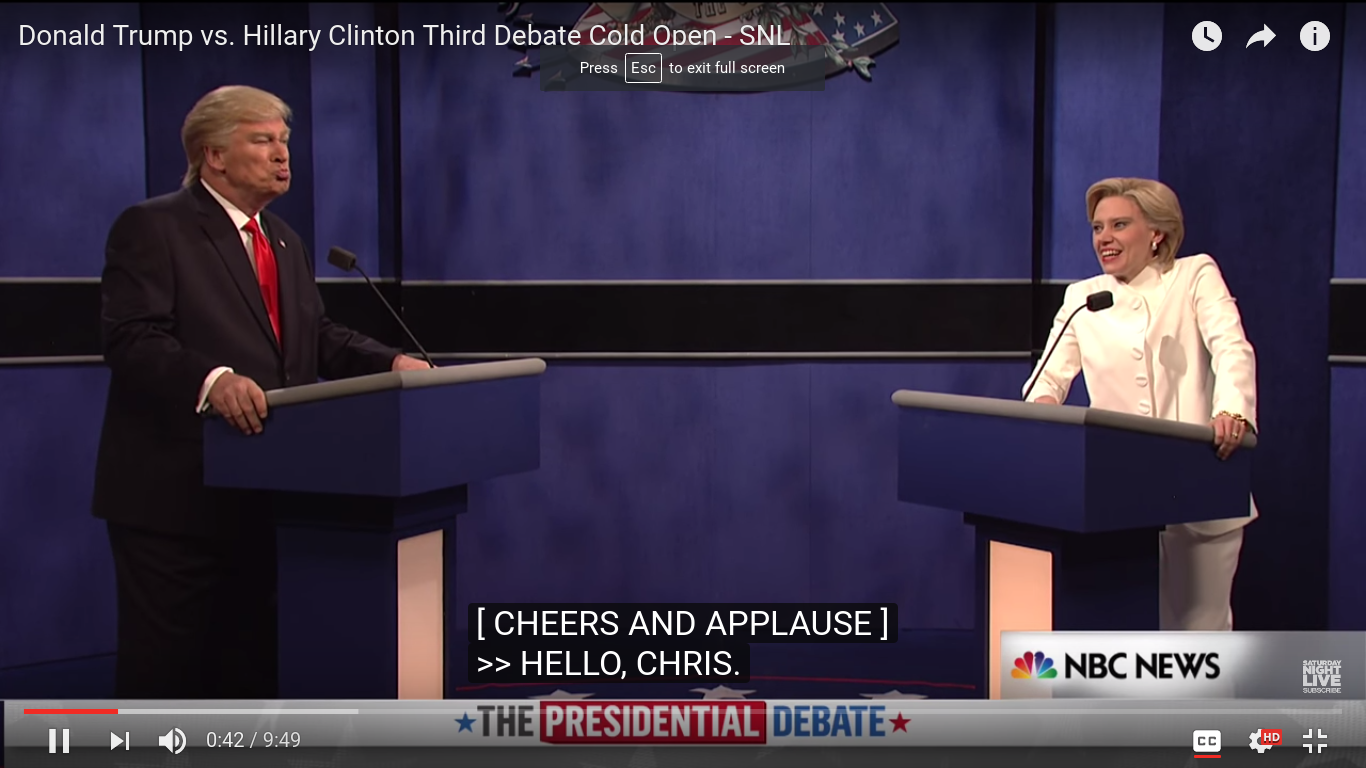
Who doesn't remember this infamous scene from Saturday Night Live's parody of the Presidential debates? If you have not seen it, I would recommend you take a minute and explore. Several weeks after the election, what is suprirsing about this? Perhaps, the overwhelming feeling expressed in this that Hilllary Clinton would be our next president. This was supported by polling at the time and, in fact, Hillary Clinton won the popular vote (meaning more Americans voted for her than Donald Trump). However, Donald Trump has won more votes in our Electoral College. In the next few days, we will be exploring what the electoral college is and assessing whether or not it should be continued.
Task
Your Task
Your group has been asked by a local newspaper (such as Ohio.com - http://www.ohio.com/) to write an opinion piece on whether or not the United States should continue using the Electoral College. As the 2016 election has been particularly contentious, your editor has asked that your group use as many mathematical reasons in defending your answer because it will be less biased. You will only have 500 words and your editor will not allow you one more word. She has also asked you to develop a political cartoon to accompany your article.
Process
Don't panic....we have a process
Writing a news article, even an op-ed, is quite a process. It requires hours of research and trying to understand a very complicated topic. However, you are not alone. We have developed the following exercises for you to complete to get the wheels turning for your op-ed piece. As you complete each piece, please make sure to upload it to our class website for evaluation. Your final grade for this Webquest will include the op-ed piece as well as all of the steps you took to get ready to write that.
Feel free to divide this work up however you see fit. Ultimately, each group will only submit one op-ed and supporting documents. You will likely want multiple group members to work on each step so you have a variety of opinions and eyes.
Step 1 - What is an op-ed and what does a good one look like?
Op ed pieces are designed to give readers of a newspaper or online forum an informed opinion. Since you will be writing one, let's take a look at what a good op-ed looks like.
As mentioned in the introduction, you will be writing your op-ed for a site such as Ohio.com. Here's a recent op-ed re-published on that site. Please read it and then complete this Herringbone assignment to help show the way the author supports his main argument. The back bone should be the argument that the Electoral College should stay. The little bones should be details and facts that support the argument.Remember, you will want the same sort of bones to support your main argument when you write your op-ed.
When you are completed, take a screenshot and submit it to our class website.
Step 2 - What is the Electoral College? Why do we have it?
Before you can decide whether or not we should have this system, you probably ought to know what it is. Begin by watching the Youtube video here. You will need to scroll to the middle-bottom before you get to the video. Take Cornell notes as you watch and make sure to submit your group's notes to our website.
For a slightly different look at the Electoral College, take a gander at the House of Representatives' site. Take Cornell notes, noting any different information compared to the video you watched. Make sure to upload these Cornell notes to our class website.
Step 3 - Data, Math, and the Electoral College
Since your editor has specifically asked for numeric data to support your conclusion, we need to work on figuring some of that out.
To start, let's review this article from the Scientific American. Now, answer the following questions. Record your answers in a Google Doc or Word Doc that you will then upload to our class website.
1. Explain what the three halfs power rule is. What does it mean for the Electoral College?
2. Explain the thought experiment with New Texaflohioginia. What does it demonstrate about the unequal nature of the Electoral College?
3. What is a battleground state? What is an example of one other than Ohio? Why would a candidate spend more time in Ohio than New York?
4. What does this article have to say about Ohio? What does it say about Mitt Romney's time there? Do you find this surprising?
Now, let's take an extended look at one battleground state, namely Ohio.

The map above shows the results for the 2016 presidential election for the state of Ohio
5.
a. Using the map above, guess what you think the percentage of voters voted in Ohio: Democrat (blue), Republican (red)
b.Using this link, record what the actual percentages were for Democrat and then Republican candidates. Remember that Hillary Clinton was the Democrat and Donald Trump was the Republican.
c. Compare your guesses with the actual results, were your guesses close? Are you surprised what the actual results were? Does the map accurately show how close the election in Ohio was?
6.

a. Use Google to find a map of Ohio and identify the following geographic locations: Lake County, Cuyahoga County, Cincinnati, Cleveland, Columbus.
b.Using this link, what percentage of voters in Lake county voted Republican? What percentage voted Democrat?
c. Using this link, what percentage of voters in Cuyahoga County voted Republican? What percentage voted Democrat?
d. Using this link provided, record the following for Lake County:total Population, population of white citizens, population of non white citizens.
e. Using this link , record the following for Cuyahoga County:total Population, population of white citizens, population of non white citizens.
f. Based on the results that you found, what trends do you notice? What can you say about Columbus and Cincinnati?
Step 4 - Organizing your thoughts and thinking graphically.
Now that you have collected information about the Electoral College, let's work on organizing it to get ready to write your article and political cartoon.
Let's go back to the Herringbone template you used for the op-ed you read. This time, write your opinion of whether or not we should get rid of the Electoral on the backbone and supporting facts on the smaller bones. Make sure to mark the source of your information so you can cite it in the article. Take a screenshot when you have completed this and submit to our class site.
Now, take a look at these political cartoons from 2016. Consider these questions and type up answers in Google Doc or Word doc. Submit your answers to our class site.
1. Which one is your favorite? Why?
2. What political message is it trying to send?
3. What are some strategies the illustrator uses to get his or her point across?
Evaluation
Students will be evaluated on the Webquest part of this assignment using the following rubric. Please remember that your op-ed and political cartoon will be a separate project completed in language arts.
| Assignment | Key Features | Points possible | Points awarded |
| Herringbone Op-ed |
Completely filled out Specific details are used for bones |
10 | |
| Cornell Notes Video |
Notes are complete Summary of notes link to Electoral College |
10 | |
| Cornell Notes House of Representatives |
Notes are complete Summary of notes link to Electoral College |
10 | |
| Data/Math/Electoral College Questions | Questions are answered complete and with detail from readings | 40 | |
| Herringbone Pre-writings |
Herringbone is complete Details are provided from the activities and readings from this Webquest Specific quotations and citations are there |
20 | |
| Political Cartoons Analysis |
Questions are answered completely |
10 |
Conclusion
And there was much rejoicing!!
Congratulations! You have now completed our Webquest journey. Hold on to all of the information you have collected. It will be useful as you start your op-ed for language arts and political cartoon.
If you would like a model to help you get ready to write, don't forget to look at the op-ed we examined in Part I of the Webquest.
Credits
1. https://www.youtube.com/watch?v=-kjyltrKZSY
3. http://history.house.gov/Institution/Electoral-College/Electoral-College/
4. https://blogs.scientificamerican.com/guest-blog/the-funky-math-of-the-electoral-college/
7. http://www.politico.com/2016-election/results/map/president/ohio/
8. http://boe.cuyahogacounty.us/en-US/RaceResultsAll.aspx