
Introduction
This lesson will introduce students to:
- spherical lens types and theory about them;
- values and formulas that are related to image formation using spherical lenses;
- tasks with spherical lenses.
Lens is a piece of transparent substance, usually glass, having two opposite surfaces either both curved or one curved and one plane, used in an optical device in changing the convergence of light rays, as for magnification, or in correcting defects of vision. Lenses are divided into and converging (convex) lenses and diverging (concave) lenses.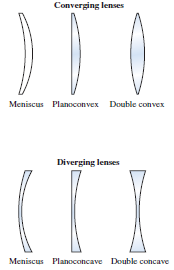 The image and the mutual position of a thin lens is defined by three distances:
- F - lens focus' length;
- d - subject's distance to the center of the lens;
- f - image distance to the lens' center.
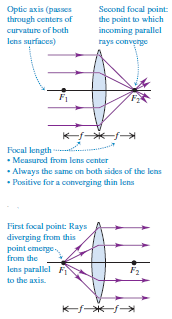

Object– image relationship formula for thin lenses: 1/F=1/d+1/fThe resulting image is characterized by three characteristics:
- image is an virtual or real,
- the image is enlarged, reduced or the same size,
- image is inverted or direct.

Task
At the end of this lesson students should:
- know lens' types and properties;
- be able to portray an image formation with spherical lenses;
- be able to solve tasks about image formation.
Process
Complete the tasks about the topic!
Exercise 2
Between the subject and the screen a corvex lens is placed and real image is acquired on the screen. The distance to the corvex lens is 9,4 cm and the distance from the lens to the screen is 53,7 cm.
a) How big is the lens' linear magnification?
b) How big is the image if the subject is 7 cm?
Exercise 3
Student placed a light bulb 52 cm away from the corvex lens and tried to get a clear light bulb image on the screen. Focus is 14 cm away.
a) How far away from the lens did the image form?
b) Describe the image!
Exercise 4
Corvex lens' focus is 13 cm. An object is placed 88 cm before the lens.
Describe the image!
Evaluation
This lesson will be evaluated with i/ni
Conclusion
In this lesson students:
- learnt about the spherical lens types and theory;
- learnt about the values and formulas that are associated with image creation using spherical lenses;
- solved tasks about spherical lenses.
Credits
Webquest created by Jana Kassaliete, REGS 12.a
pa.msu.edu
khanacademy.org
„University Physics, 13th Edition” H. D. Young (2012)
uzdevumi.lv
Teacher Page
Answers
Exercise 2
a) 5,71 times
b) 40 cm
Exercise 3
a) 19,2 cm
b) The image is real, inverted and reduced
Exercise 4
The image is real, inverted and enlarged