
Introduction
In class 12 Physics lessons students have to learn about light (or as it is often called, optics) and the basics of this topic. This includes the reflection and the refraction of light, as well as total internal reflection.
It is absolutely necessary to understand the basics of this this topic in order to understand topics like diffraction, dispersion, mirrors and others.
Task
Reading the information below is not necessary, however it does help understand the topic better.
To understand what reflection of light is we can look at this example. 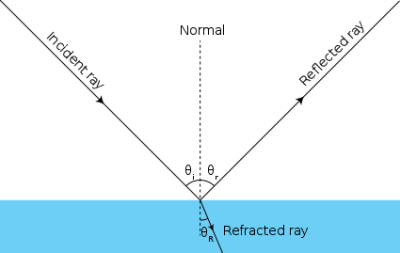
The incident ray is the beam of light that initially strikes the mirror and the reflected ray is the beam of light that bounces off the mirror after striking the mirror. The angle of incidence is the angle that the incident ray makes with the normal and the angle of reflection, or reflected angle, is the angle that the reflected ray makes with the normal. The equation for the law of reflection is given by the following formula:

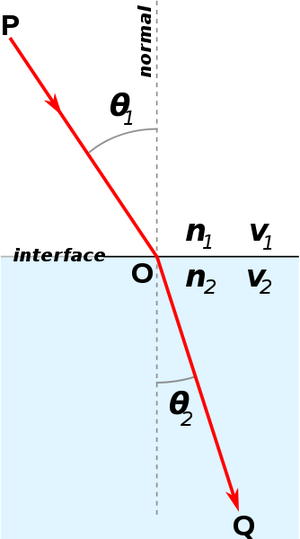
Refraction is the bending of a wave when it enters a medium where its speed is different. The rule which describes this change in direction is known as Snell's Law.
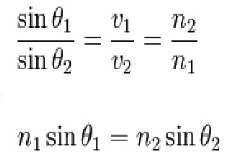
For total internal reflection to occur the light must travel from a dense medium to a less dense medium (e.g. glass to air or water to air).
In this picture you can see how the angle of the reflected ray changes when the angle of the incident ray changes too. As the angle of incidence increases so does the angle of refraction.
When the angle of incidence reaches a value known as the critical angle the refracted rays travel along the surface of the medium or in other words are refracted to an angle of 90°.
When the angle of incidence of the light ray is greater than the critical angle then no refraction takes place. Instead, all the light is reflected back into the denser material. This is called total internal reflection.

The task is to watch these videos!
To understand how reflection and refraction work you should watch the video below:
[video:https://www.youtube.com/watch?v=y55tzg_jW9I align:center]
To understand how total internal reflection works you should watch the video below:
[video:https://www.youtube.com/watch?v=WRuatAcd2WY align:center]
Process
After reading all the information and watching the videos in the previous page you should be able to answer these questions:
1.What occurs when the light bounces off an object?
2.What occurs when the light is bent?
3.If the incident angle is 30 degrees, what is the reflected angle?
4.Where does the light travel the fastest?
5.What does n stand for?
6.What is the formula of Snell's law?
7.Where do the reflected rays travel when the angle of incidence reaches its critical angle?
8.What happens when the incidence angle is greater than the critical angle?
9.Is it necessary for the light to travel from a dense medium to a less dense medium for total internal reflection to occur?
10.What is the speed of light in the vacuum?
Evaluation
Answers:
1.reflection
2.refraction
3.30 degrees
4.vacuum
5.the index of refraction
6.n1sinθ1=n2sinθ2
7.along the surface of the medium (or are reflected to an angle of 90 degrees)
8.total internal reflection
9.yes
10.300'000'000 m/s (or 300'000 km/s)
Conclusion
If you attentively watched the tutorials and answered most of the questions correctly, congratulations, you now know the basics of optics and you can continue learning more about this topic by using khanacademy, reading different textbooks and other materials.
Credits
The materials were taken from khanacademy.org which is a site used to help students understand subjects in a simpler and easier way.