
Introduction
Questions to consider:
- What is an irregular noun?
- How can we identify an irregular noun?
- How can we make singular irregular noun into its plural form?
- What is the main difference between irregular noun from regular?
Irregular noun
It does not follow a pattern compared to an irregullar noun.
While most nouns are easily made plural with a few simple changes, such as adding an “s” or “es” to the end of the word, there is one group of nouns that doesn’t seem to follow the rules. They’re called irregular nouns and you guessed it…they don’t become plural the “regular” way.
No worries, though. Here’s all the information you need to recognize and form irregular plural nouns.
This list of English examples will prove useful when learning about different parts of speech:
| When Irregular Nouns become Plural | |||
| Singular | Plural | Singular | Plural |
| analysis | analyses | appendix | appendices |
| bison | bison | cactus | cacti |
| calf | calves | child | children |
| elf | elves | foot | feet |
| goose | geese | knife | knives |
| leaf | leaves | life | lives |
| loaf | loaves | man | men |
| mouse | mice | person | people |
| scissors | scissors | tooth | teeth |
| Singular | Plural | Singular | Plural |
Task
- The teacher will let the students determine the lesson for the day through the first activity which is the “guessing game”.
- The students are asked to recall about noun for a brief discussion before introducing the lesson for the day.
- The students are asked to give examples of an irregular noun and to use it in a sentence.
- Then, the students have to participate during the question-answer exercise involving the distinction between irregular and regular noun.
- After the discussion, the students are asked to compose one paragraph with maximum of five (5) and minimum of three (3)irregular noun.
- For the last activity, the students must engage themselves in a fun way of evaluation whether they have learned something from the discussion through giving sentences using an irregular noun.
Learning Objectives:
- identify irregular nouns
- distinguish irregular nouns from regular
- create sentences using an irregular noun
Process
The teacher asked the students to open the link the day before the proper discussion.
A. Preparatory Activity
The preparatory activity of the teacher is a "guessing game" that focuses on the students capability on recognizing words through acting it. The class will be divided into two(2) and must select one representative to act or demonstrate what is written on the paper that are placed in the box. The task of each group is to identify what are those words. The group that will finish the task\activity first will be declared as the winner and will eventually received an immediate gratification which is additional 20 points for the day. In connection, the activity will serve as a hint for the discussion because those words are all irregular nouns.
B. Discussion
- The teacher will asked the students about the activity. They are obliged to indulge themselves during the class discussion. If students were not able to provide the correct answer then, the teacher would tell the class about what they did including the topic which is irregular nouns.
- Afterwards, the teacher will start the proper discussion.
What is a noun?
(The teacher will briefly discuss what is noun through asking the students first.)
Of all the parts of speech, nouns are perhaps the most important. A noun is a word that identifies a person, animal, place, thing, or idea. Here, we’ll take a closer look at what makes a noun a noun, and we’ll provide some noun examples, along with some advice for using nouns in your sentences.
A noun is a part of speech that denotes a person, animal, place, thing, or idea. The English word noun has its roots in the Latin word nomen, which means “name.” Every language has words that are nouns. As you read the following explanations, think about some words that might fit into each category.
- Person – A term for a person, whether proper name, gender, title, or class, is a noun.
- Animal – A term for an animal, whether proper name, species, gender, or class is a noun.
- Place – A term for a place, whether proper name, physical location, or general locale is a noun.
- Thing – A term for a thing, whether it exists now, will exist, or existed in the past is a noun.
- Idea – A term for an idea, be it a real, workable idea or a fantasy that might never come to fruition is a noun.
(The teacher will then proceed to the main topic.)
What are Irregular nouns?
Words in English are either Regular and Irregular.
Regular means that when they change their form (for example, when they become plural) they follow the usual pattern. Irregular means, as you might expect, that they do not follow the usual pattern of most words.
Fortunately most words in English are regular, but a significant number of everyday words are not.

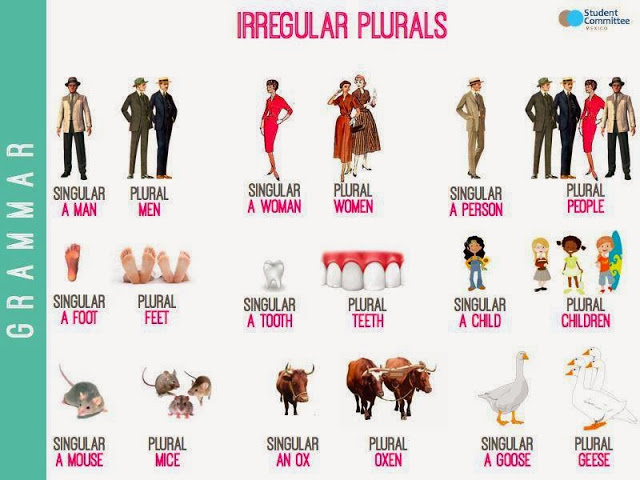
Irregular Plurals:
-
Certain words do not follow the above rules for regular plurals. There are some common types of irregular plurals that occur, and some words simply have no plural form at all.
While it is useful to memorize the common irregular plurals, for many words you simply have to know and understand that it is an irregular plural as a result of speaking and hearing English.
- Irregular nouns made plural by changing vowels, changing the word, or adding a different ending:More than one man = men More than one person = people More than one mouse = mice
1.More than one man=men
2. More than one foot = feet
3.More than one goose = geese
4.More than one tooth = teeth
5.More than one louse = lice
6.More than one cactus = cacti
7.More than one appendix = appendices
8.More than one ox =oxe
- Some irregular plural nouns have the same spelling as their singular form such as scissors, pants, bison, deer, and sheep.And then some animal nouns become plural by keeping the same spelling as the singular form or by adding an s or es.
- More than one cod = cod or cods
- More than one shrimp = shrimp or shrimps
- More than one fish = fish or fishes
- More than one quail = quail or quails
Contrasting irregular nouns from regular:

-
The majority of English nouns are regular which means they follow this simple rule. However, some nouns in English are irregular and make their plural in a different way:
child > children
man > men
sheep > sheep
Most words in English follow a simple regular pattern. For example, look at these nouns:
1 car
1 dog
1 hat
If we want to talk about more than one of each we simply add an -s to the end to make them plural (i.e. there’s more than one):
2 cars
2 dogs
2 hats
Evaluation
|
CRITERIA |
1 |
2 |
3 |
4 |
5 |
TOTAL |
|
Clarity of thoughts |
|
|
|
|
|
|
|
Grammar |
|
|
|
|
|
|
|
Usage of irregular noun(appropriateness) |
|
|
|
|
|
|
|
Mechanics( spelling, punctuation) |
|
|
|
|
|
|
Five (5) being the highest; One (1) being the lowest.
Conclusion
Although most nouns have plurals formed according to regular rules , some nouns have unusual, or irregular plurals. An irregular noun don't have any rule or pattern unlike regular nouns. In addition, when an irregular plural noun changes completely like: man- men, woman- women, ox-oxen and etc. It needs to be memorized by the students.
Credits
Teacher Page
Personal Background:
Name: Labatian, Angel Mae D.
Date of birth: October 24, 1998
Place of birth: Zone 2, Mapulog, Naawan, Misamis, Oriental
Age: 18
Gender: Female
Mother: Labatian, Mamierta Dalumos
Elementary :
Naawan Central School
Secondary :
Naawan National High School
Tertiary:
Mindanao State University at Naawan
Personality: Superior, open-minded, flexible, seldom impatient and often lazy
Facebook Account:
Angel Mae D. Labatian