
Introduction
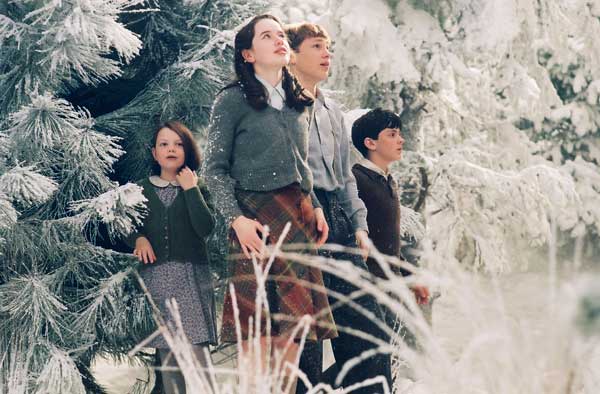
Imagine that you are able to travel in time. You have been transported to London, England during World War II. Can you imagine what your life would be like as a child in London during World War II? Now, imagine that you are a character in the book The Lion, the Witch, and the Wardrobe.
The four main characters, Peter, Susan, Edmund, and Lucy Pevensie were sent away from their parents in London to live in an old country house with the professor during World War II. They soon discover the land of Narnia where the White Witch has made it always winter and never Christmas. The Pevensie children will go on an adventure to battle the White Witch and restore all that is good to Narnia.

Have you ever wondered where authors get their ideas for their books? Are there any connections between the life of the author of The Lion, the Witch, and the Wardrobe, C.S. Lewis, and life in London, England during World War II?
Task
To complete this WebQuest, you will choose one of the following research tasks.
TASK 1
Imagine that you are living in London, England, during World War II. Write a diary or journal describing what your life was like, what your experiences were, and what your thoughts and feelings would have been during that time. Your diary must include at least three entries. Each entry must contain at least five complete sentences. Be sure to date each entry with a period-appropriate date!
Use the links provided in the Process section of this WebQuest to conduct your research.

TASK 2
You will write a biography about C.S. Lewis. Use a 4-Square to organize your writing. Your biography will contain 5 paragraphs: an introduction, 3 body paragraphs, and a conclusion. You may wish to organize the body of your biography by discussing C.S. Lewis' early, middle, and late life. In your biography, you must also explain how the author's personal life is reflected in his novels.
Your final draft of your biography must be typed using a size 12-14 font.
Use the links provided in the Process section of this WebQuest to conduct your research.
Process
TASK 1
- Please click on Children and World War II to begin Task 1.
- As you read, take notes about the children and why they were evacuated.
- After reading, click on Images of London during WWII.
- As you look at the images, imagine yourself in London and write down notes of what you observe.
- Next, click on Food Rationing During WWII.
- Write down information about yourself and your family members (names, ages, etc.). How would food rationing have affected your family? How would you feel about certain foods and items being rationed?
- Watch the videos World War II London Blitz Video and Evacuation of Children.
- As you watch the videos, try to imagine what life would have been like during this time. What would you be thinking and feeling? Write down your thoughts. Why were children evacuated?
- Use your notes from your research to create a diary/journal (with at least 3 entries) describing what your life was like, what your experiences were, and what your thoughts and feelings would have been if you had been a child living during World War II.
You may research the following sites to add more details to your journal:
- Children in the Second World War
- How Children's Lives Changed in the Second World War
- Children's Experiences During World War Two
- Evacuation of Children During World War Two
TASK 2
Use the links below to guide your research of C.S. Lewis. Please take notes from any links you use. You may use additional websites if you choose.
Consider the following questions as you gather information:
- Why was C.S. Lewis special or interesting?
- What kind of effect did his own life have on his writing and stories?
- What adjectives would you use to describe C.S. Lewis?
- What examples from his life illustrate qualities in his novel The Lion, the Witch, and the Wardrobe?
- What events shaped or changed his life?
- What obstacles did he overcome?
Evaluation
Rubric for Task #1: Diary/Journal Entries
|
CATEGORY |
4 |
3 |
2 |
1 |
|
Creativity |
The entries contain many creative details and/or descriptions that contribute to the piece. |
The entries contain some creative details and/or descriptions that contribute to the piece. |
The entries contain a few creative details and/or descriptions, but they distract from the story. |
There is little evidence of creativity in the entries. |
|
Accuracy of Facts |
All facts presented in the entries are accurate. |
Almost all facts presented in the entries are accurate. |
Most facts presented in the entries are accurate. |
There are several factual errors in the entries. |
|
Requirements |
The diary contains at least three entries, and each entry contains five sentences. |
The diary contains at least three entries, but some entries do not have five sentences. |
The diary contains fewer than three entries, or the entries are too brief. |
Many requirements were not met. |
|
Spelling and Punctuation |
There are no spelling or punctuation errors in the final draft. The setting and names that the author used are spelled consistently throughout. |
There are 2-3 spelling or punctuation errors in the final draft. |
There are 4-5 spelling and punctuation errors in the final draft. |
The final draft has more than 5 spelling and punctuation errors. |
|
Neatness |
The final draft of the entries is readable, clean, neat and attractive. It is free of erasures and crossed-out words. It looks like the author took great pride in it. |
The final draft of the entries is readable, neat and attractive. It may have one or two erasures, but they are not distracting. It looks like the author took some pride in it. |
The final draft of the entries is readable and some of the pages are attractive. It looks like parts of it might have been done in a hurry. |
The final draft is not neat or attractive. It looks like the student just wanted to get it done and didn't care what it looked like. |
Rubric for Task #2: Research Report: C.S. Lewis Biography
|
CATEGORY |
4 |
3 |
2 |
1 |
|
Organization |
Information is very organized and flows in a clear, logical manner. The essay includes an introduction, 3 body paragraphs, and a conclusion. |
Information is organized with an introduction, 3 body paragraphs, and a conclusion. |
Information is somewhat organized, and the essay is missing a required component. |
The information is disorganized, and the essay is missing one or more components. |
|
Quality of Information |
Information clearly relates to the main topic. The essay includes many supporting details. |
Information clearly relates to the main topic. The essay includes some supporting details. |
Information clearly relates to the main topic. No details and/or examples are given. |
Information has little or nothing to do with the main topic. |
|
Internet Use |
Successfully uses suggested Internet links to find information and navigates within these sites easily without assistance |
Usually able to use suggested Internet links to find information and navigates within these sites easily without assistance |
Occasionally able to use suggested Internet links to find information and navigates within these sites easily without assistance |
Needs assistance or supervision to use suggested Internet links and/or to navigate within these sites |
|
Mechanics |
No grammatical, spelling, or punctuation errors. | Almost no grammatical, spelling, or punctuation errors. | A few grammatical, spelling, or punctuation errors. | Many grammatical, spelling, or punctuation errors. |
|
Neatness |
The final draft of the entries is readable, clean, neat and attractive. It is free of erasures and crossed-out words. It looks like the author took great pride in it. |
The final draft of the entries is readable, neat and attractive. It may have one or two erasures, but they are not distracting. It looks like the author took some pride in it. |
The final draft of the entries is readable and some of the pages are attractive. It looks like parts of it might have been done in a hurry. |
The final draft is not neat or attractive. It looks like the student just wanted to get it done and didn't care what it looked like. |
Conclusion
You have made your way back to the current year, and you have returned safely. Did you take notes while you were there? Did you see anything interesting?
What would your life have been like in London during World War II? Do you think that an author’s life influences his/her works?
Your journey does not have to end just yet.
Click on the following links to play games:
Watch videos to learn more about World War II:
Credits
Reproduced from a WebQuest written by Carmelina Buffa which no longer appears to be available online.