
Introduction
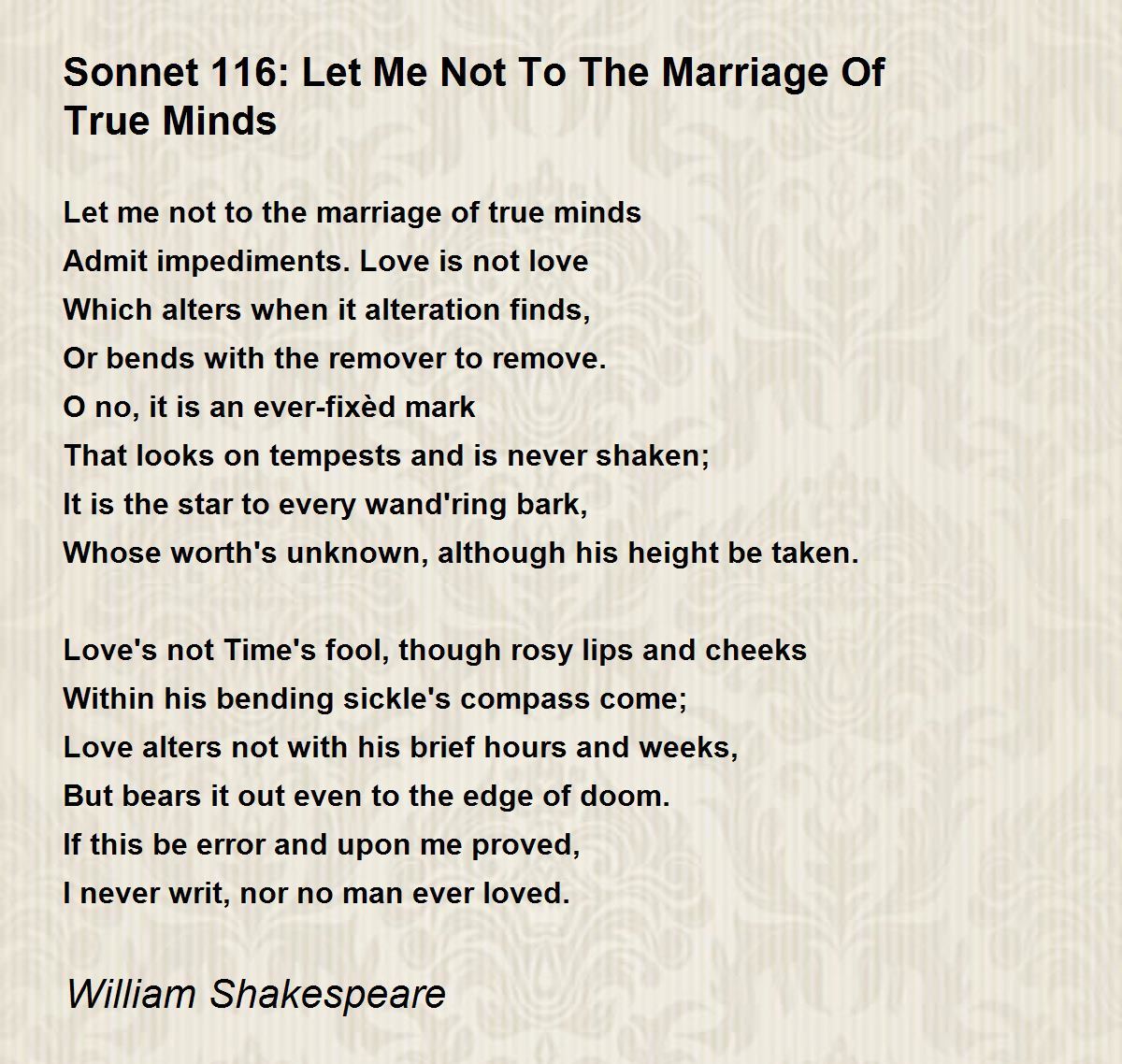
Poetry has been round for almost 4 thousand years. Like different kinds of literature, poetry is written to share ideas, specific emotions, and create imagery. Poets pick words for their that means and acoustics, arranging them to create a tempo called the meter. Some poems comprise rhyme schemes, with or extra lines that result in like-sounding words. Poetry conjures up a concentrated creative consciousness of revel in or a selected emotional reaction through language selected and organized for its meaning, sound, and rhythm.
Shakespeare wrote 154 sonnets published in his ‘quarto’ in 1609, covering themes such as the passage of time, mortality, love, beauty, infidelity, and jealousy. The first 126 of Shakespeare’s sonnets are addressed to a young man, and the last 28 addressed to a woman – a mysterious ‘dark lady’.
Task

Above is a brief example of how to analyze a sonnet.
The task is for you to analyze sonnet 116 and breakdown its structure.
You must:
- identify figures of speech. ....
- identify the Theme. ...
- Identify the Point. ...
- Identify the Imagery. ...
- Identify the Meter. ...
- Identify the Muse.
Process
You will look at the poem using the methods used in elegance. Remember to study your poem out loud, as poems are like lyrics and meant to be verbalized. This technique may even help you decipher the tone of the poem.
Analyze structure and Theme of the poem. For this, you can evaluate this poem to other Shakespearian poems if you need to reveal how these topics/symbols are commonplace in her poetry.
Explicate your poem. Paying interest to tone, symbols, images, and speaker, decipher the possible meaning of the poem. Go back and read again about figures of speech and highlight sentences you think their meaning is hidden, and decipher them to figure out their figures of speech and what they mean.
Evaluation
| marks | 1 | 2 | 3 | 4 | 5 |
|---|---|---|---|---|---|
| language use: are the figures of speech identified and explained | |||||
| theme: did the learner understand theme of the sonnet | |||||
| imaginary: was the learner able to create an imagination of the sonnet | |||||
| point: did the learner know what the writers message was about/ understand what the writer was saying | |||||
| Meter: are iambic pentameters shown | |||||
| Muse: what the writer is saying about his or her muse |
Conclusion
Hope this lesson will help you understand Poetry better and help you be able to decipher the language used in poetry, it can make you more interested in reading English sonnets and make you able analyze properly and able to identify figures of speech and also help you play with your imagination.
Credits
Teacher Page

This is designed for high school students grade 9-12, and instructs them on how to do poetry analysis based on William Shakespeare. The Poem can be tailored without problems to fit every other poet for similar tasks. Furthermore, it may be used for different types of analysis with barely greater variation.