
Introduction
 Are your ready to travel ALL AROUND the WORLD? Let's GO![video:https://www.youtube.com/watch?v=jpFYR8WazzI width:200 height:280 align:right]
The Great Rift Valley? Sea Floor Spreading?? The Ring of FIRE??? Danger lurks behind every boundary! You and your esteemed colleagues will investigate how plate tectonics has contributed to the evolution of the planet we call Earth. You will then determine if current protocols associated with these natural disasters are adequate. [video:http://youtu.be/ryrXAGY1dmE width:640 height:480 align:center]
Plate tectonics is the theory that the outer rigid layer of the earth (the lithosphere) is divided into a couple of dozen "plates" that move around across the earth's surface relative to each other, like slabs of ice on a lake.
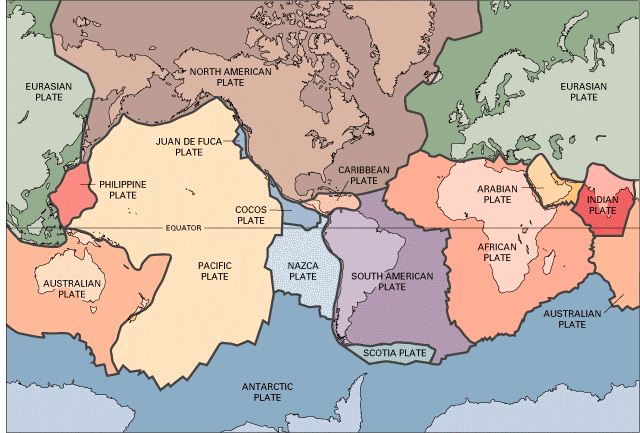
This site provides an introduction to the different types of plate boundaries, where they are located, and the destructive damage they can cause.
Click on the Task link to discover your challenge!
Task
Your first task is to assume the role of an Investigative Journalist. You and your colleagues will be investigating the WHO, WHAT, WHERE, WHEN, and HOW of plate tectonics. As you explore the various resources and DIG through the FACTS, be sure to take notes and be a thorough INVESTIGATOR! Here are some questions you should keep in mind: [video:http://www.youtube.com/watch?v=Dpn8xOJXV_A width:140 height:210 align:right]
Now let's investigate VOLACANOES AROUND THE WORLD! (Make sure your Map is handy!)

Now let's investigate Plate Tectonics Slip, Slide, & Collide
- What are the types of plate boundaries?
- What is taking place at the Mid-Atlantic Ridge?
- What kinds of Earth changes occur at each type of plate boundary?
- What features are attributed to the deformation of plate boundaries?
Once you have gathered all of this information, you and your colleagues should begin work on your detailed Boundary Plates Map.
Each finished map should contain at least six active volcanoes around the world, and the location of at least six historically significant earthquakes. After the required information is added to your map you and your colleagues should collaborate and decide which type of plate movement is occurring at each of the locations on your map.
Click on the Process link to find the instructions for this activity.
Process
Step 1: Use the following links to get additional information related to plate tectonics.
Click on each link above to visit the different websites. When you click on it a new window will appear with the information related to plate tectonics. Read the information provided and look for any links that can be helpful. There are plenty of links on each website, be careful and try explore them all but not all the information will be useful in your Quest. Be a savvy reseacher. You may copy the Project link and review these sites at home or in your "free time" in homeroom!
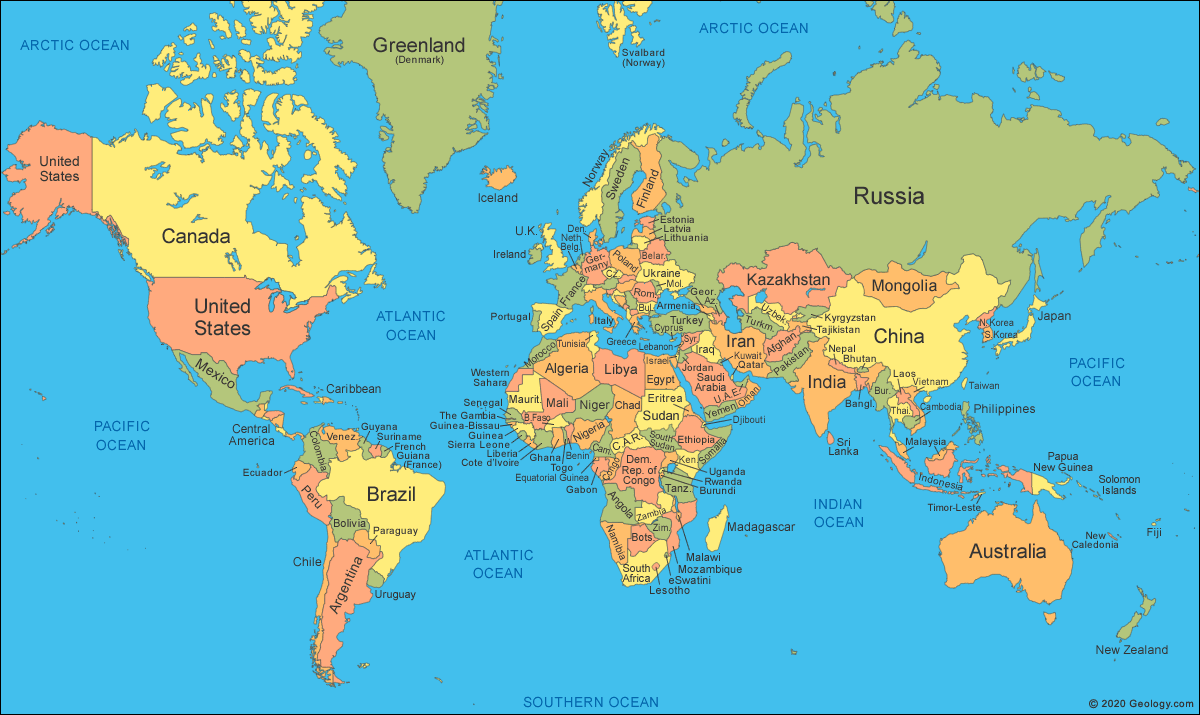
Step 2: Once you have read the information from the websites you will receive a world map identical to the one provided in this link.
The following links will provide you information on seismic activity and volcanoes locations around the world. This will help you to complete your map. Be sure to note the current population of each event.
- The Virtual Times: Recent Earthquakes and Active Volcanoes
- Geographic Region: Earth’s Active Volcanoes
Step 3: After completing your map with the six active volcanoes, the location of six significant earthquakes, and the current population at each site it is time to determine which plate and type of boundary is involved. For this you will look to the following map:
Using this map and the information provided in the previous links you will be able to determine the plate boundaries in the area of your selected volcanoes and earthquakes.
Step 4: When your map is completed, answer the following questions that will be discussed in class:
- What are the different plate boundaries near the area of your selected earthquakes and volcanoes?
- Based on the information presented, is the formation of volcanoes and the production of earthquakes related to plate tectonics? Explain your answer.


Step 5:
You and your colleagues will each complete the following Raft. Be sure to address whether current protocols associated with these natural disaters is adequate. Be sure to include rich and accurate details, concepts, and correct terms that are supported by evidence in your articles. Try to address the vocabulary terms in context.
IRIS Savage Earth Bite Size Science Volcanoes Continental Drift Blue Planet
 R: Journalist
A: Scientific Community
F: News Article/Interview (glossi.com)
T: Survival, Plate Tectonics, Types of Boundaries, Sea Floor Spreading
Step 6: Each group member will choose one of the following, being sure that content is accurate and supported by evidence:
 R: Explorer
A: Dare Devil World Travelers
F: Travel Brochure (LucidPress)
T: Choose location from Map
R: Word Smith 
A: Your Peers
F: Puzzle, Wordle, or Prezi, etc
T: Concepts and/or Vocabulary
 R: Media Mogul
A: General Public
F: Commercial or Infomercial (Wiki page)
T: Choose from Map items, Concepts, or Terms
 R: Illustrator
A: Your Peers
F: Cartoon, Animation, or Poster (goAnimate)
T: Choose from Map items, Concepts, or Terms
 R: Mac Mami/Daddy Mac
A: Your Peers
F: Rap, Poem, Lyric, or Song (Audacity)
T: Choose from Map items, Concepts, or Terms
Evaluation
[video:https://www.youtube.com/watch?v=uJCkuPCvABo width:160 height:210 align:left] This is how your work will be assessed:
|
R.A.F.T.s |
Beginning 1 |
Developing 3 |
Accomplished 5 |
Score |
|
Completeness |
Only one RAFT was completed. Most aspects of projects are missing. |
Both RAFTS were completed. Some aspects are missing or incomplete. |
Both RAFTs completed. All aspects are complete. Excellent Job! |
|
|
Content |
Most facts missing, omitted, or incorrect. |
Some facts missing or omitted. |
All facts are relevant and correct. |
|
|
C.O.P.S. |
Some errors in capitalization, organization, punctuation, and spelling. |
One or two errors in capitalization, organization, punctuation, and spelling. |
No errors in capitalization, organization, punctuation, and spelling. |
|
|
Effort |
Project is messy, disorganized, and shows little to no effort. |
Some disorganization. |
Hall Quality. “Let’s put it on the Web!” |
|
| Map | Beginning 1 |
Developing 3 |
Accomplished 5 |
Score |
|---|---|---|---|---|
| Participation | Student participated minimally in the class activity. | Student was engaged in the class activity. | Student was highly engaged in the class activity. | |
| Group work | Student minimally participated in partner discussions. | Student was involved in partner discussions. | Student was highly involved in partner discussions. | |
| Completeness | Created unfinished maps that mapped three volcanoes and three examples of earthquake activity around the world. |
Created maps that correctly and clearly mapped at least four volcanoes and four examples of earthquake activity around the world. |
Created maps that correctly and clearly mappedsix volcanoes and six examples of earthquake activity around the world. |
|
| Identification of Plate boundaries | Did not identify types of plate boundaries occurring at their mapped sites. |
Correctly identified some types of plate boundaries occurring at their most of their mapped sites. |
Correctly identified types of plate boundaries occurring at all their mapped sites. |
|
| Collaboration | Student participated minimally or not at all in class discussion. | Student engage in class discussion; shared with the entire group one or more relevant points. |
Normal false EN-US MicrosoftInternetExplorer4 Student actively engage in class discussion; shared with the entire group several relevant points. |
This is how you will assess yourself and your peers:
|
|
3 |
2 |
1 |
|
Participation |
Group member participated fully and was always completed assigned tasks on time. |
Group member participated and completed assigned tasks on time usually. |
Group member did not participate, wasted time, did not complete tasks on time. |
|
Leadership |
Group member assumed leadership in an appropriate way when necessary by helping the group stay on track, encouraging group participation, posing solutions to problems, and having a positive attitude. |
Group member sometimes assumed leadership in an appropriate way. |
Group member usually allowed others to assume leadership or often dominated the group ineffectively. |
|
Attending/ Listening |
Group member listened carefully to others’ ideas and attempted to integrate all ideas and opinions. |
Group member usually listened to others’ ideas. |
Group member did not listen to others and often interrupted them. |
|
Feedback |
Group member offered detailed, constructive feedback when appropriate, and graciously reflected on feedback given. |
Group member offered constructive feedback, but sometimes the comments were inappropriate or not useful, or member did not appropriately accept feedback. |
Group member did not offer constructive or useful feedback, and did not accept or negatively reacted to feedback from others. |
|
Interpersonal skills |
Group member treated others respectfully and related effectively to colleagues. |
Group member usually treated others respectfully and fairly. |
Group member often treated others disrespectfully or unfairly. |
|
Adaptability/ Flexibility |
Group member usually adapted effectively to the demands of a situation; was sufficiently flexible to deal with change. |
Group member usually adapted effectively to the demands of a situation; was sufficiently flexible to deal with change. |
Group member was frustrated with change and did not adapt. |
Write the proficiency level from the rubric that fits each group members’ participation in the box under the collaboration skill. Include your own name in the list for a self-assessment.
|
Group Member |
Participation |
Leadership |
Listening |
Feedback |
Interpersonal skills |
Adaptability/ Flexibility |
|
|
|
|
|
|
|
|
|
|
|
|
|
|
|
|
|
|
|
|
|
|
|
|
|
|
|
|
|
|
|
|
Individual completing form _____________________________________________
Conclusion
 Clearly you now have a better understanding of the theory of Plate Tectonics. You have interacted with the knowledge you have learned and created some innovative and imaginative pieces for your portfolio.
[video:https://www.youtube.com/watch?v=1JSs3le2irA width:200 height:280 align:right]Now, Let's CELEBRATE!!
Credits
Dynamic Earth (2014). Retrieved July 15, 2014 from Anneberg Learning WebSite: http://www.learner.org/interactives/dynamicearth/slip3.html
Earth's Active Volcanoes (2014). Retrieved July 6, 2014 from Michigan Tech University WebSite: http://www.geo.mtu.edu/volcanoes/world.html
Plate Tectonics – A Documentary. What If Productions. Isaac Frame. Web. 13 Jul. 2014. <http://www.youtube.com/watch?v=1-HwPR_4mP4/>.
Plate Tectonics (2014). Retrieved Retrieved July 6, 2014 from United States Geological Survey WebSite: http://geomaps.wr.usgs.gov/parks/pltec/
Pate Tectonics (2005). Retrieved July 6, 2014 from Wheeling Jesuit University/ NASA-supported Classroom of the Future WebSite: http://www.cotf.edu/ete/modules/msese/earthsysflr/plates1.html
Tectonic Plate Boundaries (2007). Retrieved July 6, 2014 from Science Learning Hub: http://www.sciencelearn.org.nz/var/sciencelearn/storage/images/contexts…
Virtual Times: Recent Earthquakes and Volcanoes (1997). Retrieved July 6, 2014 from The Virtual Times WebSite: http://www.hsv.com/scitech/earthsci/quake.html
World maps (2014). Retrieved July 6, 2014 from Geology and Earth Sciences WebSite: http://geology.com/world/world-map.gif
Images
http://www.geocraft.com/WVFossils/subduction.html
http://svs.gsfc.nasa.gov/vis/a000000/a000100/a000155/index.htm
http://minifigures.lego.com/en-us/Default.aspx
Teacher Page
This lesson is designed for middle school students. The roles, audiences, formats, and topics can be modified/differentiated to meet the needs of a diverse group of learners. It is appropriate for all students including ALP, EIP, ELL, Inclusion, and General Pop.
The map for the Map Activity should be printed and made available to the students.
What Is R.A.F.T.-ing?
RAFT assignments encourage students to uncover their own voices and formats for presenting their ideas about content information they are studying. Encourages student to use HOTS (Higher Order Thinks Skills); Students learn to respond to writing prompts that require them to think about various perspectives:
- Role of the Writer: Who are you as the writer? A movie star? The President? A plant?
- Audience: To whom are you writing? A senator? Yourself? A company?
- Format: In what format are you writing? A diary entry? A newspaper? A love letter?
- Topic: What are you writing about?
For more info:
http://www.greece.k12.ny.us/academics.cfm?subpage=949
http://www.readwritethink.org/professional-development/strategy-guides/…
Standards Assessed:
NGSS
NSES1 Earth and Space Science – Structure of the Earth System
The solid earth is layered with a lithosphere; hot, convecting mantle; and dense, metallic core.
NSES2 Earth and Space Science – Structure of the Earth System
Lithospheric plates on the scales of continents and oceans constantly move at rates of centimeters per year in response to movements in the mantle. Major geological events, such as earthquakes, volcanic eruptions, and mountain building, result from these plate motions.
NSES3 Earth and Space Science – Structure of the Earth System
Land forms are the result of a combination of constructive and destructive forces. Constructive forces include crustal deformation, volcanic eruption, and deposition of sediment, while destructive forces include weathering and erosion.
Georgia Performance Standards
Science
S6E5. Students will investigate the scientific view of how the earth’s surface is formed.
S6CS1 Students will explore the importance of curiosity, honesty, openness, and skepticism in science and will exhibit these traits in their own efforts to understand how the world works.
S6CS2 Students will use standard safety practices for all classroom laboratory and field investigations.
S6CS3 Students will use computation and estimation skills necessary for analyzing data and following scientific explanations.
S6CS4 Students will use tools and instruments for observing, measuring, and manipulating equipment and materials in scientific activities.
S6CS5 Students will use the ideas of system, model, change, and scale in exploring scientific and technological matters.
S6CS6 Students will communicate scientific ideas and activities clearly.
S6CS7 Students will question scientific claims and arguments effectively.
S6CS8 Students will investigate the characteristics of scientific knowledge and how it is achieved.
S6CS9 Students will investigate the features of the process of scientific inquiry.
ELA
ELACC6SL1: Follow rules for collegial discussions, set specific goals and deadlines, and define individual roles as needed.
ELACC6SL1b: Engage effectively in a range of collaborative discussions (one-on-one, in groups, and teacher-led) with diverse partners on grade 6 topics, texts, and issues, building on others’ ideas and expressing their own clearly (b) Follow rules for collegial discussions, set specific goals and deadlines, and define individual roles as needed.
ELACC6SL4: Present claims and findings, sequencing ideas logically and using pertinent descriptions, facts, and details to accentuate main ideas or themes; use appropriate eye contact, adequate volume, and clear pronunciation.
ELACC6SL5: Include multimedia components (e.g., graphics, images, music, sound) and visual displays in presentations to clarify information
ELACC6L6: Acquire and use accurately grade-appropriate general academic and domain-specific words and phrases; gather vocabulary knowledge when considering a word or phrase important to comprehension or expression
ELACC6RI3: Analyze in detail how a key individual, event, or idea is introduced, illustrated, and elaborated in a text (e.g., through examples or anecdotes).
ELACC6RI4: Determine the meaning of words and phrases as they are used in a text, including figurative, connotative, and technical meanings.
ELACC6RI7: Integrate information presented in different media or formats (e.g., visually, quantitatively) as well as in words to develop a coherent understanding of a topic or issue.
CCSS.ELA-LITERACY.W.6.1 a - e
Write arguments to support claims with clear reasons and relevant evidence.
Write informative/explanatory texts to examine a topic and convey ideas, concepts, and information through the selection, organization, and analysis of relevant content.
CCSS.ELA-LITERACY.W.6.3 a - e
Write narratives to develop real or imagined experiences or events using effective technique, relevant descriptive details, and well-structured event sequences.
Produce clear and coherent writing in which the development, organization, and style are appropriate to task, purpose, and audience.
With some guidance and support from peers and adults, develop and strengthen writing as needed by planning, revising, editing, rewriting, or trying a new approach.
Use technology, including the Internet, to produce and publish writing as well as to interact and collaborate with others; demonstrate sufficient command of keyboarding skills to type a minimum of three pages in a single sitting.
Conduct short research projects to answer a question, drawing on several sources and refocusing the inquiry when appropriate.
Gather relevant information from multiple print and digital sources; assess the credibility of each source; and quote or paraphrase the data and conclusions of others while avoiding plagiarism and providing basic bibliographic information for sources.
Draw evidence from literary or informational texts to support analysis, reflection, and research.
NETS- S
NETS-S 1 Students demonstrate creative thinking, construct knowledge, and develop innovative products and processes using technology.
NETS-S 3 Students apply digital tools to gather, evaluate, and use information.
NETS-S 4 Students use critical thinking skills to plan and conduct research, manage projects, solve problems, and make informed decisions using appropriate digital tools and resources.
NETS-S 5 Students understand human, cultural, and societal issues related to technology and practice legal and ethical behavior.
NETS-S 6 Students demonstrate a sound understanding of technology concepts, systems, and operations.