Introduction
I know the formulas for the area and circumference of a circle and use them to solve problems; give an informal derivation of the relationship between the circumference and area of a circle. (7.g.4)
I know the formulas for the volumes of cones, cylinders, and spheres and use them to solve real-world and mathematical problems. (8.g.9)
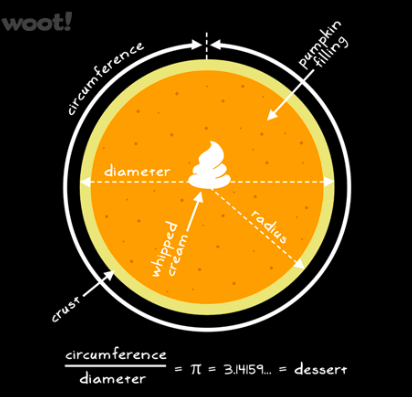
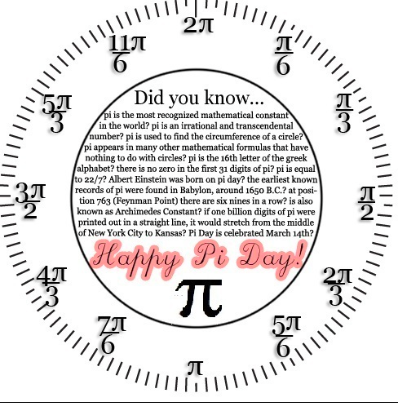
The mathematical constant , sometimes written as Pi, is approximately equal to 3.14159... Each year, Pi Day is celebrated on March 14 by math enthusiasts around the world. You have been selected to explore the meaning of Pi and to celebrate Pi Day through online activities.
Task
To prepare for these explorations, you will need to browse some lessons on circumference and area of circles. Next, you will engage in web-based inquiry to explore the meaning and history of Pi and calculations involving Pi. You will also explore the history of Pi Day and how it is celebrated. You can then celebrate Pi Day by engaging in online activities of your own choosing. Links to resources on Pi and Pi Day are provided.
Process
Process Part I: Pi and Circles
-
Watch Lesson: //voicethread.com/new/share/6630434/
For extra help go to: Circumference of a Circle & Area of a Circle
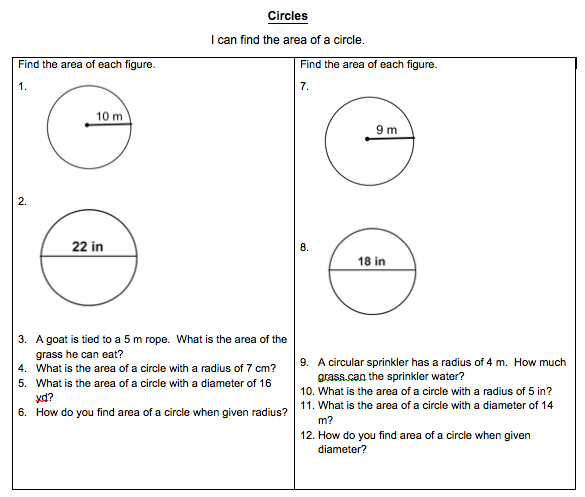
2. Complete 12 questions below.
Process Part II: Learning About the Meaning and History of Pi
Complete questions below using what you know about pi.
- What is the relationship between the symbol and the word Pi?
- Who was Pi first used by?
- The value of Pi comes from what ratio?
- How long has Pi been known?
- Why is Pi called a mathematical constant?
- Why does Pi continue infinitely?
- What is a transcendental number?
- What number did Egyptians first use for Pi?
- Why is Pi an irrational number?
- How many digits of Pi are known?
- The Greek letter used to represent Pi is an abbreviation of the Greek word meaning what?
- Which mathematicians first used the symbol ? Why?
Process Part III: Learning About Pi Day
- Why is Pi Day celebrated on March 14?
- For how many years has Pi Day been celebrated?
- March 14 is also whose birthday?
- Who tried to find the first calculation of Pi?
Links to help you answer the questions:
Process Part IV: Pi
- Find where/if your birthday (MM/DD/YYYY) appears in the digits of Pi by using the Pi-Search Page.
- Try they interactive and printable wordsearch on circles after you circle each word you MUST click "check word"
Evaluation
You will be graded on the following:
-12 area of circle questions
- Questions about the history of pi

Conclusion
EXTRA STUFF...
http://www.youtube.com/watch?v=mZ4CP0vTgEE (Very good)
https://www.youtube.com/watch?v=7zoqL2iOpvo
http://www.youtube.com/watch?v=-SUJDK1HOWg
http://www.youtube.com/watch?v=icrjzF3zl5A
(Happy Pi Day! _Paradox.by.avi)
http://www.youtube.com/watch?v=_rJdkhlWZVQ
http://www.youtube.com/watch?v=6BbEdZFfJ9U
http://www.youtube.com/watch?v=fSPSp6KdFJg
http://www.youtube.com/watch?v=MHfXB5yIXgk (History of Pi Rap)
http://www.youtube.com/watch?v=L3R84Y6SgWg (Mathematical Pi Song)
http://www.youtube.com/watch?v=OMq9he-5HUU (Song from π!)
http://www.youtube.com/watch?v=NcxeR0YQySw
(Mathematical Pi, Pi Day Project)
http://www.youtube.com/watch?v=wnSNbvH_kJ4 (Mr Smith's Pi Rap)