Introduction
Did you know that cups can have a voice? All sound consists of vibrations, from a cello's mellow tone to your own vocal cords. So, if cups have a voice, that means something has to vibrate! Let's explore!

Task
Materials you will need:
- Cups of various sizes/materials
- Sharpened pencil
- Yarn/string of various lengths
- Paper towel (wet)
- Scissors
- Q-tips or toothpicks
Procedure:
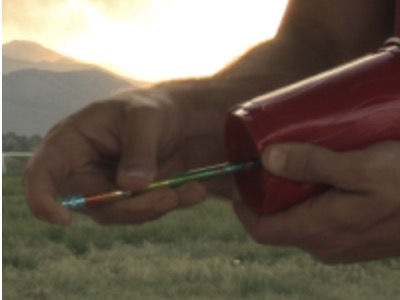
- Take your cup and poke a hole in the bottom with the sharpened pencil.
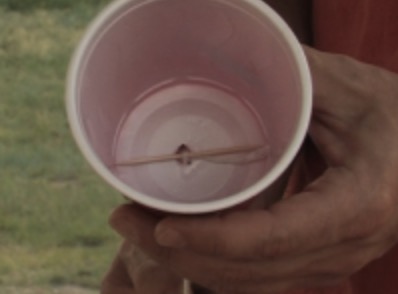
- Snap off a piece of Q-tip and make sure it fits in the bottom of the cup.
- Use the scissors to cut a length of string (12"-18") and thread it through the hole at the bottom of the cup.
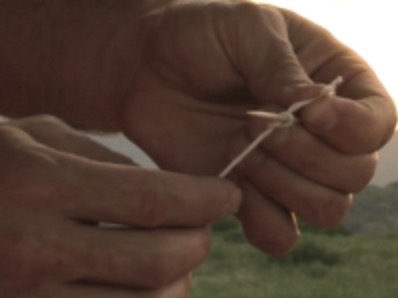
- Tie the string (the end that is inside the cup) to the Q-tip securely!
- Pull the string that is outside of the cup until the Q-tip catches on the inside of the cup. Give it a tug to make sure it is secure.
- Now you are ready to make this cup talk. But before you do, slide your finger down the length of the string. What do you notice? What is vibrating as you do this? Make a prediction about how the sound will change when you use a wet paper towel to grip the string. What do you think will change, if anything?
- Fold a paper towel into quarters and get it wet (not dripping!)
- Make your cup talk! Pinch the string with the wet paper towel, and slide it down the length of the string. Listen to your cup sing!
Move on to the next module!

Evaluation
Try some alterations. What happens when you...
- Use a different length of string?
- Use a different size of cup?
Discuss your findings with your group. Then move on to the next module.
Conclusion
How does this work?
All sound is transmitted by some kind of vibration. As your fingers slide across the string, the vibrations in the string create a sound. The wetness of the paper towel creates a type of "stickiness," increasing the stick and slide effect. The cup provides amplification for the string and also vibrates as a result of the "sticking" and "sliding." This causes the cup to sing!
If you have additional time:
1. See if you can create a rhythmic song with a few members of your group.
2. See if you can connect two cups to create a cup "telephone." Keep the string taut and try taking turns whispering and listening with a partner.
What happens if a 3rd person holds the string in the middle while you try to talk?
Could you hear your partner better using the cups and tight string than if you were speaking to each other in the same volume over the air?
In this activity, your voice vibrated the air inside of the cup, which in turn made the bottom of the cup vibrate. These vibrations were transferred to the string and then into the bottom of your partner's cup, which made the air inside of his or her cup vibrate and become detectable sound. When the string goes slack, the vibrations dissipate more easily and get lost along the way. (Landline phones work on the same idea but they transfer the sound waves into an electrical signal, which can travel even farther over wires—and the landlines don't have to be kept taut.)
Sound, such as human speech, travels in incredibly small waves—incredibly fast (about 1,126 feet per second), which is why you couldn't see it or detect a delay while it traveled across the cups and string.
Have you ever noticed how things sound different underwater? Because water's molecules are packed together more closely than those in air, sound waves move more easily—faster and farther—under water. Whales and other marine animals that use sound to communicate under water take advantage of this fact. Scientists think whales can hear each other from hundreds (and maybe even thousands) of miles away—without even a string telephone! (Information quoted directly from http://www.scientificamerican.com/article/talk-through-a-string-telepho… for this segment).