
Introduction
Imagine you are a student in a classroom on the first day of school. The teacher comes in and is ready to teach. What kind of teacher do you want? Do you want one who will lecture the entire time making a subject which may already bore you unbearable, putting you to sleep, and making you dread returning to the class? OR Do you want a teacher who puts your needs, learning strengths, and interests into use to teach you, making the subject interesting, engaging, fun, and memorable? As a future teacher what kind of teacher do you want to be?
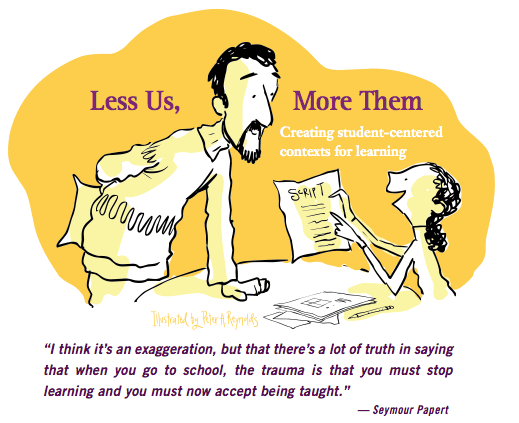
Student-Centered Differentiated Instruction is utilizing the strengths, interests, previous knowlege, and learning styles of students to create a more effective, interesting, and memorable learning experience where lifelong learning can occur.
"When educators can design learning environments well enough, students will be able to learn mostly on their own. In an environment where the educator is respected for their expertise, and appreciated for their faith in the student's abilities, they will be asked for their help, encouragement and clarification when the student needs it. In turn, the students are appreciated for their willingness to take responsibility, become involved, and do the work needed to succeed. Mutual trust and respect is created rather than confrontation. Change is inevitable and there is a bright new hope on the educational horizon (Bogdan, 2014)."\

Task
Working in groups, each student will take a topic related to differentiation and student-centered learning and will do an in-depth study of the topic. Taking the information gleamed, the groups will create a power point presentation with activities and a lecture to present to fellow students, teaching one aspect of differentiated student-centered learning.
Each student will create a lesson plan in the content area that they plan to teach and will utilize teaching strategies, methods of differentiation, plan for other issues that may arise in the classroom such as classroom management. The lesson plan must include the standards to which they are teaching, materials necessary, allotted time, assessment options/questions, assignments and activities and why assigned.
Process
Students will pick a topic from the list of given topics.
Students will then pick a group and brainstorm their topics.
Using the KWL Chart students will begin to take notes and consider prior knowledge before researching their topic.
(This is the link for the chart- www.teach-nology.com/worksheets/graphic/kwl )
Students will work together in their groups to research their topics using the references provided in this webquest and further research of their own.
Students will create a power point presentation of their information and discuss the implications of their topic on differentiated instruction.
Together the groups will present a 10 minute lecture with mini activities to enhance learning to the other groups in the class.
The presentations will be peer-reviewed and will also be graded upon the rubric criteria presented in the webquest.
For the assignment, students will create a lesson plan utilizing all of the information covered in tis unit and the lesson planning unit previously covered.
Evaluation
The lecture and powerpoint will be peer reviewed.
|
Exemplary 4 |
Accomplished 3 |
Developing 2 |
Beginner 1 |
Score |
|
|---|---|---|---|---|---|
|
Differentiation
|
Includes methods, reasons for, examples of, and difficulties and benefits of | Includes the definition, examples, and methods | Includes the definition but no real examples or any other information | Does not address any of the categories previously outlined | |
|
Power Point Presentation |
WOrked as a group, had the correct length of speech, clearly showed teamwork and effort, had the correct number of slides in the powerpoint. | Power point was completed but was not in great detail. There was groupwork but not fully as a team. The lecture was under 7 minutes. | The lecture was 3 minutes or under. The powerpoint did not have enough slides. | Tey did not work together. there was a lot of detail left out of the information. The lecture part showed students were not in agreement about the subject. | Lacking powere point, lotion, etc. |
|
Lesson Plan |
The lesson plan has all of the necessary content, is well written, and shows understanding of classroom management as well as student-centered teaching with differentiation with examples of activities to be done by students. | The lesson plans includes over 3 components of differentiation and student-centered teaching, some good examples of activities but does nto fully utilize differentiation methods and/or has soome components of lesson planning missing. | The lesson plan does not go into details on handling issues outside of content, does not have differentiation, and is not fully written. | The lesson plan lacks all differentiation but does have some of the components of the lesson planning. | No differentiation. major writing errors. Very few components of lesson planning from previous unit included. |
|
|
Conclusion
Differentiation and student-centered learning are two ways of ensuring student success. The methods outlined in the power point and the information shared will assist in future lesson planning.
In order to differentiate instruction teachers mustlook at the learning styles, types of teaching strategies, and the needs of their students in order to ensure success.
There are many strategies that can be used in planning lessons with differentiation and for using and creating a student-centered classroom.
Credits
Comic on Teacher's Page. (2014). Retrieved from: http://www.justintarte.com/2013/11/5-ways-to-make-your-classroom-more.h…)
Introductory Comic. (2014).
Moore, Kenneth D. (2012). Effective Instructional Strategies: From Theory to Practice: 2nd edition. Sage Publications. Los ANgeles. (50-83)
National Association of Secondary School Principals. (2005). Creating a culture of literacy: A guide for middle and high school principals. Reston, VA.
Pritchard, ALan. (2009). Ways of Learning: LEarnning Theories and Styles in the Cllassroom." (57-110).
Rosenshine, B., Meister, C., & Chapman, S., (1996). Teaching students to generate questions: A review of the intervention studies. Review of Educational Research, 66(2), 181–221.
Sousa & Tomlinson. (2005). Differentiation and the Brain. Solution Tree Press.
Teacher Vs. Student Centered Learnign Chart. (2014). Retrieved from: http://silkweb.com/sst/The%20University%20Experience/screen2.html
Teacher Page
(Retrieved from: http://www.justintarte.com/2013/11/5-ways-to-make-your-classroom-more.h…)
Student-centered differentiated lesson plans are plans that take into account their prior knowledge, learner styles, interests, and needs into account while in the planning process. In student-centered learning the teacher is less of a focus and the student becomes more of a part of their education. They are made responsible and accountable for their own education which empowers the student.

Retrieved from: http://silkweb.com/sst/The%20University%20Experience/screen2.html
According to Kenneth D. Moore, "teachers can differentiate at least four classroom elements based on students' readiness, interest, or learning profile...These four parts are the content, process, products, and learning environment (2012, p 50)." The content is the subject matter itself, process is materials and methods, products are what the learner is to be doing by the end of the lesson, and the environment is the setting of the room whether it be group settings, classroom management, the actual setup of the desks in the room, etc.

One way for teachers to ensure differentiation is the use of learning styles. A simplified definition of a learning style is the way in which a student performs well and is comfortable using in the learning Process. Efficient uses of learning style include classroom environment, use of graphic organizers, study methods, teaching methods, activities in the classroom, assessment techniques, and the physiological, psychological, and social needs of the student.
There are many websites to go to to take learning styles inventories and learn about how to utilize learnign styles.
The activity included in this webquest has many types of instructional stategies. Students are encouraged to use creative thinking to help create interest and make learning more enjoyable as well as assessing other skill strengths and weaknesses. Students also use demonstration to help show their current knowledge and to help strengthen social learning skills. Socratic method vias speaking. Students are asked to compare the strategies of demonstation and critical thinking which is also called concept attainment. The group activity is called cooperative learning and graphic organizers are used to keep track of information and to assist in hands on learning.
The teaching methods not only help socialization skills but also prepare them to teach future generations with their own creation of a lesson which helps teast/ assess their skills with lesson planning and utilizes reinforcing previous learning.