
Introduction


Did you know the earth is kind of like a great big puzzle?! It actually used to look completely different than it does now!
This is how the earth looks today:

But this is how it used to look:

Do you see the difference?
❌ Photo unavailable
A long, long time ago (more than 200 million years ago!) there weren’t seven continents like there are now, instead, there was just one. It was a SUPER continent!!
This continent was called Pangaea (Pan-Jee-Uh).
It was believed that over time, through a process called Continental Drift, (get it? because the continents drifted!  ), that all continents were once joined together in the SUPER continent Pangaea before breaking up and drifting to their current positions on earth.

Check this out! That's a lot of shifting going on!

The theory of Continental Drift was thought up by this really smart geophysicist and meteorologist named Alfred Wegener. That's him down there. 

Wegener came up with this theory to explain how the same animal and plant fossils were found across huuuuuuuge oceans on different continents. Kinda made sense! But there were still a couple of things from his theory that didn't quite make sense just yet.

Turns out, Wegener was onto something REALLY BIG after all! With the help of other scientists decades later, a new theory combining Wegeners accepted theories and the scientists' new theories, was born.
We will now introduce you to…. Drumroll, please!
Plate Tectonics!
This theory says that Earth's outer layer is made up of large, moving pieces called plates. All of Earth's land and water sit on these plates. The plates are made of solid rock. Under the plates is a weaker layer of partially melted rock. The plates are constantly moving over this weaker layer.
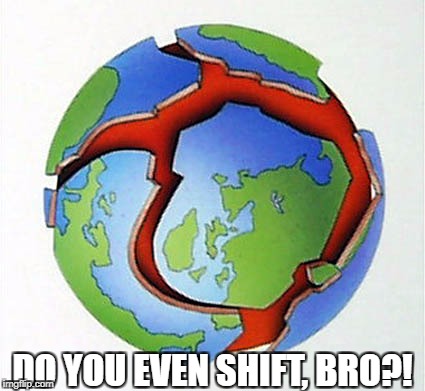
In the following WebQuest, you will learn some really cool stuff about Plate Tectonics!
Get ready to divide, slide, and collide!!
Task

By the end of this Web Quest you should have a basic understanding of what plate tectonics are and how they affect the world!

- Compare and describe each of these layer's of earth: Core, mantel, and crust.
- Explain and understand the theory of Plate Tectonics.
- Describe the three types of tectonic plates and how the process lead to changes of the earth's surface features.
Within this WebQuest, you will be asked to participate in a short video and group project. These tools are to help introduce the concept of plate tectonics and to fully understand how the process begins and what results comes from collision of these SUPER plates.
Below you will find a picture of the end result from the group project. This project is a fun way of learning how tectonic plates interact and develop into the Earth surface that we know today.
Good Luck and get ready to COLLIDE into some fun!

Process
Task 1: Divide the layers of the Earth.
1. Break up into groups of 3.
2. Review the diagram below.
3. Within your group, discuss the layers of the earth and describe their characteristics. Which one is your favorite?

Now that you have discussed the layers, let's review the theory of the plate tectonics and how this journey begins.
Task 2: Slide into Plate Tectonics theory.
1. Watch this short video on plate tectonics, the video is attached below.
2: After watching the video, visit the website below to understand the 3 different types of Tectonic plate boundaries and how they move.
Last but not least! Let's finish up with a group project. This is an interactive group project that will allow you to see changes in the earth's surface due to the interactions of plate boundaries.
Task 3: Collide with a Group Project
Materials you will need:
* Box
* cutting instrument
* blue paper
* cardboard strips
* tape or glue
* writing material
* instructions
1. Students should divide into groups of 3.
2. Once into groups, prepare the boxes for the project. Below is an image of how your box should be cut.
3. After your box is completed, follow the instructions below to finish your project!
http://westernreservepublicmedia.org/antarcti/platesht.htm
4. Once completed, within the group explore the different ways that plate tectonics can collide.
5. During the activity, describe and discuss how these plate boundaries affect the surface of the earth.
Evaluation
Assesment:
Answer the following questions either in a group or individually.
1. How many continents are there now?
2. How many continents were there before?
3. What was the name of the supercontinent?
4. What kind of puzzle is used to describe earth?
5. What are the large, moving plates of the earth called?
6. Name the layers of the earth?
7. Which layer of the earth do we live on?
8. In which way do the tectonic plates cause earthquakes?
9. In which way do the tectonic plates create mountains?
10. Name the three main types of plate boundaries.
Evaluation:
|
CATEGORY |
20 points |
15 points |
10 points |
5 points |
|
Overall Participation |
Used time well in the lab and focused attention on the WebQuest. |
Used time pretty well. Stayed focused on the WebQuest most of the time. |
Did the WebQuest but did not appear very interested. Focus was lost on several occasions. |
Participation in the WebQuest was minimal OR student was hostile about participating. |
|
Assessment & Follow-Up |
Student possesses a thorough understanding of the lesson. |
Student possesses a good understanding of the lesson. |
Student possesses an okay understanding of the lesson. |
Student did not possess an understanding of the lesson. |
|
Task 1: Layers of Earth |
Illustrates an accurate and thorough understanding of scientific concepts described in the diagram. |
Illustrates an accurate understanding of most scientific concepts described in the diagram. |
Illustrates a limited understanding of scientific concepts described in the diagram. |
Illustrates an inaccurate understanding of scientific concepts described in the diagram. |
|
Task 2: Video |
Illustrates an accurate and thorough understanding of scientific concepts described in the video. |
Illustrates an accurate understanding of most scientific concepts described in the video. |
Illustrates a limited understanding of scientific concepts described in the video. |
Illustrates an inaccurate understanding of scientific concepts described in the video. |
|
Task 3: Group Project |
Clear, accurate diagrams are included and make the experiment easier to understand. The project is labeled neatly and accurately. |
Diagrams are included and are labeled neatly and accurately. |
Diagrams are included and are labeled. |
Needed diagrams are missing OR are missing important labels. |
TOTAL: __________
Conclusion
Congratulations!
You've completed the Plate Tectonics WebQuest!

In conclusion, you should be able to:
- Compare and describe each of these layer's of the earth: Core, mantle, and crust.
- Explain and understand the theory of Plate Tectonics.
- Describe the three types of tectonic plates and how the process leads to changes in the earth's surface features.
You now have a great grasp of how Plate Tectonics work and how they affect the geography of our earth! Understanding the important topics covered in this WebQuest will lead you on the path to becoming a magnificent geologist!!

To learn even more about Plate Tectonics, check out these super fun sites!
https://www.learner.org/interactives/dynamicearth/plate2.html
https://www.brainpop.com/science/earthsystem/platetectonics/
https://kids.britannica.com/kids/article/plate-tectonics/346101/251364-toc