
Introduction
The violence and horror of isolation soon yielded to an even more pervasive companion. As the sharks that trailed the slave ship well knew, death was a universal presence aboard the slave ship. Its ubiquity was matched only by its variety, as men and women sickened from disease, dehydration, and the ever-present effects of the rolling yaw of the ship. Many died. The damp, dank, crowded holds spawned endless varieties of deadly afflictions. Children, whose mortality exceeded that of adults, fared particularly poorly. Although mortality rates of those crossing the Atlantic improved over time, on average more than one in seven Africans who boarded a slave ship did not leave alive. The count was generally higher among men than women and higher still among children of both sexes. Slave ships left a trail of dead bodies across the Atlantic.
Task
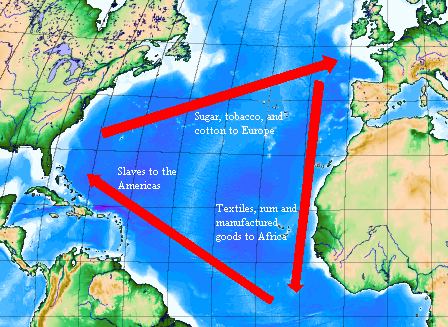
Station 1: Triangle Trade and Economic Systems

|
Mercantilism |
Both |
Capitalism |
|
Country 1st Nation’s strength depended on wealth (gold) Colonies source of raw materials Favorable balance of trade Increase exports Decrease imports Tariffs |
Benefited from establishment of colonies |
Individual 1st Private individual seeking profit Merchants amassed great wealth Joint-stock companies (British and Dutch East India Companies) |
Station 2: Map Analysis


Station 3: Roots of Slavery
The Roots of Slavery
The term slave has its origins in the word slav. The slavs, who inhabited a large part of Eastern Europe, were taken as slaves by the Muslims of Spain during the ninth century AD.
Slavery can broadly be described as the ownership, buying and selling of human beings for the purpose of forced and unpaid labor. It is an ancient practice, mentioned in both the Bible and the Koran.
As for those of your slaves which wish to buy their liberty, free them if you find in them any promise and bestow on them a part of the riches which God has given you.
-- Koran, Chapter 24, Verse 32.
Knowing that whatsoever good thing any man doeth, the same shall he receive of the Lord, whether he be bond or free.
-- Old Testament, Ephesians 6, Chapter 6, Verse 8.
Indeed, the main religious texts of Judaism, Islam and Christianity all recognize slaves as a separate class of people in society. Going back further in time the Mayans and Aztecs kept slaves in the Americas, as did the Sumerians and Babylonians in the Near East. The Egyptians employed huge numbers of slaves, including the Jews, Europeans and Ethiopians.
In ancient times a slave in North Africa, Greece or Rome, or in Arab countries, could rise to a position of public prominence. Women might marry into the ruling class.
No slaves married their masters or mistresses in the Americas, although there were secret relationships, usually forced upon the slave. Whether badly or well treated, slaves were, in American society at large, marked out and despised for the color of their skin, and so were their descendants.
Station 4:Slave Owners and Castles