
Introduction
Created by Ms. Mary Lenore Lane
**Note: This lesson is designed to be completed with the help of parent volunteers and classroom aides.**
Good morning, Little Scientists!
You may have noticed a special new addition to our classroom this morning. That mysterious thing in the jar on the science table is called a chrysalis.
But what is a chrysalis?
We are going to do a webquest to discover what a chrysalis is, what it looked like before it came to our classroom, and what it will soon become!
 Grab your butterfly nets, because our webquest begins now!
(Click on the word Task in the bottom right corner)
Task
We are at the first step of our journey towards learning about the life cycle of a butterfly!
That's right! Very soon, our chrysalis will become a beautiful BUTTERFLY!
Before our classroom butterfly emerges from the chrysalis, we need to learn about how it grew and changed to become what we see today and the changes that will soon happen. We also need to learn what needs to be done to keep it alive and happy until we can release it into the wild!
STEP ONE
Working in groups of four, your task will be to follow the life cycle of a butterfly. Each person in the group will research one stage of the life cycle and draw a picture and write down answers to questions about that stage of the life cycle.
The stages are:
1.) Egg
2.) Caterpillar
3) Chrysalis
4) Butterfly
STEP TWO
Once you have all completed your research and finished your picture and explanation, you will present what you discovered to your group. Once you are finished presenting, you will watch a video together of the life cycle of a butterfly. Working together, you will create a poster of a complete butterfly life cycle to share with the class.
STEP THREE
Next, your group will work together to create a name for our classroom's future butterfly and write a ten sentence creative story about the adventures our butterfly will have once we release it outside. As the lead scientist, I will collect each group's proposed butterfly name and we will vote as a class on what to call our class butterfly when it emerges!
(Click on the word Process in the bottom right corner to start your research!)
Process
 Let's get started, Little Scientists!
STEP ONE
First, decide as a group who is going to research each stage of the life cycle. As you explore this webquest, remember what you learn so that you can share interesting facts about your stage with your group.
You have been given a worksheet with space to draw a picture of your life cycle stage and to write a summary of what you learned and answers to the questions listed. As you work your way through the research, use your colored pencils to draw a picture of your life cycle stage, drawing inspiration from the websites, and answer the questions outlined in your research section. You will be presenting what you learned to your group, so take the time to write a detailed summary.
Find your life cycle stage section below and remember to ask if you have any questions! Once you are finished with your section, move on to step two.
EGG STAGE
Butterflies begin their life cycle as an egg. Your goal is to explore the websites and find answers to the following questions:
1.) Where does the Monarch Butterfly lay its eggs?
2.) How does the egg stick to the leaf?
3.) How does the larva (baby butterfly) get out of the egg?
4.) What is your favorite fact about butterfly eggs?
Follow this link to learn how our buttefly's life began: Butterfly Eggs.
Go to this website and look under "Stage One: Eggs" to see real pictures of Monarch Butterfly eggs to inspire your drawing.
Write your answers on your worksheet and don't forget to draw a picture of butterfly eggs in the space provided!
Now that you are informed about butterfly eggs, share your knowledge with your group!
CATERPILLAR STAGE
The caterpillar (or "larva") is the second stage of the butterfly's life cycle. Your goal is to explore the websites and find answers to the following questions:

1.) How long does the larval stage last?
2.) What do caterpillars eat?
3.) How many times do caterpillars molt?
4.) What is your favorite fact about caterpillars?
Go to this website to learn about caterpillars.
Visit this site to learn more about the second life cycle stage and to see pictures of the beautiful colored caterpillars: Monarch Caterpillars.
Write your answers on your worksheet and don't forget to draw a picture of a caterpillar in the space provided!
Now that you are informed about caterpillars, share your knowledge with your group.
CHRYSALIS STAGE
The chrysalis is the third stage of the butterfly's life cycle (also called the "pupa stage"). Your goal is to explore the websites and find answers to the following questions:
1.) Do butterflies make cocoons?
2.) Does the chrysalis change color as it develops?
3.)How long does the butterfly stay in the chrysalis?
4.) What is your favorite fact about the chrysalis stage?
Visit this website to learn about what happens to the butterfly while it is in the chrysalis.
Follow this link to learn more and to see pictures of a Monarch butterfly emerging from it's chrysalis: Chrysalis.
Write your answers on your worksheet and don't forget to draw a picture of a chrysalis in the space provided!
Now that you are informed about the chrysalis stage, share your knowledge with your group!
BUTTERFLY STAGE
This is the last stage in the butterfly's life cycle! Your goal is to explore the websites and find answers to the following questions:
1.) What colors are Monarch butterflies?
2.) What do adult butterflies eat?
3.) Is there a difference between boy butterflies and girl butterflies?
4.) What is your favorite fact about Monarch Butterflies?
Go to this website to learn about what happens to butterflies once they come out of the chrysalis.
Visit this site to learn how to take care of a butterfly: Caring for our Class Butterfly.
Write your answers on your worksheet and don't forget to draw a picture of an adult Monarch butterfly in the space provided!
Now that you are informed about the adult butterfly stage, share your knowledge with your group!
STEP TWO
Now that you have completed your research and finished your worksheet, take turns sharing what you learned with the rest of your group.
Using each of your group member's worksheets and the classroom art supplies, create a poster of the complete life cycle of a Monarch butterfly to be hung in the hallway.
Once you are done, watch the following video together:
[video:https://www.youtube.com/watch?v=ocWgSgMGxOc align:center]
STEP THREE
For the last step in this webquest, work together as a group to choose a name for our new classroom chrysalis and the butterfly it will become. Once you have chose a name, work together to write a ten sentence creative story about the adventures our butterfly will have once we release it to the wild. Select one student to write the story on a sheet of notebook paper to be turned in.
Here are some prompts to get your creative juices flowing:
Where will our butterfly go?
What animals might cause our butterfly harm?
Will our butterfly make any friends?
Will our butterfly meet any famous people?
Once you are finished with your story, turn it in to me, the lead scientist, and I will gather all the proposed butterfly names and conduct a vote to see what we want to name our classroom butterfly!
(Click on the word Evaluation in the bottom right corner)
Evaluation
Student's will be evaluated based on the following rubric:
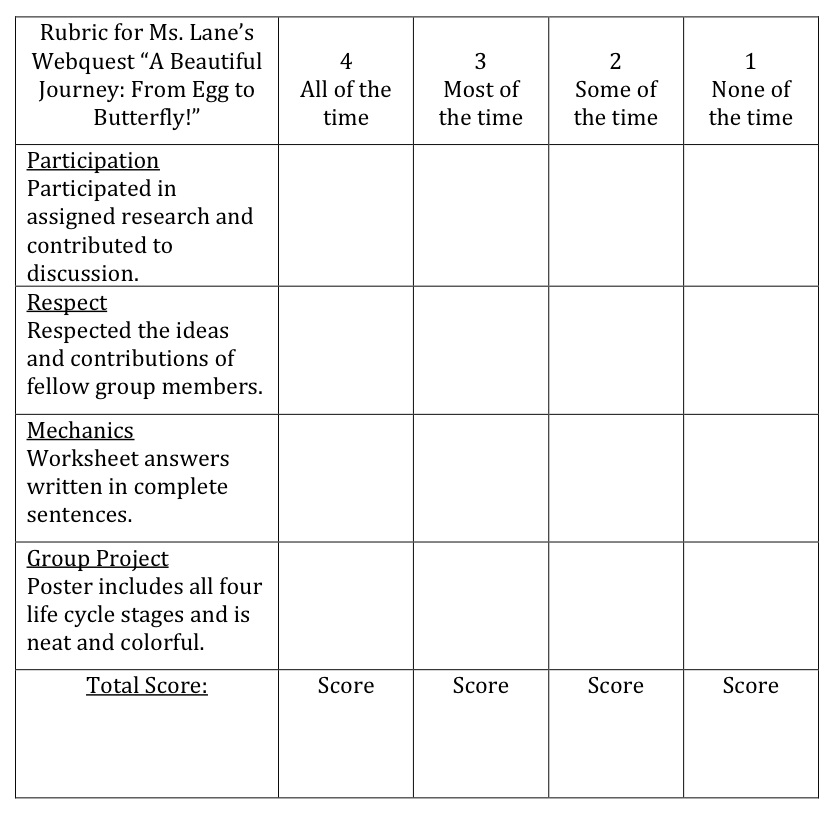
(Click on the word Conclusion in the bottom right corner)
Conclusion
CONGRATULATIONS!!
You have completed the webquest and have discovered the life cycle of our new classroom friend.

You learned that our chrysalis started out as an egg, became a caterpillar, turned into the chrysalis we see today, and will soon become a beautiful Monarch butterfly!
Excellent work, Little Scientists.
I wonder what we will decide to name our butterfly friend...