Introduction
This PD will build upon your knowledge about chicken pox (Varicella) and how to control it within a school setting
Chicken Pox (Varicella) is a highly contagious infection caused by the varicella-zoster virus, which is a member of the herpes group of viruses.
It is usually a mild disease that lasts a short time in healthy children. However, it can be severe in adults and may cause serious or even fatal complications in people of any age.
Vaccination of children against chickenpox not only prevents serious disease in childhood, but also ensures immunity in adolescence and adulthood, when complications from the disease can have severe outcomes. Vaccination has been highly effective in reducing varicella hospitalisations among young children in Australia.
Task
I would like you all to think back when you were in school......
_2.jpeg)
How many of your friends or peers got chicken pox?
Did you yourself have chicken pox? If so how did you feel? What were your symptoms?
Have you never had chicken pox?
What are ways in preventing the spread of Chicken pox in schools?
Process
Causes:
Chickenpox is highly contagious, and is spread through the air, by coughing, sneezing or direct contact with people who are infected. About 90% of unvaccinated people who have not previously had chickenpox will become infected when they come into contact with the virus.
Symptoms:
Symptoms of chickenpox take between 10 and 21 days (14 to 16 days on average) to show after infection. The main symptom is an itchy red rash that turns into open lesions or small wounds, which then crust over. Chickenpox can also cause flu-like symptoms, such as fever, headache and sore throat.
Complications of the disease can include: infection of the lesions, pneumonia (lung infection), difficulty walking and balancing, meningitis (infection of the membrane surrounding the brain), and encephalitis (brain infection).
Infection during pregnancy can result in congenital abnormalities in the baby. Staff who are pregnant need to take appropriate precautions if they have a student who has chicken pox.
Prevention:
Students who have chicken pox should not attend school until the last chicken pox blister has dried. If students are diagnosed with chicken pox parents should contact the school and classroom teachers need to inform parents that there has been a case of chicken pox within the class.
Alternatively, parents can vaccinate their children against chicken pox and it is free under the National Immunisation Program Schedule.
Immunisation against chickepox is achieved in one dose of the MMRV (measles-mumps-rubella-varicella) combination vaccine at 18 months of age.
Evaluation
Information for parents:
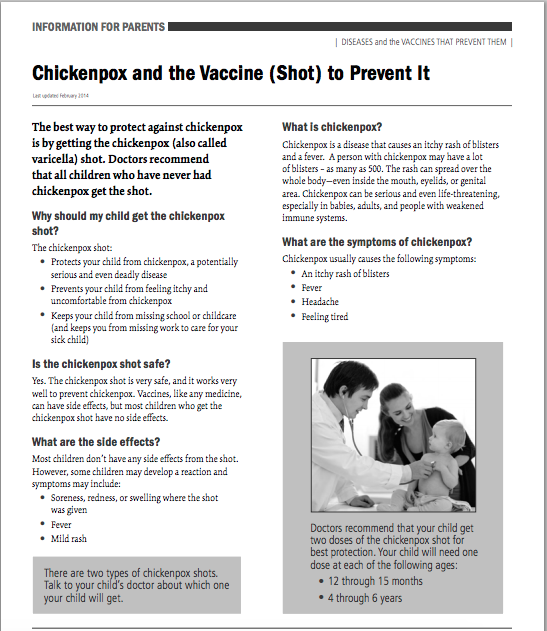
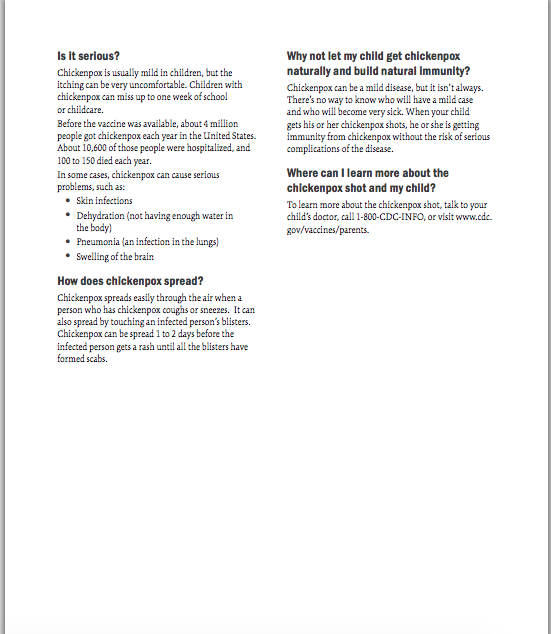
Find attached a parent information sheet from the "Centre's for Disease Control and Prevention" website that will answer most of the parents questions they may have. This information sheet can be found at:
http://www.cdc.gov/vaccines/vpd-vac/varicella/downloads/PL-dis-chickenp…