
Introduction
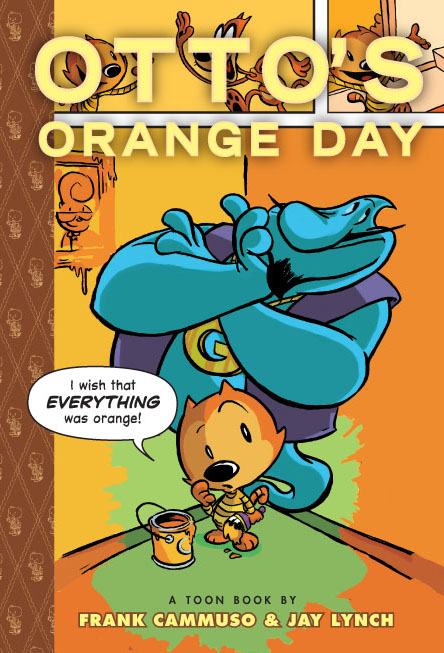
Otto’s orange day, is a story written by Jay Lynch and illustrated by Frank Cammuso. The story is about a cat who loves color orange and he meets a magical genie who makes his dreams come true. Otto wants the whole world orange but the new world seems great at the beginning but then everyone falls in trouble because of Otto’s dream.
This WebQuest is designed for 6 graders which they will be working for two weeks of preparation, explanation and researching to prepare an event.
What do you think the event will be about? Wishes? Colors? If you chose colors, you are right.
Our students will prepare an event called “Colors Stations” where they will talk about colors in specific details.
Task
After reading “Otto’s, orange day”, get ready to learn more about colors.
In two weeks you will work in groups to prepare an event but you have to work on these:
|
Stages |
What is required |
|
Jigsaw |
Talk about the elements of the comic story. |
|
One day, one color |
Write advantages and disadvantages on an imaginative situation. |
|
Searching |
Search about the color that will be assigned by the teacher. |
|
Writing |
Write about the information found about the colors. |
|
Event |
Create poster to present your work. |

Process
- Step one:
Task name: Story Jigsaw
Each group has different task to complete in order to find the elements of the story "OTTO'S, ORANGE DAY".
- You can find the story in this link:
http://www.professorgarfield.org/toon_book_reader/toon_book_ottos_orange_day_en.html
- Don’t forget to use simple present for your answers. For more explanation about simple present tense you can visit this link,
http://www.englisch-hilfen.de/en/grammar/simple_present_form.htm
Task #1 for group1:
You should look for the setting of the story:
- When was the story written? How did you know?
- Where does the story take place? How did you know?
Task #2 for group2:
You should look for the characters & characterization of the story:
- Who is the main character?
- How the main character is described in the story? What about the other characters?
- Are the characters believable (act as real)?
Task #3 for group3:
You should look for the plot of the story:
- What is the most important event in the story?
- How is the events show in the story?
Task #4 for group4:
You should look for the narrator of the story:
- Who is the narrator (speaker) in the story?
- Describe the narrator in two sentences.
Task #5 for group5:
You should look for the theme of the story:
1- What is the theme of the story? Is there more than one theme in the story?
2- What is the grammar tense used in the story? Provide your answer with some examples.
Follow these steps to complete this task:
Step 1: get in your groups based on your teacher's division.
Step 2: use the link to read and listen to the story.
Step 3: use the PowerPoint slides for more information about the elements of analyzing a story. (Setting – plot – characters – theme – narrator).
Step 4: with your group complete the worksheet by writing about the element that the teacher assigns it to your group.
Step 5: get in your new groups based on your teacher's division in order to complete the jigsaw.
Step 6: with your new group complete the second worksheet and write about all the elements of the story.
Worksheet 1
Worksheet 2
- Step two:
Task name: One day, one color:
Each group will be assigned with a color (red, green, pink, blue and yellow).
Once your group the color, you have to imagine what would happen if the whole world became one color.
You will discuss:
1. What are the positive things of having a one-color world?
2. What are the negative things of having a one-color world?
Then as a group, you will complete the Activity sheet to write the positive and negative things using would/ wouldn’t with the following sentence structure below:
|
Subject + would + main verb (positive). Subject + would + not + main verb (negative).
|
Step three:
Task name: Searching
To prepare for the event, you need to find information that you will share with others.
Now you need to read about the color because it will help when your group will prepare the event. You have to search about the following points:
1- Definition (meaning of the color given).
2- Facts (special things or facts about the color).
3- Objects (it can be food, weather, drink….etc.)
4- Group opinion (what do you think about the color?)
These websites will help you with your research. Work as a team because it will help you to find great information.
Step four:
Task name: Writing
After you research, as a team you will complete the activity sheet. You have to write small paragraphs about the information you found.
Remember:
1- Use present simple.
2- Work together to have a better writing.
3- Feel free to ask any question.
4- Give your activity sheet to the teacher when you are done.
Step five:
Task name: Colors Station “event”
In group, you are going to design a poster about a color. After that, you are going to present their posters in the playground at the break time for the administrators, teachers, students, and other workers in the school.
1- Step one: design a poster
In groups, you are going to design a big poster about the color that it was assigned to your group using the information that you already searched about before.
You have to include these points on the poster:
- The definition of the color.
- The usage of the color in our life.
- Facts about the color.
- Object with that color.
- Your group opinion about that color.
- Free section: you can include more interesting information.
2- Step two: Decorate your group table
After designing your poster each group will get a table to put the poster on it and you are going to work together on decorating the table. You can decorate the table with any style you would like.
For example:
- Bring objects with that color.
- You can use music.
- You can wear cloths with that color.
- Bring food or drinks.
|
Important note: submit the poster and the materials that you will use two days before of the colors stations event.
|
3- Third step: tell everyone about the event
You have different options to inform the school about the event:
|
In the school |
Online |
|
Morning assembly |
|
|
Post cards on advertisement board. |
Snap Chat |
|
In person |
FACEBOOK……. You can use any social media you want. |
Or you can use this invitation card
Finally: Color Station event
Now you are ready to present your work. Each group member will have a role:
|
Students |
Roles |
|
1 |
Welcome the audience. Explain the definition of the color. For example, you can say: Welcome to The Red Color Station. We are here to tell you about the definition of the red color. |
|
2 |
Tell the facts about your color using clear and loud voice. |
|
3 |
Show your audience the objects that you found about your color. |
|
4 |
Explain or share where we use the color in our life. |
|
5 |
Ask your audience questions. For example: What do you think will happen if everything in the world will be yellow? |
Finally, don’t forget to thank the audiences for by saying: thank you for listening, have a nice day, thank you for your attention.
Evaluation
Rubric for the colors station WebQuest:
|
|
Excellent 5 |
Good 4 |
Fair 3 -2 |
Need improvements 1 -0 |
|
Analyzing the story |
All element of the story are mentioned. |
One or two elements are missing. |
Three or four elements are missing. |
More than four elements are missing. |
|
Advantages and disadvantages (One color one day) |
Well-structured sentences using would and wouldn’t. Ideas are very clear and logical. |
The sentences are clear and logical. Used would and wouldn’t but not as the provided sentences structure. |
Well-structured sentences, but the meanings are not clear enough without using the sentence structure. |
The sentences are not clear or logical. Didn’t use the given sentence structure. |
|
Information about colors |
Found about all points. Information are accurate and well described. |
Found about all point but the information need more details. |
Found about some points. Information lack accuracy and details. |
One or two points are found and the information are not understandable. |
|
Writing the information (Grammar) |
Well organized paragraphs. Clear and appropriate sentences used. No grammatical mistakes. |
Well organized paragraphs. Clear and appropriate sentences used. Some grammatical mistakes are found (2- 4). |
Have some organization in the paragraphs. Unclear sentences and grammar mistakes are found (4- 8). |
No organization of paragraphs with unclear sentences and lots of grammatical mistakes. |
|
Delivery of the event (Colors stations) |
Welcomed the audience, used eye contact, speaks with confidence and clear volume. Delivered the information in clear way and thanked the audience at the end. |
Communicated well with the audience but found little difficulties in delivering the information. |
Knew the information very well but didn’t deliver it with confidence and clear voice. |
No eye contact and didn’t use clear volume. The information weren’t understandable for the audience. |
Conclusion
You have completed the road of your colors stations now.
In groups, you have learned about: what the color mean, how to use it, when to use it and facts about it.
Are you interested on how colors were found? You can search for it by your own because you’ve learned a lot about colors.
Hope you had fun!
Credits
linked websites:
http://www.englisch-hilfen.de/en/grammar/simple_present_form.htm
http://www.infoplease.com/spot/colors1.html
http://listverse.com/2012/12/24/10-fascinating-facts-about-color/
http://www.youthedesigner.com/graphic-design-tips/22-intriguing-facts-about-colors-that-you-need-to-know/
http://www.factmonster.com/spot/colors.html
http://www.colormatters.com/color-resources/color-matters-for-kids
http://www.professorgarfield.org/toon_book_reader/toon_book_ottos_orange_day_en.html
Author Biography
Permissions
We all benefit by being generous with our work. Permission is granted for others to use and modify this WebQuest for educational, non-commercial purposes as long as the original authorship is credited. The modified WebQuest may be shared only under the same conditions. See the Creative Commons Attribution • Non-Commercial• Share-Alike license for details.