
Introduction
A WebQuest for 6th Grade Health and Physical Education
Designed by Justine Wellman
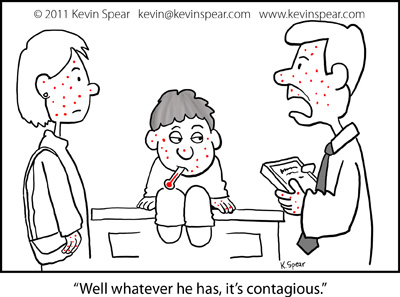
Communicable diseases such as, measles, whooping cough, mumps, chicken pox, Hepatitis A & B, Impetigo (school sores) and head lice can contribute to the disruption of students learning in the school and wider community. Diseases can be spread directly or indirectly, from person to person, from insects or animals to people, or the environment. Through this webquest you will gain an understanding of how these communicable diseases are transferred, what the symptoms are and how they can be treated or prevented.
There has been an outbreak of many communicable diseases within the community and the local hospital has asked it's research department (our classroom) to publish a book identifing the most common diseases that are likely to appear within the school community. A book will be published as a resource within the classroom using Blurb - http://au.blurb.com.


Task
As a whole group we will discuss what we mean by childhood communicable diseases or conditions and identify as many as we can. These will be written on the white board.
A series of flashcards (each containing a different disease/condition) will be used as a guide within this learning task.
In a group of 3 you will have 15 minutes to brainstorm everything you know about the disease or condition you have received on your flash card. Document any myths or facts you have heard or observed.
You are to present your finding as a word document including text and imagines to support your findings which will be published in a combined classroom informative text.
Process
Your group of 3 will now find evidence to support or dismiss these claims.
With your partner you have two 45 minute lessons to look at the websites provided and find the answers to the following questions in relation to the disease identified on your flashcard:
What are the symptoms?
How is it treated?
Discuss immunisation.
Are there exclusion periods?
How does this disease affect different people?
How serious is it?
How do you catch it?
Is it preventable?
What can be done to prevent it?
What is the Department of Education's policey on it?
Measles
http://www.betterhealth.vic.gov.au/bhcv2/bhcarticles.nsf/pages/measles
http://www.sahealth.sa.gov.au/wps/wcm/connect/public+content/sa+health+…
http://kidshealth.org/parent/infections/bacterial_viral/measles.html
Whooping cough
http://healthywa.wa.gov.au/Healthy-WA/Articles/U_Z/Whooping-cough-pertu…
http://www.rch.org.au/kidsinfo/fact_sheets/Whooping_cough/
http://www.sahealth.sa.gov.au/wps/wcm/connect/public+content/sa+health+…
Chicken pox
http://raisingchildren.net.au/articles/chickenpox.html
http://www.rch.org.au/kidsinfo/fact_sheets/Chickenpox_Varicella
http://www.betterhealth.vic.gov.au/bhcv2/bhcarticles.nsf/pages/chickenp…
Hepatitis A
http://www.betterhealth.vic.gov.au/bhcv2/bhcarticles.nsf/pages/Hepatiti…
http://www.hepatitisaustralia.com/hepatitis-a/
http://www.health.gov.au/internet/main/publishing.nsf/content/ohp-hep-a…; B school sores and head lice
Hepatitis B
http://www.hepatitisaustralia.com/about-hep-b/
http://www.betterhealth.vic.gov.au/bhcv2/bhcarticles.nsf/pages/Hepatiti…
http://healthywa.wa.gov.au/Healthy-WA/Articles/F_I/Hepatitis-B
School sores
http://www.betterhealth.vic.gov.au/bhcv2/bhcarticles.nsf/pages/impetigo…
http://www.rch.org.au/kidsinfo/fact_sheets/Impetigo_school_sores/
http://www.health.wa.gov.au/docreg/Education/Diseases/Communicable/Bact…
Head lice
http://health.vic.gov.au/headlice/
http://kidshealth.org/parent/infections/common/head_lice.html
http://access.health.qld.gov.au/hid/infectionsandparasites/parasites/he…
Department of Education Infectious Diseases Procedures
https://www.education.tas.gov.au/documentcentre/Documents/Infections-Di…
Evaluation
Communicable Disease Book Resource Rubric
|
|
Beginning |
Developing |
Emerging |
Advanced |
|
Visual appeal |
Lacks visual appeal; no color present |
Layout has some visual appeal; at least 1-2 colors present |
Layout and template style is visually appealing; at least 3 colors present |
Visually stimulating for targeted audience; variety of colors, images and graphics used to help enhance content |
|
Spelling/ Grammar |
Contains 10 or more spelling or grammatical errors |
Contains 5-9 spelling or grammatical errors |
Contains 1-4 spelling or grammatical errors |
No spelling or grammatical errors |
|
Organization |
Information is chaotic and disordered; no use of titles or headings |
Some sense of organization; a title is used, but lacks headings to break up information; labels may be hard to see |
Many headings are used to break information; material is well- organized and easy to read |
Titles and headings are used effectively; information is presented in a clear, fluid manner that makes sense to the audience |
|
Creativity |
Visual lacks creative elements |
Limited use of creative elements, images, and/or graphics |
Uses some images and graphics, but could use more |
Many creative images, graphics & other elements used to create an eye-catching visual |
|
Definition of disease |
No definition present |
Definition of disease is in 1-2 words |
Definition of disease is present |
Definition is explained in detail |
|
Signs/Symptoms of disease |
No signs or symptoms given |
1-2 signs/ symptoms given |
3-4 signs/ symptoms given, with some explanation |
5 or more signs/ symptoms given with detailed explanations |
|
Causes/Origin of disease
|
Cause/ origin of disease not identified |
Cause/ origin of disease is briefly mentioned |
Cause/ origin of disease is clearly explained |
Complete and thorough explanation of cause/ origin of disease is provided |
|
How disease is spread/ Prevention |
No mention of the spread of disease or how the spread can be prevented |
Mention of how the disease is spread OR how the spread can be prevented |
Explanation is given for how the disease is spread and one or two ways to prevent it |
Descriptive, inclusive explanation provided for several ways the disease can be spread AND specific examples of how the spread can be prevented |
|
Treatment of disease |
No treatment provided |
Treatment is briefly mentioned |
One or two treatments are given and clearly explained |
Several treatments of disease are provided with thorough explanations of each |
|
Word document turned in on time |
Brochure not turned in on due date
|
Brochure turned in TWO days late
|
Brochure turned in ONE day late
|
Brochure turned in on due date
|
ADDITIONAL COMMENTS:
Conclusion
Well Done!
The hospital board would like to take this opportunity to thank their research team on the effort they showed whilst gathering information for this very valuable informative text.
The hospital now has a book which can be distributed through schools, identifing childhood communicable diseases and highlighting there systems, causes, treatment, how it is spread and how it can be prevented.
Since completing this task 'whopping cough' has been in the media due to the death of an infant.
Do you believe immunisation should be made compulsory in Australia? Discuss..
Credits
Reference
ACARA. (2013, May). Retrieved from Australian curriculum, assessment and reporting authority: www.acara.edu.au
Teacher Page
Curriculum Links
Health and Physical Education
Being healthy, safe and active
Investigate community resources and strategies to seek help about health, safety and wellbeing (ACPPS053)
Plan and practise strategies to promote health, safety and wellbeing (ACPPS054)
Contributing to healthy and active communities
Investigate the role of preventive health in promoting and maintaining health, safety and wellbeing for individuals and their communities (ACPPS058)
English
Expressing and developing ideas
Identify and explain how analytical images like figures, tables, diagrams, maps and graphs contribute to our understanding of verbal information in factual and persuasive texts (ACELA1524)
Interacting with others
Participate in and contribute to discussions, clarifying and interrogating ideas, developing and supporting arguments, sharing and evaluating information, experiences and opinions (ACELY1709)
Creating texts
Use a range of software, including word processing programs, learning new functions as required to create texts (ACELY1717)
Teacher resources