
Introduction
Welcome Year 10s,
This unit will introduce you to a new way of evaluating the representations of race, class and gender that you encounter.
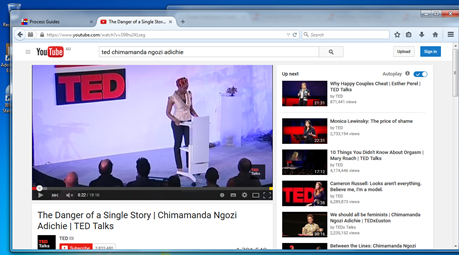
The first stage of your journey is understand the danger of a 'Single Story'.
Watch the following TED talk on YouTube before continuing to the TASK tab.
https://www.youtube.com/watch?v=D9Ihs241zeg
Task
Your Task is to first reflect on the TED talk you have just watched by adding a critical reflection post on the following class discussion page:
https://muut.com/natinoz/
By the end of the discussion you should have a broader understanding of the sorts of single stories you come across every day without realising.
In Groups of 4, decide on one Minority group that you want to research futher to combat the 'single story' title.
Research:
Background
Social Status
Common Misconceptions
Media/Literary presence
Self-perpetuated cultural representations
TASK:
Put together a group presentation using PowerPoint which you will deliver to class on the 6th Lesson.
Process
On your learning journey you are required to review the surrounding literature on the topic of social stereotyping:
STEP ONE:
Browse through the following articles for information specific to your topic:
http://www.bu.edu/law/central/jd/organizations/journals/bulr/volume92n4/documents/STARK.pdf
http://www.ferris.edu/jimcrow/links/VCU.htm
STEP TWO:
Select an Image from the following database and then follow the steps to analyse the image:
http://media-kitlv.nl/
STEP THREE:
Use the following process guide for analysing Media images:
http://webquest.org/sdsu/processguides/photographs.html
STEP FOUR:
Brainstorm social groups or individuals that you encounter everyday in films, media or literature that are misrepresented:
In your groups, brainstorm possible misrepresentations, how they are perceived negatively, why they are perceieved as such and what might be the whole story:
Brainstorm:
http://www.a.freshbrain.com/solvr/d/o7ktut9z60
Evaluation
Process Guide #3: Evaluating Web Pages
Did you know that anyone can write and publish a web page? Because of this, it is important that you and your teacher use web sites that are created by people who are are qualified to be writing on the subject matter. For example, would you rather use information on the human body written by a doctor, or someone who has just been to the doctor?
The following are a list of questions you need to consider when evaluating at a web page along with some tips and things to look for.
- Who wrote it?
- Is he/she an expert in the field? A professor or teacher? Or just someone with a little interest in the area?
- Is there biographical information available?
- What exactly do we know about the author?
- Unless the web page is part of a larger site (e.g. an encyclopedia or journal), there must be an author cited.
- Who is publishing it?
- Has an individual just put up his/her own site? Or is it part of a university or company site?
- If you come across a geocities, angelfire, tripod, or aol site, you need to remember that anyone can (and does) create web pages on these sites.
- If in doubt of the source, try going to the base site (i.e. http://www.geocities.com). If this site ends up being just a web page provider, think twice about using the information.
- Is there an opinion being presented?
- Who is providing the information?
- Do they have any self interest in the way they present the information? (e.g. Watch out for information on smoking from a tobacco company!)
- How old is the web page?
- When was the information published?
- There should be a date somewhere on the page, especially if the page contains statistics or other time sensitive material.
This page was designed by Dan McDowell for the Triton and Patterns Projects of San
Conclusion
So you want to get people to think like you? One of the best ways to do this is to present your argument in a way that convinces them your way is the right way.
In order to successfully argue your point, it is important that you not only show how good your idea is, but you need to refute the opposition. Research done needs to include topics and ideas that go against your argument.
Setting up a persuasive argument for either a presentation or paper can take many different forms. The following outline is simple, yet effective strategy to present and defend a persuasive argument.
- Introduction - Inform the reader/listener about the issue at hand. State the facts that surround the situation.
- State your case - Discuss why your way is the best way. Share evidence and expert opinions supporting your position.
- Examine and refute the opposition - It is vital that you recognize and discredit opposing views. Look for flaws, loopholes, and reasons to reject other suggestions. If there are positive aspects of the opposing view, point them out, but compare them to the overall benefit of your case.
- Reconfirm your position - Now it is time to review the main points of your arguments. Be sure to address any items that may have come while refuting the opposition.
- Conclude that your position is superior - Be confident in your closing that your way, is indeed, the only way based upon all the information just provided.
Credits
Process guides from webquest.org
http://webquest.org/sdsu/processguides/persuasive.html