
Introduction
Have you ever wondered how you could apply math to the real world? Well today we are going to experience a real world application that will help save you money as well as help you express your creativity.
The “back story”
Your rich uncle visited your house recently, and when you showed him your room, you mentioned that it is not exactly the room of your dreams, but it’s OK. So as an early birthday present and as a reward for being his favorite relative, he is spoiling you with a one-time gift of $10,000. His challenge to you is use the money to create your dream room spending as much of the money as possible without going over the $10,000. And one more thing, any money that you do not spend goes to your younger brother or sister. Be creative and let’s get to work!
Task
The project itself:
You may use your own room dimensions or a “standard” 10 feet by 12 feet bedroom (with a standard 8 ft. ceiling). You must:
- Make a scaled blueprint (drawing) of a 10 x 12 room, including 1 door, 2 windows, and a closet door (write down the scale – 1 in = 2 feet or ¼ in = 1 foot, etc.);
- Add furnishings;
- Include all wall, window, and floor coverings (you must include paint, carpet (or other flooring material, curtains or blinds, etc.);
- Collect pictures or advertisements of the purchases made to verify prices/sizes (use the internet, catalogs, newspaper ads, or even photos from a “virtual shopping trip”;
- Create an itemized list of all purchases and total costs;
- Prepare a final presentation of your dream room; and
Stay within the $10,000 budget.
Use online shopping websites to get ideas for your dream room.
Process
The presentation:
You must create a report style final project that is no larger than 9x12 (standard construction paper). It must include the following pages:
- Cover (include your name and an illustration or graphic)
- Scale drawing of the room (including placement of furniture and other items)
- Pictures (advertisements, photos, etc.) of items purchased – also include samples of carpet, paint and fabric colors)
- A table or other spreadsheet of your detailed spending (see attached example) Show the beginning balance of $10,000 and your ending balance as part of your table or spreadsheet.
- A paragraph (or more) describing the room and why you chose specific items for the room. Use this to tell about your personality and the things you like.
Example Table:
|
Item name or description |
Actual size (if applicable) |
Cost of item(s) |
Running expenses |
Running balance |
|
|
|
|
|
$10, 000 |
|
Twin size bed |
|
$500 |
$500 |
$ 9,500 |
|
Poster |
|
$ 20 |
$520 |
$ 9,480 |
|
Dresser |
|
$200 |
$720 |
$ 9,280 |
|
TV |
|
|
|
|
|
Wii console |
|
|
|
|
|
Carpet |
144 sq ft. |
|
|
|
|
Paint |
4 gallons |
|
|
|
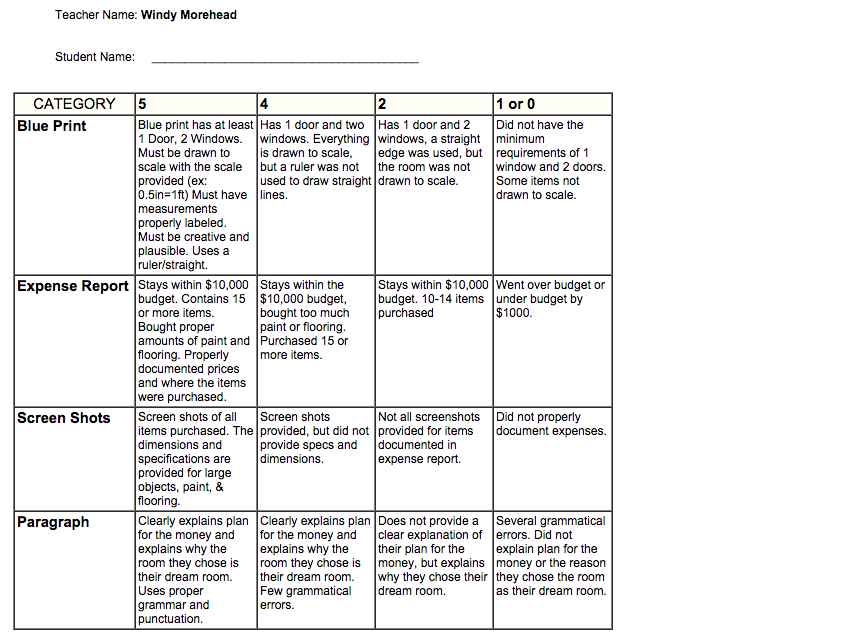
Evaluation
Conclusion
After completing this project, you will have a better understanding of how to budget, calculate area, and draw blue prints. This is an invaluable skill that can be used when you get your own home.
Credits
Credit to:
Mrs. Voigt
http://www.district87.org/staff/stined/dreamRoom.htm
http://middle-school-lessonplans.suite101.com/article.cfm/dream_room_descriptive_essay
Rachal Marquez