
Introduction
In Moscow on the evening of January 21, 1924, shock and near-hysterical grief greets the news that Vladimir Ilyich Lenin, leader of the radical socialist Bolshevik has passed away. Lenin was a well-respected figure in Russia's history. His preserved body has been on public display there since shortly after this death in 1924, with rare exceptions in wartime. The mausoleem is situated in the Red Square in the center of Moscow which serves as a resting place of Lenin.
Task
Now that someone has to succeed Lenin and there are 6 potential successors. With hindsight, Stalin became the ruler of USSR. How did Stalin rise to power?
Process
INDIVIDUAL
1. Read the background information on Lenin's death
2. Read the sources given
4. Analyse the sources (inference)
a. take into account the author, audience, date, message and the purpose
3. Pick out the evidence which answers the inquiry question
GROUP
1. Discuss with your groupmates the inferences and evidence to support the inference.
2. Write down the inferences and evidence on the worksheet
3. Group your sources into reasons that you think led to the rise of Stalin
4. Present your group's ideas neatly on a piece of butcher sheet.
5. Present your group's view to the class
Source A: Adapted from an article on ‘Joseph Stalin (1879-1953)’ from BBC.
|
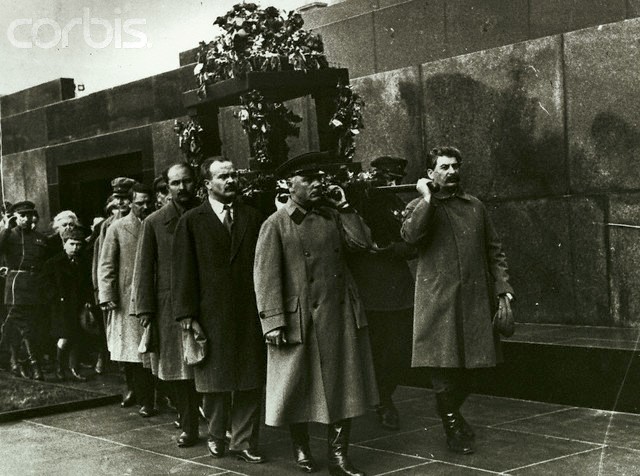
Source B: Lenin’s funeral procession with Stalin as the Chief Mourner, published in Pravda
Source C: From a biography of Trotsky
Immediately after the Party Conference, Trotsky left for a resort to recover from his prolonged illness. On his way, he learned about Lenin's death on 21 January 1924 and that the funeral would be held on 26th January. He was about to return when a follow up telegram from Stalin arrived, giving an incorrect date of the scheduled funeral, which would have made it impossible for Trotsky to return in time. Trotsky obeyed the telegram and did not return for the funeral. Many commentators speculated that Trotsky's absence from Moscow in the days following Lenin's death contributed to his eventual loss to Stalin, although Trotsky generally discounted the significance of his absence.
Source D: A Historian’s view on Stalin’s skill in outwitting his political rivals
Thoroughly schooled in political gangsterism, Stalin possessed too much guile and cunning for his rivals. He cleverly sowed discord among the others with a strategy of divide and rule, acquiring 'allies' as quickly as he discarded them. Initially, he aligned himself with Kamenev and Zinoviev, as a means of undermining Trotsky, the most capable of his competitors. He turned against them in the middle of 1925. At this point, Kamenev and Zinoviev promptly threw in their lot with Trotsky. As a result all three lost their membership of the Politburo.
Evaluation
Level Descriptors
|
Level |
Descriptors |
Marks |
|
L1 |
Describes provenance/ repeats the source content with no inference
|
1m |
|
|
E.g. Source A is about Stalin who was the leader of USSR.
|
|
|
L2 |
Valid inference(s) from the picture, unsupported Award 2 marks for 1 unsupported inference. Award 3 marks for 2 unsupported inferences
|
2-3m |
|
|
E.g. Source A tells me that Stalin is seen to be loyal and patriotic to Lenin. Source A tells me that Stalin is the natural successor of Lenin.
|
|
|
L3 |
Makes valid inference(s) from the picture with evidence
|
4-5m |
|
|
E.g. Source A tells me that Stalin is seen to be loyal and patriotic to Lenin. The poster is showing Stalin pointing his hand forward as a command to the Russians to follow him. His predecessor, Lenin, is standing behind him like a spirit and is seen to inspire and guide Stalin. (4m)
Source A tells me tells me that Stalin is the natural successor of Lenin. The poster reinforces the idea of Stalin’s legitimacy as after Lenin’s death, Stalin, Trotsky and 5 others were contending for succession to be USSR’s leader.
|
|
Scoring Rubric for Oral Presentations:
| Category | Scoring Criteria | Total Score | Score |
| Organisation (5m) | Information is presented in a logical sequence. | 5 | |
| Content (15m) |
Introduction is attention-getting, lays out the problem well, and establishes a framework for the rest of the presentation. |
5 | |
| Presentation contains accurate information. | 5 | ||
| There is an obvious conclusion summarizing the presentation | 5 | ||
| Presentation ( 15m) |
Speaker maintains good eye contact with the audience and is appropriately animated (e.g., gestures, moving around, etc.). |
5 | |
| Delivery is poised, controlled, and smooth | 5 | ||
|
Visual aids are well prepared, informative, effective, and not distracting. |
5 | ||
Conclusion
Reflection
Write down:
3 things i have learned in class
2 things i found interesting
1 question