
Introduction
In this Didactic Unit, we are going to analyse precisely an important factor in our society: migratory movements, a matter currently having great relevance and causing considerable concerns to a large part of the population. Therefore, throughout this learning process we are going to put an end to myths and stereotypes built on causes and consequences of this phenomenon, trying to show a more objective and positive reality of matters, starting from the development of a critical way of thinking. We would like to realize a learning process in values ending with xenophobic and racist concepts.
Vocabulary:
Demography, racism, xenophobia, migratory movements, equality, human rights, economic balance...
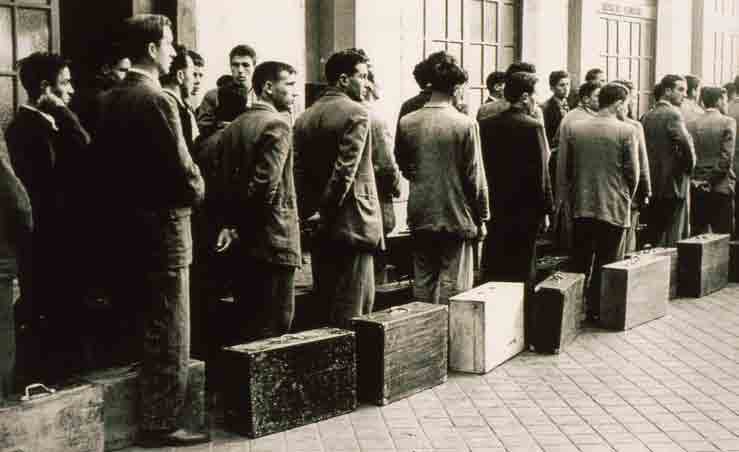
Task
1.Listen to this video:
“British woman attacks immigrants on a London train”. (It starting from 0.24 to 2.33 minuts.)
https://www.youtube.com/watch?v=8WjsxVu1ly4 (3m and 30 s.)
Then, at the end of this video, students will answers this following questions:
Why do you think they come to our country to live?What's their life situation when you get here?Are they well received?What do they work for? Is it true that they take work from us?What does xenophobia mean?
2. What kind of migratory movements do these images correspond to?
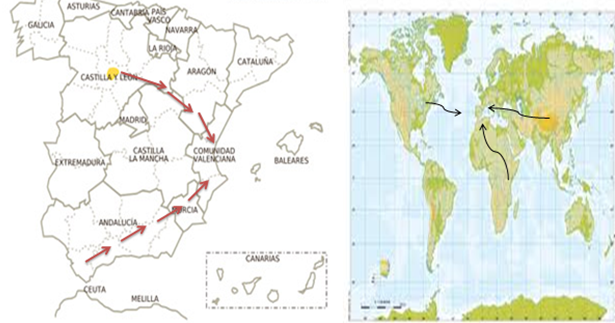
A) ______________ B_____________
3. Read the following documents.
The country of opulence.
Generally, they take on the work that the Anglo-Saxons reject as they now: cooks, dishwashers, domestic servants, growers, construction works, refrigerators, textile factories, metal fonts. They feed badly, they went through long and exhausting days, and they usually shared the rent in the “hot beds” called so because some get up and some lie down.
Undocumented workers receive lower wages than normal, complete the work more walks and dangerous for health and lack social security and the presentations that have other workers.
Temporary from here working there.
20.000 temporary workers leave our borders to look for work in other countries, while the employers of the field and construction demand 300.000 occupations. To the French vintage, a cutter will receive 750 and one carrier 900€ a week: at the end of the season, a family of four can earn 15,000€ in two months. They work four hours in the morning and four in the afternoon, the employer pays the trip of arrival and the maintenance. On the other hand, many Spaniards, the workers sleep next to the agricultural machinery, between sacks of cement and the open air. Soils are lower and entrepreneurs have a preference for Romanians because they accept to work for less time, without stopping or always because they are more submissive. This explains the numbers of emigration.
Then in groups of 3 or 4 people, they will answer the following questions:
What kind of work do immigrants have in Spain?
Does it affect negatively or positively the economy?
If there is a job offer;For what reasons do Spanish workers migrate to other countries?
What kind of conclusions have you reached?
4. English Song.
Listen to the song and answer the questions:
https://www.youtube.com/watch?v=O9aigRfQj3w (4m, 35 s)
Do you agree with the song?What part of each song do you like the best?Do you think the message of the song influences society? And if so, why is there still so much inequality?
5.GLOGSTER
Students to make in groups of 4 or 5 people a glogster with the following premises.
- Explain the causes of migrations
- What are the consequences in our country?
- Introduce the values of respect and equality and explain the meaning of the word “xenophobia”.
- Look for a song in English dealing with racism.
Process
First, we present a video to know previous ideas and we ask students what do they think about it.
Then we begin to explain the concepts of demography: emigration, immigration and we do an activity with them to know what they have learned.
When they already know new concepts, we introduce ourselves a little more in the subject by two documents dealing with migratory movements and every repercussion they have.
Up to this point, their arguments should be much more elaborate than in the first activity. Afterwards, we analyse and work on the same theme with a song.
And in order to finish, they should realise a glogster where they apply all the concepts they have learned.
Learning is developed gradually so that students do not forget what they have learned.
Evaluation
The way to evaluate the subject will be done as follows. First, we will write down your answers in the pre-teaching class. This will be useful to know our previous ideas and to modify at some time activities if it is necessary.
Then, progressively, we will begin to evaluate your responses in the following activities. Your answers should now be much more critical, reasoned and argumentative than the previous ones. If the reasoning is adequate and fits the reality, we will gradually complicate questions and activities.
The glogster will serve as a final evaluation because they shed light on everything has been learned. Here we can see if they have understood the concepts and what consideration they now have of reality. This evaluation will be done in a group, but we will evaluate individually their participation in the activities.
Therefore it will be evaluated
Your participation in the tasks.
Critical thinking.
Reasoned argument.
Evolution in the learning process.
Cooperative participation.
Conclusion
Migratory movements have been and are a subject very studied by many scientists since this social phenomenon requires of diverse agents, as they are demography, economy, sociology ..., for its explanation and understanding. This didactic proposal aims to reflect on one of the most controversial facts caused by this factor: Migratory movements affect society, but ... In what way? Is it beneficial or harmful? This way, we will try to give a Positive vision of this concrete matter, enriching students and obtaining a greater baggage about important elements by which our environment is composed.
If we get students having a different vision than the beginning one in the unit, we will have achieved our goals. If students react critically and argue reasonably the different questions, we have done a very important job: ending with racism lashing our society