
Introduction
Logarithms
_0.jpg)
In mathematics, the logarithm is the inverse operation to exponentiation. That means the logarithm of a number is the exponent to which another fixed number, the base, must be raised to produce that number. In simple cases the logarithm counts repeated multiplication.
For example, the base 10 logarithm of 1000 is 3 "log10(1000)=3", as 10 to the power 3 is 1000(1000 = 10 × 10 × 10); the multiplication is repeated three times.
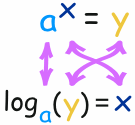
More generally, exponentiation allows any positive real number to be raised to any real power, always producing a positive result, so the logarithm can be calculated for any two positive real numbers a and x where a is not equal to 1. The logarithm of x to base b, denoted loga(x), is the unique real number y such that ay = x
(Proceed to the Task Tab)
Task

"Logarithm" is a word made up by Scottish mathematician John Napier (1550-1617), from the Greek word logos meaning "proportion, ratio or word" andarithmos meaning "number", ... which together makes "ratio-number"!!
During this quest we will identify the three main statements of logarithms by doing a variety of activities:
Activity #1:
please click on the link that provides for you to discuss together the basic definition of logarithms.
https://www.mathsisfun.com/algebra/logarithms.html
the link is provide the three statements of logarithms; exponential statement, logarithmic statement & natural logarithm.
Activity #2:
since the technology has become a sweeping all fields in the present age, what do you think of watching the following video for learning more in a fun way on some logarithm applications in reality:
[video:https://youtu.be/zzu2POfYv0Y align:center]
Activity #3:
To solve logarithms, you should know different rules for it:

(Proceed to the process Tab)
Process
What do you think of solving the next Worksheet to test your anderstanding:

(Proceed to the Evaluation Tab)
Evaluation
|
criteria |
3 |
2 |
1 |
0 |
|
Number of questions solved |
The student solved all the questions. |
the student solved most of the questions. |
the student solved some of the questions. |
the student have not solved any of the questions. |
|
Number of questions solved correctly |
The student solved all the questions correctly. |
The student solved most the questions correctly. |
the student solved some of the questions correctly. |
the student have not solved any of the questions correctly. |
|
Used different ways to solved each question |
The student used at least four ways to solve the questions |
The student used at least three ways to solve the questions |
The student used at least two ways to solve the questions |
The student used only one way to solve all the questions. |
(Proceed to the conclusion Tab)
Conclusion
To be a genius in the concept of logarithm, you have to rely on specific laws make it easier to deal with the logarithm:
