
Introduction
Hello, and welcome to this weblesson. Hopefully by the end you will know:
How muscles are named.
How muscles work with bones and create movement.
Differentiating muscles
Naming and locating where the major muscles are.
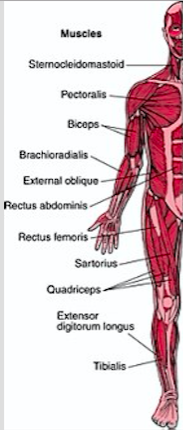
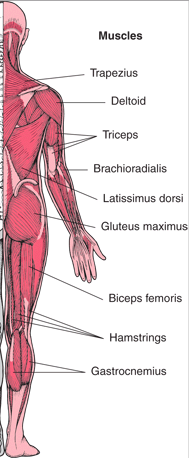
Task
Using the links answer the followiing questions.
http://www.ck12.org/life-science/Muscles-Bones-and-Movement-in-Life-Sci…
1.)How do muscles work with the bone to create movement?
https://jonbarron.org/article/human-anatomy-physics-muscles
2.)What is the eight part code of naming muscles?
3.)How are muscles named?
http://sportsmedicinejuliasawyer.weebly.com/muscular-system.html
4.)What are the muscles that are in the leg?
5.)What are the two muscle fibers?
6.)When are the two muscle fibers used?
https://www.youtube.com/watch?v=Ktv-CaOt6UQ
7.)How many muscles are there in the body?
8.)What are Myosin and Actin? What are they responsible for?
9.)What type energy do muscle tissues convert? How?
10.)Where are Smooth, skeletal and Cardiac muscles found?
11.)What are the two protein rule?
12.)When the muscle cells are at rest what is it called?
13.)What muscle protein are Actin blocked by?
https://www.youtube.com/watch?v=I80Xx7pA9hQ
14.)What is the largest muscle in the body?
15.)What is the biggest muscle in the body?
16.)Why do muscles always pull and not push?
17.)What are the four functional groups? what is the function of each one?
18.)What are the three phases of the muscle twitches?
19.)What do abduction and adduction mean?
20.)What is Isotonic and Isometric?
Process
Study the image then label the major muscles of the body.
http://highered.mheducation.com/sites/dl/free/0072907932/23630/muscles1…

Do the following activity.
Evaluation
Self reflection:
How well did you follow the direction given for the project?
I tried to follow as many directions as possible for this project.
Did you collect, analyze, and interpret information appropraitely?
I mostly collected, analyzed and interpreted the information appropriately, there were a mistakes and misunderstanding.
Did you organise information in an appropriate way?
I did my best to organise my information in an easy and appropriate way.
How well did you communicate ideas?
In my opinion I could've done a better job for communicating my ideas and making them simple and easier to follow.
What were your challenges in completing this project? What were your successes?
My successes in the project were being able to find good videos and websites. my challenges were being able to make my project creative and interesting.
What do you know now that you didn't know before you began this training room?
Before begining this I new about the movements of the joints and the basic muscle groups of the body.
Conclusion
Answer Key:
1.) Muscles move the body by contracting and when the muscles contract it pulls the bone causing it to move.
2.) Size, Shape, Orientation of the muscle fibers, mechanical fibers, mechanical action of the muscles, number of origins of a muscle, the points of a origin and insertion, name of the muscle function, the muscle's location.
3.) Muscles are often named for the region or the bone the muscle is attached to.
4.) Gluteus Maximus, Sartorius, Biceps femoris, Gastrocnemius, Achillies Tendons.
5.) Slow twitch and Fast twitch
6.) Slow twitch is used for more endurance and fire more slowly, where as fast twitch is used to generate short burst of strength or speed and fire more rapidly.
7.) 640 muscles in the body
8.) Actin and Mysion are protiens in the Sarcomere.They convert chemical energy into mechanical energy and are responsible for generating force and movement.
9.)The muscle tissues convert chemical energy into mechanical energy by contracting and relaxing.
10.) The smooth muscles are found in the hollow organs (etc, stomach and blood vessels), the cardiac muscle is around the heart and keeps the blood pumping, skeletal muscles are the ones attached to the skeleton.
11.) 1: proteins like to change shape when stuff binds to them, 2: changing shapes can allow proteins to bind and unbind with other stuff.
12.) The Actin is blocked by Troponin and Tropomyosin.
13.)The longest muscle is the Sartorius.
14.) The biggest muscle is the Gluteus Maximus.
15.) When muscles contract, the insertion point (which moves) brings the bone closer to the origin point (doesn't move), and the movement is always pulling.
16.)The four functional groups are; Prime movers, Antagonist, Synergists and fixators. Prime movers are muscles responsible for generating specific movement. Antagonist muscles oppose a specific movement. Synergists muscles help the prime movers with extra strength. Fixator muscles the prime muscles with stabilizing the origin joints.
17.) The three phases are; Latent period, Period of contraction and Relaxation period.
18.) Abduction is the movement away from the midline and adduction is the movement towards the midline.
19.) Isotonic is the change in muscle length and Isometeric is no change in muscle length.