
Introduction
Intended for: 4th grade
Time Frame: 2 hours
(2 class periods)
In this WebQuest we will explore the 8 planets in our solar system! By going through the different areas, all you new astronauts will learn exciting new information! A WebQuest is a useful way to gain information, instead of just being in a classroom!
ASTRONAUTS NEEDED! I need YOU to explore the solar system and all that it has to offer, get ready for BLAST OFF!

Task
Purpose:
Creating a web quest to introduce the solar system. The planetary research will familiarize them with the planets and their features. It will bring a new resource other than using a textbook.
Objective: : After completing this web quest the students will be able to identify what a solar system is and all that it consists of such as the planets and moons by their unique features.
Standards (5 points)
- §112.15. Science, Grade 4
8) Earth and space. The student knows that there are recognizable patterns in the natural world and among the Sun, Earth, and Moon system.
Directions: Read the information on each planet and continue onto the next!
Mercury:Mercury is the closest planet to our Sun. It is named for the ancient Roman god of trade and profit. Legend says Mercury's winged sandals gave him super speed. Mercury the planet is super fast, too. It zips around the Sun every 88 days - faster than any other planet. No wonder it got its name from the quickest of the ancient gods.Mercury is the smallest planet in our solar system. There are dwarf planets that are smaller. If Earth were a baseball, Mercury would be a golf ball.
Venus: Venus is the second planet from the sun and our closest planetary neighbor.
Similar in structure and size to Earth, Venus spins slowly in the opposite direction most planets do. Its thick atmosphere traps heat in a runaway greenhouse effect, making it the hottest planet in our solar system with surface temperatures hot enough to melt lead. Glimpses below the clouds reveal volcanoes and deformed mountains.
Venus is named for the ancient Roman goddess of love and beauty, the counterpart to the Greek goddess Aphrodite.
Earth:Earth is the third planet from the sun and the fifth largest in the solar system. Just slightly larger than nearby Venus, Earth is the biggest of the terrestrial planets. Our home planet is the only planet in our solar system known to harbor living things. The name Earth is at least 1,000 years old. All of the planets, except for Earth, were named after Greek and Roman gods and goddesses. However, the name Earth is an English/German word, which simply means the ground.
Mars:Mars is a rocky body about half the size of Earth. As with the other terrestrial planets - Mercury, Venus and Earth - volcanoes, impact craters, crustal movement, and atmospheric conditions such as dust storms have altered the surface of Mars. Mars has two small moons, Phobos and Deimos, that may be captured asteroids. Potato-shaped, they have too little mass for gravity to make them spherical. Phobos, the innermost moon, is heavily cratered, with deep grooves on its surface.
Jupiter:Jupiter is the fifth planet from our sun and the largest planet in the solar system. Jupiter's stripes and swirls are cold, windy clouds of ammonia and water. The atmosphere is mostly hydrogen and helium, and its iconic Great Red Spot is a giant storm bigger than Earth that has raged for hundreds of years. Jupiter is surrounded by more than 50 moons (with more a dozen more awaiting confirmation). Scientists are most interested in the Galilean satellites — the four largest moons discovered by Galileo Galilei in 1610: Europa, Callisto, Ganymede and Io. Jupiter also has three rings, but they are very hard to see and not nearly as intricate as Saturn's.
Jupiter is named for the king of ancient Roman gods.
Saturn:
Saturn was the most distant of the five planets known to the ancients. In 1610, Italian astronomer Galileo Galilei was the first to gaze at Saturn through a telescope. To his surprise, he saw a pair of objects on either side of the planet. He sketched them as separate spheres, thinking that Saturn was triple-bodied. Continuing his observations over the next few years, Galileo drew the lateral bodies as arms or handles attached to Saturn. In 1659, Dutch astronomer Christiaan Huygens, using a more powerful telescope than Galileo's, proposed that Saturn was surrounded by a thin, flat ring. In 1675, Italian-born astronomer Jean-Dominique Cassini discovered a "division" between what are now called the A and B rings. It is now known that the gravitational influence of Saturn's moon Mimas is responsible for the Cassini Division, which is 4,800 kilometers (3,000 miles) wide. We've discovered 53 confirmed moons and another 9 provisional moons (for a possible total of 62 moons).
Uranus: The seventh planet from the sun with the third largest diameter in our solar system, Uranus is very cold and windy. The ice giant is surrounded by 13 faint rings and 27 small moons as it rotates at a nearly 90-degree angle from the plane of its orbit. This unique tilt makes Uranus appear to spin on its side, orbiting the sun like a rolling ball.
The first planet found with the aid of a telescope, Uranus was discovered in 1781 by astronomer William Herschel, although he originally thought it was either a comet or a star. It was two years later that the object was universally accepted as a new planet, in part because of observations by astronomer Johann Elert Bode.
Neptune:The ice giant Neptune was the first planet located through mathematical predictions rather than through regular observations of the sky. (Galileo had recorded it as a fixed star during observations with his small telescope in 1612 and 1613.) When Uranus didn't travel exactly as astronomers expected it to, a French mathematician, Urbain Joseph Le Verrier, proposed the position and mass of another as yet unknown planet that could cause the observed changes to Uranus' orbit. After being ignored by French astronomers, Le Verrier sent his predictions to Johann Gottfried Galle at the Berlin Observatory, who found Neptune on his first night of searching in 1846. Seventeen days later, its largest moon, Triton, was also discovered.
Process
This WebQuest is designed for students to be introduced to the 8 planets of our solar system. They will learn interesting facts, and the special features of each planet.
Evaluation
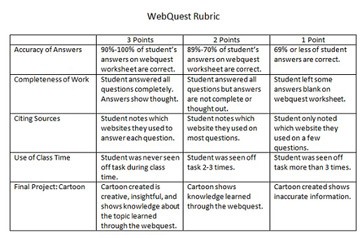
There will be formative and summative assessments. Be prepared for a pop quiz at any time after the WebQuest has been completed.
Conclusion
After completing, the students will have gained knowledge on the Solar System and how to navigate a WebQuest.
Credits
http://questgarden.com/181/08/9/150425072943/t-resources.htm
I used another students webquest as a template. I was very intrigued as to how detailed it was, and I was excited to create my own.
Teacher Page
Thank you for visiting my WebQuest. This was an exciting new way to bring information to my "students". Instead of doing an activity with a pencil and paper, I was able to create this webquest to hopefully give excitement to the classroom. Technology is very important in this day and age and teachers should be able to implement technology in the classroom.