
Introduction
On this WebQuest, you will develop an understanding of the Fibonacci Sequence (and its connection to Golden Rectangles), Golden Ratio, Golden Rectangle, and the term ratio (as it applies to rectangles).

Check out this article for more information about the Golden Ratio in Archictecture!
http://www.goldennumber.net/architecture/
Task
Today, you will use the information on this WebQuest to complete the following assignment. Please pay close attention to the directions given. After you have finished the assignment, you will send the file to me via e-mail. Please work diligently as I will expect you to contribute to the discussion we will have in class.
This assignment is due on December 8, 2015.
Process
1. Consider the following questions.•What’s the Fibonacci Sequence?
0, 1, 1, 2, 3, 5, 8, 13, 21, 34, 55, 89….
•How do you get it? What’s the pattern?
Start the sequence with 0 and 1. Add the current term to the previous term to get the next term.
•Where do we see this sequence?
Notice that the Golden Rectangle has the ratio of phi. Today, you will construct a Golden Rectangle using Fibonacci Sequence.
2. Observe the following diagram.

What do you think a Golden Rectangle means?
Refer to the rectangles above.
Next, find the ratio of each rectangle's length: width, and rewrite the ratios so that the width is 1. Keep this value in mind.
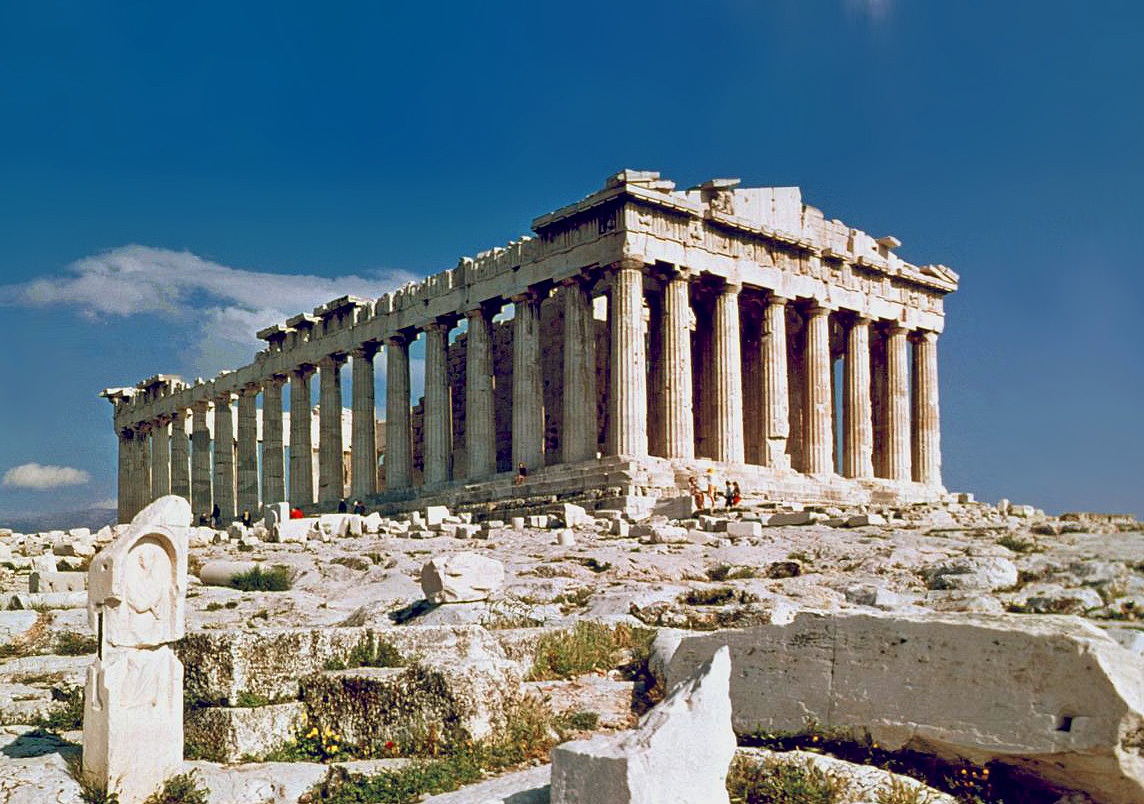
There is a specific rectangle that has been observed and used since ancient times, and is still used by architects today. The Parthenon in Athens and the Mona Lisa are good examples of where we see Golden Rectangles.

3. You will be observing and constructing the Golden Rectangle today.
Use the following website to construct the rectangle.
http://web.geogebra.org/#geometry
- Open the website above and begin a clean page
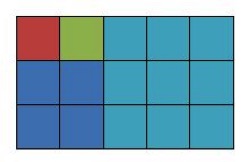
- Construct a 1 x 1 box around the middle of the page
- Construct another adjacent to it
- Construct a 2 x 2 square adjacent to and below the rectangle
- Construct a 3 x 3 square adjacent to and to the left of that rectangle
- Your drawing should look like this:
- Continue drawing squares in a clockwise direction until your paper runs out of space
- What do you notice about the pattern with the size of the squares?
- Measure the length and width of each rectangle that was formed using the Fibonacci Sequence. The first three rectangles you should measure are highlighted in yellow below.
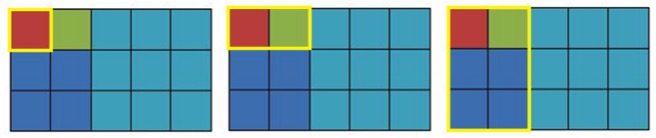
What do you notice about the ratio between the length and width of each rectangle as you measure larger and larger rectangles?
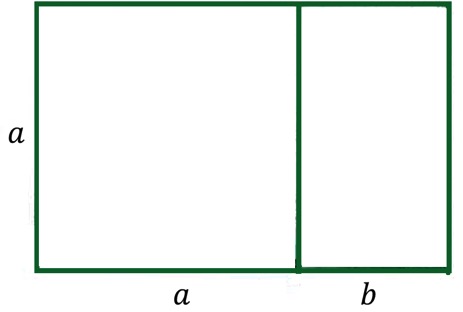
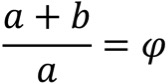
Phi is called the Golden Ratio.
Based on your work, what is a good approximation of Phi?
Evaluation
Export your construction on GeoGebra as a png file. Send your file as an attachment to me via e-mail at lv123@gmail.com by December 8, 2015 @ 11:59PM. In your e-mail, include your response to the final question, "What is a good approximation of Phi?"