
Introduction
Rhythm!
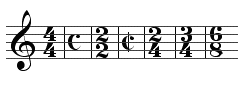
During our rhythm unit we have learned that rhythm is one of the foundations for music! The many components including steady beat, time signatures and rhythmic durations this is what helps groups of musician no matter the size stay together to create wonderful music. Rhythm allows musician to know when to play what note at a specific time. Through this webquest you will be reviewing time signatures, rhythmic durations and the concept of a steady beat. With these tools you will be able to identify the time signature of your favorite song!
Demographics:
18, 7th Grade General Music Students in a computer lab
Standards:
NY State Learning Standards for the Arts
- Knowing and using art materials and resources
- Responding to and analyzing works of arts
Music Education National Standards
- reading and notating music
- listening to, analyzing and describing music
NY State Learning Standards for Technology
- Information Systems, Students will access, generate, process and transfer information using appropriate technologies
ISTE
- Critical Thinking, problem solving, and decision making
Objectives:
Students will answer the review questions based on the musictheory.net lessons with no mistakes
Students will complete the “Rhythmic Math Quiz” with 80% accuracy.
Students will complete the “Fabulous Four” listening quiz with 80% accuracy
Students will create and explain a labeled Rhythm Tree starting from the longest duration to the shortest with a maximum of two mistakes.
Student will identify the time signature of the pop song of their choice with no mistake.
Task

Calling All Rhythmic Detectives!
After completing the Rhythm Unit you now are a Rhythmic Detective! Your job is to be able to identify the time signature of your favorite pop song by going through this webquest! The "clues" to help you identify the time signature of your favorite pop song are located in the Process section of the webquest. After you finish each clue you will be one step closer to identifying the mystery time signature of your favorite pop song!
During this webquest you will be:
1.) Identify the duration of rhythmic durations (including dotted rhythms)
2.) Creating a rhythm tree, to show a visual presentation of the rhythmic durations
3.) Choosing 3 pieces of classical music that use the three common time key signatures we discussed in class
4.) Find a pop song and listen to see if you can identify the time signature
Process
Investigation #1: Review Time Signatures and Rhythmic Durations
1.) Visit the website www.musictheory.net/lessons , to review Rhythmic Duration and Key signatures read the lessons to refresh your memory! When on the site click on the top bar where it says "Exercises", after click on and read the lessons "Note Duration" and "Measures and Time signature" complete the following questions after you finish! Complete the questions on a Word Document, make sure to add a heading including your name, date, and assignment! Print out your answers.
a.) What does the top number of a time signature represent? What does the bottom number represent?
b.) On a piece of staff paper draw a measure of 2/4, 3/4 and 4/4. Fill the measures with the correct amount of beats.
c.) How many eighth-note would be equal to the duration of a whole note?
2.) Now that we have an understanding of note values, let us put our math skills to the test and complete the following quiz! Go to:
http://www.musictechteacher.com/music_quizzes/aq_rhythmic_math_quiz/quiz.html and complete a Rhythmic Math Quiz! At the end print out your results!
3.) Lets put our listening skills to the test with this short time signature and rhythm quiz! Remember to print your results when finished!
http://www.musictechteacher.com/music_quizzes/quiz_fabulous_fours001.htm
Investigation #2: Analyzing and Creating use Rhythm!
1.) Create a Rhythm Tree using the different note durations reviewed! Your rhythm tree should be created using Microsoft Word. To construct the tree make sure to use the following note durations: whole note, half-note, quarter- notes, eighth-notes and sixteenth notes. Start from the largest duration to the smallest. Make sure to label the notation values! Also at the bottom of your rhythm tree explain why the rhythm tree is a helpful tool for musician especially when first learning! If you need help, look at the rhythm tree example on this website.
http://www.essential-music-theory.com/rhythm-tree.html
2.) Rhythm has been around for a very long time!! When looking back into the history of music we see through the compositions of well-known composers that they used time signatures to organize their music! Here are two links to famous classical composer pieces, open up their compositions and identify the time signature. Take the first four measures of each piece and label the "big" beats using slashes like we did in class! Save the compositions and open them up in the application “Paint”. Use the tools in paint to create the slashes. Remember finding the time signature is easy. Don’t be scared if you see a lot of notes on the page!
a.) 12 Variations on "Ah, vous dirai-je maman" By Mozart
b.) Suite Bergamasque By Debussy
http://imslp.org/wiki/Suite_bergamasque_(Debussy,_Claude)
**After clicking on link look for "Sheet Music"**
3.) Hopefully the clues are coming together to close this investigation! Look up your favorite pop song on Youtube.com. After listening for a few time see if you can identify what time signature it uses! If you are having a hard time listening to the drums, they are usually the instruments keeping the steady beat! Be prepared to share you song and you time signature finding to the class!
Here are two examples!
- Happy By Pharrell Williams, Time Signature= 4/4
https://www.youtube.com/watch?v=ZbZSe6N_BXs
- Breakaway By Kelly Clarkson Time Signature =3/4
Evaluation
Rhythmic WebQuest Rubric!
|
Points |
0= Incomplete |
1=Needs Improvement |
2=Developing |
3=Meets Expectations |
|
Review Questions |
Students did not complete Review questions in “Investigation #1” |
Students answered all three questions in “Investigation #1” incorrect |
Students answered review questions in “Investigation #1” but made more than one mistake |
Student answered review questions in “Investigation #1” correctly with no mistakes |
|
Rhythmic Math Quiz |
Students did not complete “Rhythmic Math Quiz” |
Students completed the “Rhythmic Math Quiz” and received lower than a 60% |
Students completed the “Rhythmic Math Quiz” and received between a 61%-79% |
Students completed the “Rhythmic Math” Quiz and received an 80% or above. |
|
“Fabulous Four” Listening Quiz |
Students did not complete the “Fabulous Four” Listening Quiz |
Students completed the “Fabulous Four” Listening Quiz and received lower than a 60% |
Students completed the “Fabulous Four” Listening Quiz and received between 61%-79% |
Students completed the “Fabulous Four” Listening Quiz and received an 80% or above |
|
Rhythm Tree |
Students did not create a Rhythm Tree |
Students created the “Rhythm Tree” but made more than two mistakes and did not explain the diagram |
Students created the “Rhythm Tree” and explained it but made more than two mistakes |
Students created the “Rhythm Tree” and explained it with a maximum of two mistakes |
|
Identifying the Time Signature |
Students did not decide on a pop song and did not identify the time signature |
Students decided on a pop song but did not identify the time signature correctly |
Students decided on a pop song and identified the time signature but made more than one mistake |
Students decided on a pop song and identified the time signature with no mistakes |
Credits
Websites Used
www.musictheory.net/lessons
Musictheory.net is a great website for music educators and their students! It is a reliable resource that students can access at home. The site includes lessons, exercises and tools. The lessons go into detail about specific music concepts that are covered in general music classes. The exercises have students practicing the material they learned in the lessons which is a great assessment tool for teachers. This website would be targeted for students in middle school to high school. I used this website in my webquest because it gives a good review on Note Duration and Time Signatures, students will be able to review the concepts already learned in class without me lecturing about them.
http://www.musictechteacher.com/music_quizzes/aq_rhythmic_math_quiz/qui…;
http://www.musictechteacher.com/music_quizzes/quiz_fabulous_fours001.htm
Musictechteacher.com is another website I used for my webquest. This website has different activities and quizzes for students that revolve around musical concepts. Also the quizzes have a print option, which is great for teachers. This allows teachers to see student's progress in a specific area they are teaching. The rhythmic math quiz will assess student’s knowledge on rhythmic symbols/duration. The math that is involved in the quiz is multiplication, division, subtracting and adding which are concepts that 7th grade students have learned in their math classes. The "Fabulous Four" Listening quiz that I added in my webquest also assess students on rhythm, only it has them listening and identifying specific rhythms.
http://www.essential-music-theory.com/rhythm-tree.html
EssentialMusicTheory.com is very similar to MusicTheory.net except is does not have as many concepts. A lot of the musical concepts covered on this website are basic including notation, rhythms, clefs and intervals. The website does a great job organizing and discussing the concepts however there are not quizzes and areas where students can practice and apply the concepts they are learning. This website is a great reference tool for students when studying for a test or completing homework. I used this website in my webquest because it does a nice job explaining and presenting the "Rhythm Tree". It displays the diagram and also explains the importance. The rhythm tree helps students understand the breakdown of rhythm durations.
http://imslp.org/wiki/12_Variations_on_%22Ah,_vous_dirai-je_maman%22,_K…;
http://imslp.org/wiki/Suite_bergamasque_(Debussy,_Claude)
Imslp.org is an amazing resource for musician, music educators and students. The website has downloadable classical sheet music that is not under the copyright law. Students are able to download and print out the music at their convenience. It also provides recordings of classical pieces for students to listen to. Students can look up composers, instrumentation and genres to find a specific piece of music. I used this website for my webquest because it applies history to the concept of rhythm. Showing students composers like Mozart and Debussy is providing them with background to where music that we listen to today has developed. Having them identify the time signature and locate the "big" beats of classical music demonstrates that they have a strong foundation in the concept of rhythm.
Youtube.com is a great teaching tool for music educators. What better way to teach a concept in music then to have students listen, analyze and identify what they are learning in class in actual pieces that exist. Youtube.com has unlimited amount of music from classical to pop music. I used YouTube in my webquest because it applies to something students use in their everyday life. Students will listen and watch their favorite songs on YouTube when they are at home after school. With this in mind having students look up their favorite song on YouTube to identify the time signature applies it to their everyday life.