
Introduction
Speaking skill is the productive skill formed in oral mode. It is very important to express someone's feeling orally. There are some ways used to improve speaking skill. However, I only chose presentation to improve students' speaking skill.
There are two basic skills of using presentation that should be mastered by the students; explaining and questioning.
Explaining
When you explain something, such as a process, structure, situation or theory, you give the reasons why it is like it is. The involves linking causes (the reasons) with their effects (a description of the thing you are explaining).
Useful language
Below are some expressions that are commonly used in spoken explanations of cause and effect.
Identifying causes/reasons
- The reason (for ...) is (that)
- That's because ..
- That's because of / due to ..
- The/ one explanation (for..) is (that) ...
- What has brought this about/led to/ caused this ... is ...
- What's responsible for ... is ...
can you think of any other expressions to add?
Expressing certainty/uncertainty
- I think ..... that's because/ the reason is (etc.)
- It's likely that
- I'm certain
- I'd say
- it could be that
- It could well be that
- Possibly
- I'm sure
- There's no doubt (in my mind) (that)
Questioning
Useful Language
Introducing a question
- I've got a questions about ....
- Could I ask a question....?
- Sorry, could I just ask ...?
Clarification
- Sorry, I didn't follow what you said about ...?
- What did you mean when you said ...?
- Could you give me an example of ...?
More information
- I was interested in what you were saying about ...
- Could you tell us more about...?
- Could you expand a bit on what you were saying about ...?
Checking comprehension
- So you mean...?
- So you're saying ...?
- Can i just check I've understood - did you say...?
- Have I got this right ...?
Responding to answers
Satisfied answer
- Yes, I see.
- OK, thanks.
- Thanks, that's clear now.
Dissatified answer
- That's not really what i was asking. what I meant was...
- OK, but what I really wanted to know was ....
- Sorry, I'm still not clear about ....
- Perhaps I didn't make my question clear. What I was really asking was ....
Source :Anderson, K., Maclean, J., & Lynch, T. (2004). Study speaking. Cambridge: Cambridge University Press.
Task
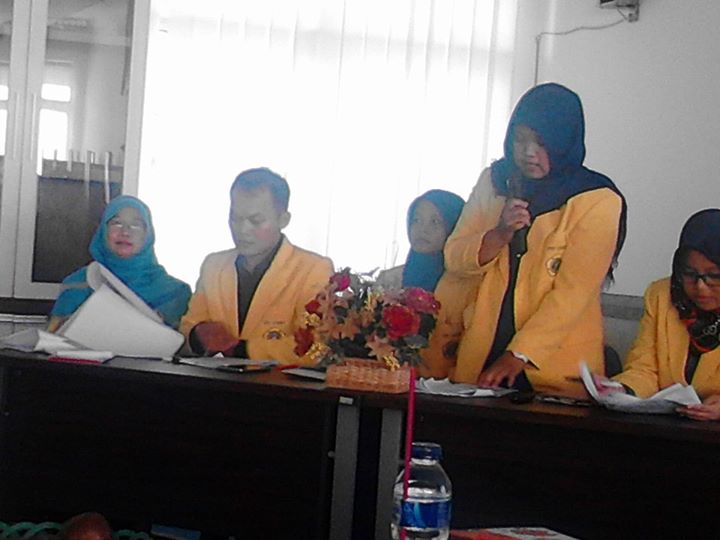
The class that consists of twenty students is divided to four groups. Thus, each group consists of five students. The presentation only takes ten minutes for each group.
The students will presents about:
1. Profit and loss.
2. Financial statement.
3. Fixed asset.
4. Work sheet.
It is just a training for introduction. Thus, the powerpoint is not needed in this activity.
Process
1. The students will try to do a presentation.
2. They have to prepare the presentation in thirty minutes.
3. After the preparation is done, they will present it without powerpoint in front of class around fifteen minutes for each group.
4. One group will present and other groups will give questions.
Note : - ten minutes : explaining.
- five minutes : questioning.
Evaluation
There are some criteria that should be considered during the presentation.
. Pronunciation – This refers to the way each word is uttered correctly and clearly.
• Stressing and Intonation – This refers to how certain words and phrases are given emphasis, as well as the correct rise and fall of pitch.
• Correctness – This refers to grammar, syntax, and construction. These aspects need to be correctly used; errors and mistakes can give a negative impression on the listeners and create confusion.
• Vocabulary – This refers to the choice of words; the speaker must have a wide vocabulary to effectively verbalize thoughts and ideas.
• Voice Quality – Aside from the speaker’s physical appearance, the quality of his voice also affects the impression of the listener on him. The voice must be clear, crisp, and full because it is the medium by which the message is relayed to the listener.
• Fluency – This refers to the ability to use the required language in a manner that is smooth and spontaneous.
• Appropriateness – The speaker must be able to gauge the audience properly, in terms of what type of audience they are and match the message to this classification. For example, if the listener is a top-level executive, then the tone and content of the message should be appropriate to this person. Ideas and information must be relevant and interesting to the audience.
Rubric
Scoring Rubric for Oral Presentations:
PRESENCE 5 4 3 2 1 0
-body language & eye contact
-contact with the public
-poise
-physical organization
LANGUAGE SKILLS 5 4 3 2 1 0
-correct usage
-appropriate vocabulary and grammar
-understandable (rhythm, intonation, accent)
-spoken loud enough to hear easily
ORGANIZATION 5 4 3 2 1 0
-clear objectives
-logical structure
-signposting
MASTERY OF THE SUBJECT 5 4 3 2 1 0
-pertinence
-depth of commentary
-spoken, not read
-able to answer questions
OVERALL IMPRESSION 5 4 3 2 1 0
-very interesting / very boring
-pleasant / unpleasant to listen to
-very good / poor communication
TOTAL SCORE _______ / 25
Conclusion
The students learns how to be a good speaker in a presentation. They also learn how to ask question to the speakers. Thus, they have experience for conducting the next presentation.
There are some aspects that have to be considered by them such as pronunciation, stressing and intonation, correctness, vocabulary, voice Quality, fluency, and appropriateness.