
Introduction
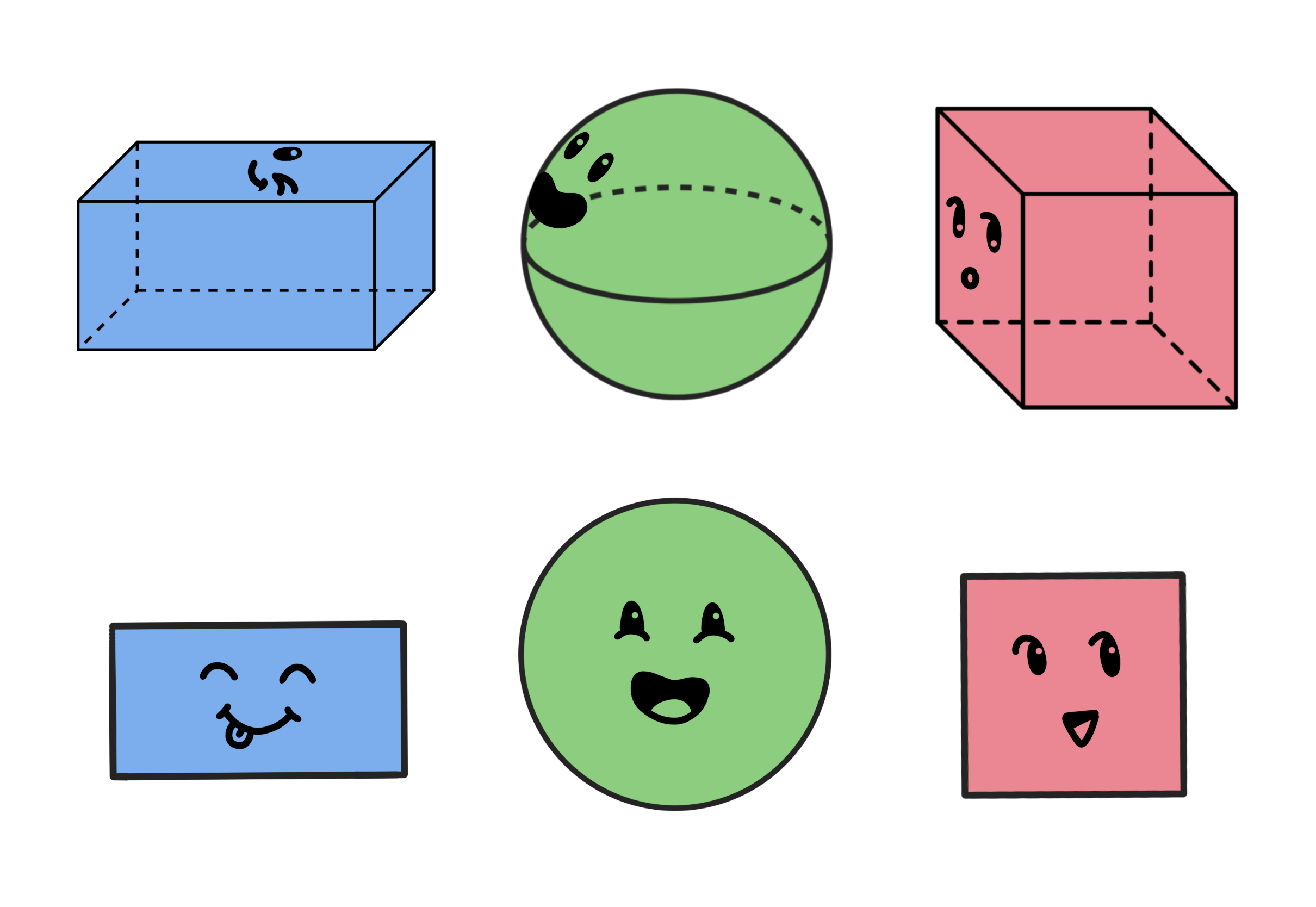 We a surrounded by different shapes every day! From the rotating circular shape of car tire, to the iconic rectangular shape of your television. In assigned groups, you will present to the class what shapes you were able to find and whether they are 2D or 3D shapes.
Standards
MA.1.GR.1.1 Identify, compare and sort two- and three-dimensional figures based on their defining attributes. Figures are limited to circles, semi-circles, triangles, rectangles, squares, trapezoids, hexagons, spheres, cubes, rectangular prisms, cones and cylinders.
Guided Questions
- What is the name of this shape, and how do you know?
- How many sides and corners does this flat shape have? How many faces and edges does this solid object have?
- How is a rectangle different from a square? How is a 2D shape different from a 3D shape?
- Where can you find examples of this shape in our classroom or at your home?
- What smaller shapes can we put together to build a larger hexagon or rectangle?
Students will identify, classify, and analyze two-dimensional and three-dimensional geometric shapes based on their defining attributes
Task
We will have a quick review on several two-dimensional shapes. Using our knowledge on common 2D shapes like circles, triangles, squares, and rectangles; we will introduce those familiar shapes to their three-dimensional counterparts. By learning about 3D shapes and their defining attributes, this will help us identify the differences between two-dimensional and three-dimensional shapes. Student will be given a small break where they can access online resources to familiarize themselves with shapes. Then after our whole group, students will be separated to different tables containing a collage of daily objects. They will work together to create a chart, identifying and sorting those objects into two different categories: 2D and 3D shapes. After time has expired, I will call each group and ask to present their findings. I will ask them certain questions regarding their findings to test their reasoning.
Process
Whole Group
Students will have a quick refresher on basic two-dimensional shapes.
- Using physical foam shapes, the teacher will name each shape and it's defining attributes to present it to all the students.
- The teacher will hand out the foam shapes to pass around so students can familiarize themselves with the shape.
- The teacher will play a video about 2D shapes to help reinforce what the students learned.
Teacher will introduce three-dimensional shapes.
- The teacher will go over a presentation about the features of 3D shapes: edges, faces, and vertices.
- Using physical three-dimensional foam shapes, the teacher will name each shape and it's defining attributes to present it to all the students.
- The teacher will hand out the foam shapes to pass around so students can familiarize themselves with the shape.
- The teacher will play a video about 3D shapes to help reinforce what the students learned.
Students will be given brain break where they may access selected resources to explore shapes at their own leisure.
Breaking into groups.
- Teacher will separate students into 5 groups of 4, assigning them to a premade tables containing a collage of everyday objects.
- Students will have access to their laptops where teacher provides some resource websites.
- Each table will have one chart that all students (in that group) will collaborate on.
- Students will observe and categorize objects into the chart, making sure to separate them based on 2D or 3D properties.
Resource Websites:
After allotted time, teacher will call on each group to present their results.
- Each student will pick on object from their chart to present to the class.
- The teacher will ask the student one of various questions based on their findings.
- The teacher will ask for aid from other students to see if they agree with the group's answers.
Later when all groups have presented, the teacher will call for whole group.
- Students will use synchronous tools provided by the teacher.
- Using this quiz. The teacher will ask for all students to shout the answer to each question.
Evaluation
Groups will be graded on:
- Ease of collaboration
- Understanding of concept
- Accuracy of the information provided
- Effectively explains mathematical thinking
- Application of knowledge and skills learned
Each section will be with the same amount of points from 1-5. 1 meaning student did not reach satisfactory in any category and 5 meaning students exceeded in each category.
Conclusion
Students will learn about the differences between a two-dimensional and three-dimensional shape. In the process, they will gain critical and collaborative thinking through group work. Additionally they will gain confidence in public speaking as they present their answers with the class. Here is an enrichment activity to be played in competitive spirits after the whole group quiz.
Teacher Page
Stephanie Felton