
Introduction
Welcome to Mr. Fowlers Geography class where we will discuss the 5 themes of geography and how they affect people in their everyday lives. We will have several fun and exciting activities that will help us with a better understanding of how the themes play into relationships among places, humans and different environments. We will also take a look at some historical events and using our critical thinking skills we will complete an activity where we connect people and places to those historical events and why they are important. Finally, we will explore what is Economics and why it is important and complete an activity so we all have a better understanding of both micro and macro economics concepts.
Before we get started it is important to understand the definition of what is geography.
DEFINITION OF GEOGRAPHY
ge·og·ra·phy
1 : a science that deals with the description, distribution, and interaction of the diverse physical, biological, and cultural features of the earth's surface ---- In plain English this basically means that geography is the study of the earth and everything that is here.
(Source-Merriam Webster Collegiate Dictionary)
THE FIVE THEMES OF GEOGRAPHY
Location
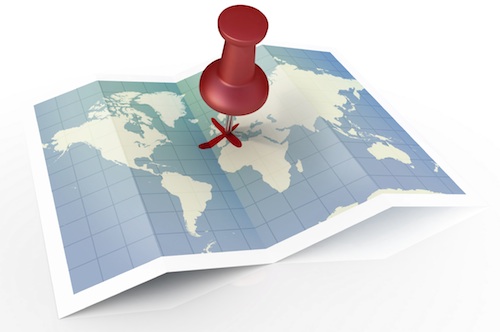
Location is divided into two parts: specific location and general location. A specific location is an actual address, like "123 Main Street," or a set of geographical coordinates like "44N58, 93W15." A general location describes where a place is in relation to another place. It does not give a direct address but indicates a place's relative location and its relative distance. For example, the general location of a certain store could be "twenty minutes away by car, next to the bank." (Picture Source: Google Images)
Human–Environment Interaction
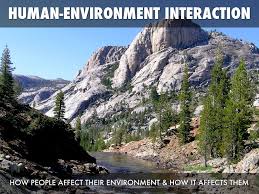 Human-environment interaction describes how people work together and how they function in their environment. This interaction divides into three key areas: our dependence on the environment, how we alter the environment and how the environment changes us. Dependence refers to our need for something, like natural resources, from the environment. We alter the environment by, for example, building roads through wildlife areas. The environment also changes us: For example, people in cold climates wear coats in the winter to shield themselves from the cold.(Picture Source: Google Images)
Place
 Place is a description rather than a location. Place is divided into two categories: human differences and physical differences. Human differences are the ways in which people change and develop a place. These changes may be concrete, as in building construction or cultural. Physical differences describe the ways in which a part of the world is characteristically different from others. For example, some places have mountains, while others have desert terrain. (Picture Source: Google Images)
Region
 Each region has specific characteristics. There are three types of region: government, functional and general. Government regions are formally and politically defined; the United States is a government region, as are the European Union and the city of London. A functional region has specific services designated for that area; school districts, for example, are functional regions. General regions are loosely classified by broad terms. For instance, different parts of the U.S. can be thought of as the South, the Northeast and so on. (Picture Source: Google Images)
Movement
 Movement is the way people travel from place to place, circulate information, trade good and services and share ideas. The way in which food travels to a grocery store or how people travel from one place to another are both examples of movement. (Picture Source: Google Images)
HISTORICAL EVENTS & GEOGRAPHY
An Artificial Division
Geography and history tend to be taught as two distinct subjects with little common ground. But there are many ways in which geography interacts with history, where both disciplines become more relevant. History is as much shaped by geography as it is by almost any other factor. The more easily we can see the interdependence of history and geography, the more understandable and interesting both subjects will become.
How Geography Affects Early History
When we study ancient civilizations almost anywhere in the world, one simple fact jumps out. Most civilizations initially formed around major rivers, especially those that led to oceans. We can point to the early civilizations that formed along the Nile River in Egypt, the Tigris and Euphrates Rivers in the Middle East, the Yangtze River in China, or the Ganges River of India. Each development had a lasting influence on history.
Mountain Barriers
Mountains also have a major role to play in the history of most countries. In the past, mountains were the barriers that restricted movement. Whether that is the movement of explorers, settlers, traders or armies are of importance at various times in a nation's development.
Flatland Effects
Even large flat plains can have a significant influence on the history of a people. It does not seem completely accidental that the tribes that lived on the Great Plains domesticated horses as a way to travel and hunt more efficiently. The Tartars of the Siberian Plain did the same, as did the Tuaregs of the flat sandy plains of North Africa. In each case, wide expanses and the use of horses influenced the development of that particular culture, its values and its history.
Weather and Geography
Many of us may not immediately see the impact of some geographic phenomenon on subsequent events. Weather and land features, for example, were both major influences in the defeat of both Napoleon's "Grande Armee" and Hitler's 6th Army in their separate attempts to conquer Russia. The Russian winter, the overextended supply lines and the very long retreat back over the Russian steppes in subzero temperatures, ensured their defeat. Each army lost more than 250,000 men-another example of how geography causes history to change.
Guiding Our Learning
Advanced knowledge is derived from an understanding of basic facts. We must be completely familiar with the basic concepts and the fundamental facts of geography in order to appreciate their effect on history. The physical geography of any region is the template upon which its history is written. Knowing the template's features fluently allows us to understand the history more quickly and easily. We must be able to quickly and accurately label certain features such as land forms, rivers, weather and climate information, the crops or products, the resources available, transportation hubs and routes and other geographic data. We need to be able to understand and apply the basic terms and concepts of geography including their definitions.
Maps and Atlases
To achieve fluent performance we can use different types of geographic maps and atlases. These maps might depict size and relative location, physical features, economic characteristics, major cities, travel routes, etc. There are many kinds of atlases with many types of maps.
GEOGRAPHY AND ECONOMICS
Relationship
One might make you think of maps, the other of graphs - but there's a lot of overlap between geography and economics.
What is economics?
Economics is the study of how people create and consumer goods and services. This covers everything from government tax policies to why drinks cost so much in cinemas. But it’s not all about numbers: a big part of economics is looking at how people behave and how they respond to changes in their situation.
How do economics and geography meet?
There are some very simple ways in which geography affects economics: for example, long distances and difficult terrain affect the ability to distribute goods, while factors like climate might affect the kind of goods and services that people want. The distribution of natural resources also has a huge affect on the economy.
But there are also human elements to economic geography. For example, you might look at how economic factors determine where and how people live, such as when people move to places where they can get a job more easily.
Micro Economics vs. Macro Economics
The difference between micro and macro economics is simple. Microeconomics is the study of economics at an individual, group or company level. Macroeconomics, on the other hand, is the study of a national economy as a whole. Microeconomics focuses on issues that affect individuals and companies.
Task
ACTIVITY 1
Made In... & Read All About It
Follow the directions listed for each part of this activity listed below and also on your worksheet list. We are going to make posters that will help illustrate the 4th and 5th themes of Geography. Students will each need a poster and a copy of the worksheet.
Made in…
On one side of your poster draw the following chart. Then complete the chart by adding the items needed in each column. You must have at least 10 items.
Read All About It
On the other side of your poster brainstorm movies, books, or stories that take place in a specific region of the world. Then draw a chart like is showing on the worksheet and fill in the corresponding columns with the required information. You must have at least 5 items.
Notes
If so desired this could be a team exercise of 2 to 4 students per group completing the tasks and discussing and brainstorming the project together.
ACTIVITY 2
You are the News Director for a major news network and your reporters are often stationed around the world. In order to program the satellite and connect the reporters to your news broadcast, you need to research information about their locations.
Your Task
Using your Reporter Check List Sheet you need to:
- Find locations for your reporters,
- Know the city, country and continent
- Research their exact latitude and longitude
- Locate each reporter on a world map
- Understand the time zones and times of day
- Know the season and possible weather conditions.
ACTIVITY 3
In completing the Economics lessons, you will be able to understand the broad range of information that social studies covers. You will be able to see social studies as so much more than the study of history. You will understand that social studies topics such as American History, World History, Civics/Government, Geography, and Economics have impacted our past and will impact our future as well.
You will be divided up into small groups to work on the assignment. You can talk about your favorite part, what interested you the most, or how your group worked together.
Process
ACTIVITY 1 PROCESS
Made in…
On one side of your poster please fill in the following chart. You must have at least 10 items.
|
Type of Item |
Brand Name |
Made in… |
|
Stuffed Cow (Example) |
Liberty toy (Example) |
China (Example) |
|
|
|
|
|
|
|
|
|
|
|
|
|
|
|
|
|
|
|
|
|
|
|
|
|
|
|
|
|
|
|
|
|
|
|
|
|
|
|
|
Read All About It
On the other side of your poster brainstorm movies, books, or stories that take place in a specific region of the world. Then fill in the following chart. You must have at least 5 items.
|
Title |
Region/Location |
How does the region affect the story? |
How might this story be different if it occurred in a different region? |
|
Mulan (Example) |
China (Example) |
Takes place during a war in China, see some customs and values of the culture, Chinese armor and weapons (Example) |
If this had taken place elsewhere it may have been acceptable for women to fight in wars, so Mulan would not have been rejected (Example) |
|
|
|
|
|
|
|
|
|
|
|
|
|
|
|
|
|
|
|
|
|
|
|
|
|
ACTIVITY 2 PROCESS
Let’s Program the Satellite. Where are the reporters?
1. First, you need to station your reporters in capital cities around the world. Choose three countries, on
different continents, from this list. Fill in your checklist sheet.
2. Using the Geography IQ website, find the capital city of each and fill in your checklist sheet.
3. Find the exact latitude and longitude for each capital city location. Fill in your checklist sheet.
4. On the world map, attached to your checklist sheet, draw a line along the equator and the prime
meridian. Plot the approximate location of each reporter using the latitude and longitude
coordinates. Mark the location and label it on the map.
5. Using this distance calculator find the approximate distance from your TV studio in New York to each
location in miles. Fill in the checklist sheet.
6. Your broadcast is at 7:00pm in New York, NY on October 20th, 2013. What date and time will it be in each
location when you broadcast? Use this time zone converter to help you find out. Fill in your checklist sheet.
7. Look at your map. Is your reporter in the northern or southern hemisphere? Fill in your checklist sheet.
8. What season is it in each location? Fill in your checklist sheet.
9. What is the current temperature in each location? Fill in your checklist sheet.
Now that you know the exact details, use your data to answer these questions?
1. What kind of clothing should your reporter wear to fit the weather conditions?
2. Will your cameraman need bright lights to light the reporter in the dark?
3. If the satellite can only travel east around the world from your TV studio in New York, in what order will
your reporters appear.
ACTIVITY 3 ECONOMICS
- Create definition flashcards for the terms needs and wants. Explain to your classmates the differences between the two words.
- Create definition flashcards for the terms Imports and Exports. Explain to your classmates the differences between the two words.
- Create definition flashcards for the terms micro and macro economics. Explain to your classmates the differences between the two words.
- Make a list of things people need (hint: needs are things necessary to survive)
- Make a list of things people want (hint: wants are things we wish for)
- Now select 5 countries and identify what the national currency is for that country and what is their main imports and exports
- Does the country have the raw materials required or do they need to import raw materials to make the product they are exporting?
- Then cross compare the lists of needs and wants and develop a concept map of where the product will come from to get to you.
Evaluation
Evaluation
ACTIVITY # 1
Project worth 50 Points
|
|
Needs Improvement |
Fair |
Good |
Exemplary |
Score |
|
Made In… |
Chart has 1 or less correct answers and not fully completed |
Chart has 2 to 5 correct answers |
Chart has 6 to 9 correct answers |
All areas are completed with correct answers |
|
|
Read All About It |
Chart has 1 or less correct answers and not fully completed |
Chart is completed but incorrect answers are in place in some of the question boxes so that only 1/3 or 2/3 of the question is correct. |
Chart has 4 correct answers |
All areas are completed with correct answers |
|
|
Neatness and Appearance |
Messy, incomplete, missing information |
Chart is readable but not very well organized, no extra effort put forth |
Very professional neat and organized well on the poster board |
Very professional neat and organized well on the poster board. Student went above and beyond requirements with adding pictures and maps. |
|
|
Follows directions and works well with teammates |
No teamwork, seemed more interested in other things. Talking but not communicating about the project |
Not all areas are completed. Did not work together or communicate very well |
All areas are completed students communicated and worked as a team but needed better communication on the project |
All areas are completed students communicated and worked well as a team, with each contributing to the project |
|
|
Demonstration of Understanding |
Little to no effort given on the project. |
Only have a few answers completed could not completely explain the answers that were given on the chart |
Understood the project and requirements. Performed well in the group, not fully sure of some answers. |
Identifiable performance characteristics reflecting the highest level of performance. Ability to explain the project answers |
Evaluation
ACTIVITY # 2
Project worth 100 Points
|
|
Points 5 |
Points 10 |
Score |
|
Latitude |
Incorrect |
Correct |
|
|
Longitude |
Incorrect |
Correct |
|
|
Distance |
Incorrect |
Correct |
|
|
Time |
Incorrect |
Correct |
|
|
Hemisphere N/S |
Incorrect |
Correct |
|
|
Season |
Incorrect |
Correct |
|
|
Temperature Fahrenheit |
Incorrect |
Correct |
|
|
Clothing |
Incorrect |
Correct |
|
|
Lighting Yes or No |
Incorrect |
Correct |
|
|
Delay in Seconds |
Incorrect |
Correct |
ACTIVITY # 3
Project worth 50 Points
|
|
Needs Improvment |
Fair |
Good |
Exemplary |
Score |
|
Flash Cards |
Missing vocabulary words, limited or missing information on all of some of the vocabulary words |
All vocabulary words listed with limited to no information |
Organized with some information for all vocabulary words |
Neat well organized with in-depth information on all vocabulary words |
|
|
Needs List Wants List |
Lists are incomplete missing some or all of the information |
Lists are completed with one word or very limited wording |
Both lists are developed and organized with some information |
Both lists are well developed, neat, organized and detailed |
|
|
Currency Imports Exports |
Contained little to no information for the majority of the answers |
One word answers with very limited information, but all questions were answered |
Answers are complete in a somewhat organized format |
Contained detailed answers in a well documented format that was neat and very well organized |
|
|
Raw Materials |
Contained little to no information for the majority of the answers |
One word answers with very limited information, but all questions were answered |
Answers are complete in a somewhat organized format |
Contained detailed answers in a well documented format that was neat and very well organized |
|
|
Comparison |
Little to no information did not display higher order thinking skills on the project |
Limited answers to the questions, not very well organized and no details were present |
All answers had some detail and were organized. Higher order thinking skills were present |
Very detailed in a well organized format. All answers were given with attention to detail and a complete well thought out explanation showing higher order thinking skills |
Conclusion
At the end of this lesson you will now have a better understanding of the 5 themes of social studies. You will understand the importance of history and how it applies to the area of geography. You will also have a better grasp of economics and how it relates to people, locations and cultures.
Credits
Websites used:
BCCA. "Look Up Longitude and Latitude" 25 Mar 2015
< http://www.bcca.org/misc/qiblih/latlong_oc.html >
Parker, Alan. "Home Page." Temperature World. 08 Mar. 2004. 25 Mar 2015
< http://www.temperatureworld.com/ >.
Thorsen, Steffan. "Distance Converter" Date and Time.com 25 Mar 2015
< http://www.timeanddate.com/distance/converter.html >
Thorsen, Steffan. "Time Zone Converter" Date and Time.com 25 Mar 2015
< http://www.timeanddate.com/worldclock/converter.html >
"World Map." Geography IQ. 25 Mar 2015
< http://www.geographyiq.com/world.htm >.
Images taken from google images web 25 Mar 2015
Teacher Page
MADE In... & READ ABOUT IT ACTIVITY 2
What you need to do:
This be either a group or individual activity or even a homework assignment
Print out copies of the worksheet and pass out to students
NEWS REPORTER ACTIVITY 2
What you need to do:
Divide class into pairs
Print out and copy checklist sheets for each group (on legal paper!)
Print out map from Enchanted Learning, enlarge to legal size and make enough copies for each group
Print out 2 or 3 Correcting Sheets . The students can check their own data.