
Introduction
This web quest has been designed to outline the issues surrounding communicable diseases within childcare centre facilities. This web quest will allow educators within the centre to search for communicable diseases that are common in Australia.
Communicate and chronic diseases are an illness caused by pathogens, they are bacterial and virus infections that spread from one person to another in environments such as child care centres, schools, family day care centres and before/after school care facilities.
There are numerous types of infectious diseases can occur, such as:
Bacteria- tiny living organisms some are harmless, others are dangerous to people
Protozoa-microscopic organisms with animal-like behaviours
Fungi-organisms that require certain environmental factors to survive
Helminths-worm-like organisms living in and feeding on living hosts
Virus-bacteria that replicates inside living cells of other organisms
Rickettsia-living creatures such as worms or lice that survive by feeding on living organisms
(Commonwealth of Australia, 2015)
Below is a diagram that identifies how we as educators can break the chain of infections.
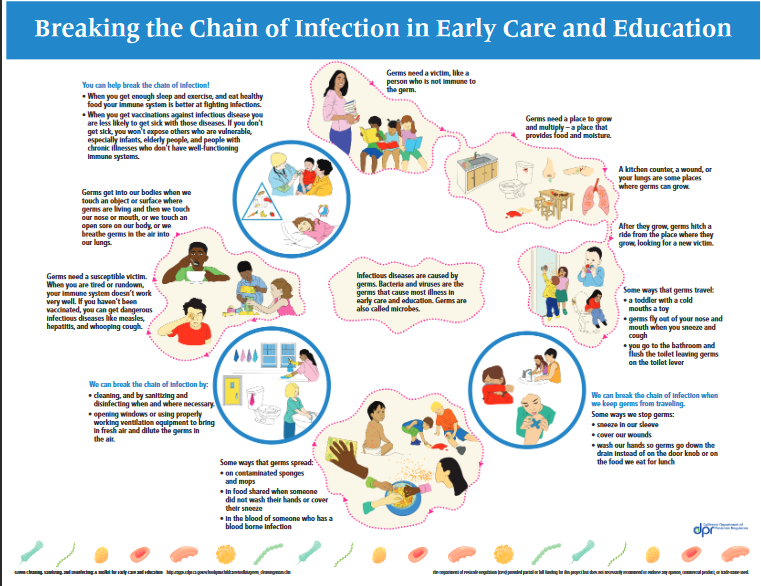
(Robertson, 2015)
There are numerous ways germs can be spread which include:
-direct contact (bodily fluids, touching surfaces that have bacteria)
-coughing or sneezing (droplets of bacteria)
-animals (diseases in fur or bodily fluids)
-food (germs can grow when stored incorrectly)
-contaminated air (droplets or small particles of germs in the air)
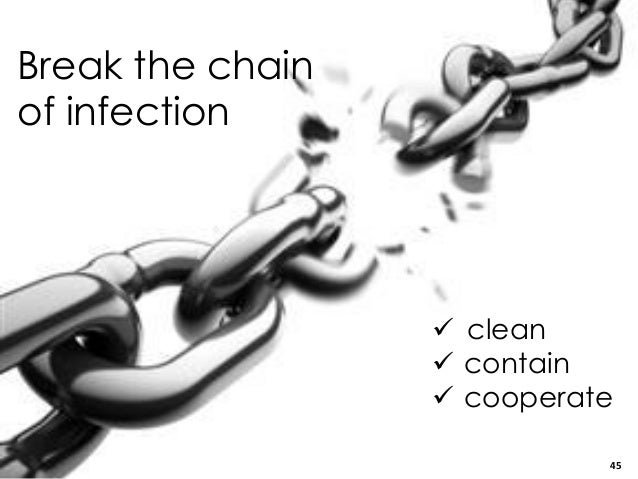
Through utilizing hygienic practices and establishing environment sanitisation (disinfectant). We as educators can prevent harmful infections from spreading and occurring.

Retrieved from: http://image.slidesharecdn.com/infectionpreventioncontrolschools-150814…
Task
Task
As educators it is our job to recognise chronic and communicable diseases. This task involves you to search the web or links provided for information on common diseases in a child care centre.
You are to identify:
- What the disease is?
- The causes of the disease?
- The symptoms?
- The incubation period (time between exposure and the development of symptoms)?
- What is the exclusion period from the service?
- How to diagnosis
- Any preventions or treatments for this particular disease?
Process
This task involves you to work as groups or can be done individually, if you work as pairs or groups make sure to choose colleagues in the same room as you.
- Identify current procedures and/or policies, posters in the room that correspond with fighting the spread of a specific disease. Reflect on if the room needs more information on specific diseases, if we do not have enough posters/pictures in the room or diseases need to be related to certain age groups
- From your research you are to construct your own poster that outlines information about the disease
- How can we promote the posters to establish a healthy environment for all children and educators? Can they be placed where we know diseases can occur? Can they be placed in all rooms or particular rooms for particular age groups? Can we design something that makes it simpler for all individuals in the centre to understand chronic or communicable diseases?
- List changes that we could make
- Report back to director about what ideas you have come up with
Resources that you could use include:
Staying Healthy:
https://www.nhmrc.gov.au/guidelines-publications/ch55
Queensland Government: Communicable disease control guidance
http://disease-control.health.qld.gov.au/
NSW Government: Health:
http://www.health.nsw.gov.au/Infectious/Pages/default.aspx
World Health Organization:
http://www.who.int/mediacentre/factsheets/en/
Government of South Australia:
http://www.who.int/mediacentre/factsheets/en/
http://www.sahealth.sa.gov.au/wps/wcm/connect/public+content/sa+health+…
Some diseases to consider
Some diseases can be prevented through immunizations/vaccinations in child care, parents may choose not to vaccinate their child, which means particular diseases can occur and be transmitted.
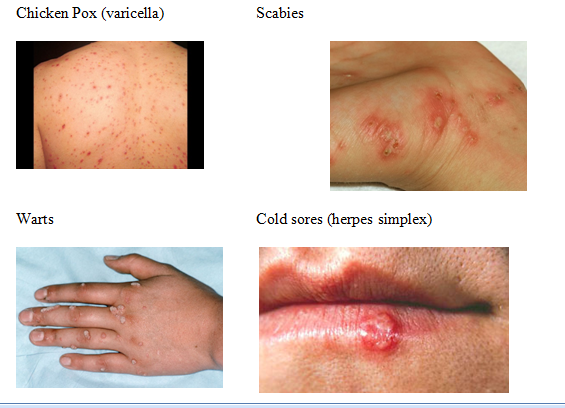
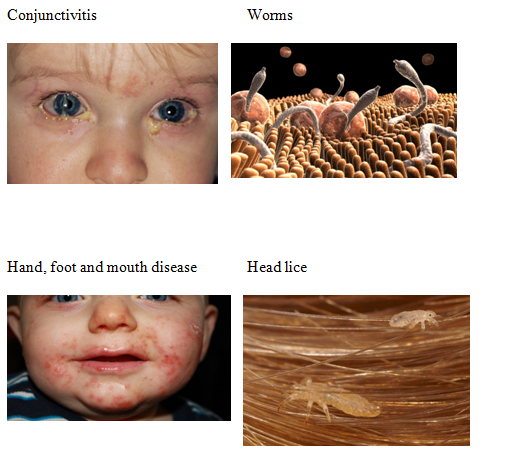
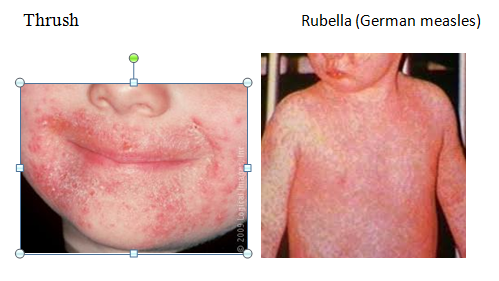
There are a number of chronic and communicable diseases that can be transmitted in childcare, these are just some of them:

Evaluation
This project will need to be finished when we have our next staff meeting (two weeks time).
In this staff meeting you will present findings, posters and changes that you came up with that will help prevent infections
Conclusion
As educators it is hoped you will become more familiar with the illnesses that are common in child care and how they can be prevented through precautions such as washing hands, correct food handling procedures, covering cough or sneezes with a tissue or sleeve.
This task relates to the:
National standards:
Standard 2.1: Each child’s health is promoted
Standard 2.2: Healthy eating and physical activity are embedded in the program
Standard 3.1.2: premises, furniture, and equipment are safe, clean and well maintained
Early Years Learning Framework:
Principle 5 from Early Years Learning Framework: ongoing learning and practice
Outcome 2.4: children are connected and contribute to their world
Outcome 3.2: children have a strong sense of their own wellbeing
Element 3.1.2
Premises, furniture and equipment are safe, clean and well maintained
- See more at: http://www.acecqa.gov.au/Physical-environment#sthash.A5hRo7Cm.dpuf
Standard 2.1
Each child’s health is promoted
Standard 2.1
Each child’s health is promoted
Standard 2.1
Each child’s health is promoted.
Credits
References
Robertson, C. (2015). Safety, nutrition and health in early education. (6th ed.). Boston, MA: Cengage Learning.
Commonwealth of Australia (2015). Communicable diseases information. Retrieved from: http://www.health.gov.au/internet/main/publishing.nsf/Content/ohp-commu…