
Introduction
Standard: SC.5.E.5.3 Distinguish among the following objects of the Solar System -- Sun, planets, moons, asteroids, comets -- and identify Earth's position in it.
Virtual Field Trip Overview
Today, the 5th grade students are going on a virtual field in exploring planets, asteroids, and comets that's throughout the solar system. Next, the 5th grade students are going to learn about the inner and outer planets that makes up our solar system. Then, the 5th grade students are going to learn about how asteroids and comets can impact our planet Earth in area of climate, weather, habitat, and human life and other planets. Last, the 5th grade students will have the opportunity to showcase their new found learning skills in task/process that involves independent work and some fun filled science center learning activities. Therefore, let's buckle up and enjoy the ride as we move through space in learning about the planets, asteroids, and comets in the solar system.
Resource :
StarLord Animation Inc. (2015) Solar system body scale Research retrieved
from
https://www.youtube.com/watch?v=At0w3pnIVgc
Exploring Our Solar System: Planets and Space for Kids – FreeSchool (2016)
Research retrieved from
https://www.youtube.com/watch?v=Qd6nLM2QlWw
Institute of Physics (2012) The dangers of asteroids and comets Research retrieved from
https://www.youtube.com/watch?v=13tWdZXRJjg
Task
Directions: Students you will have the opportunity to learn about the inner/outer planets based on two detailed videos "What's the difference between inner/out planets and Solar System-Inner/Outer Planets"
Standard:SC.5.E.5.3 Distinguish among the following objects of the Solar System -- Sun, planets, moons, asteroids, comets -- and identify Earth's position in it.
Task/student independent work: Each student will be responsible on describing the differences between inner and outer planets based on choice board such as T-chart, illustrations, digital colleague, diagram while using the virtual field trip information for reference.
Teacher example of choice board (only)
T-Chart Venn Diagram

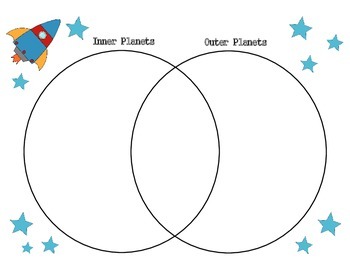
Resource information:
Kneasfey,T. (2013) What's the Difference Between Inner Planets and Outer Planets? Research retrieved from https://www.youtube.com/watch?v=c3JN6a5Hxiw
Reilly, A. (2015) Solar system-inner/outer planets Research retrieved from
Process
Directions: Student will be participating in digital science center activities
Standard:SC.5.E.5.3 Distinguish among the following objects of the Solar System -- Sun, planets, moons, asteroids, comets -- and identify Earth's position in it.
Center Activity 1 (Guess the Planet)
Task: 5th grade students will watch the video to become more familiar with learning the planets. Then, they will have to re-create the solar system that entails labeling the planets and arranging them in order (inner/outer).
Center Activity 2 ( Difference Between Comets, Asteroids, Meteoroids, Meteors, Meteorites)
Task: The 5th grade students will complete a short description such as diagrams, pictures & labels, on describing each of the science words comets, asteroids, meteoroids, meteors, meteorites and provide reasoning your logic (source of information)
Teacher Example (only)
| Science word | Definition |
Reasoning (How do you know?) |
Source of information |
comet |
space object that consist of dust, ice and possible of gas when near sun |
Comets are left over materials after planet formation it comprise of clouds of dust, gas, ice. |
Physics Stack Exchange (2017) Research retrieved from https:physics.stackexchange.com/questions/25149/how-does-a-comet-from
|
Note: The 5th grade students will have 30 minutes in each center before rotating to the next center activity
Resource link:
Guess the Planet (2011) Research retrieved from
https://www.youtube.com/watch?v=tknpM-vYKK0
Less Than Five - What's the Difference Between Comets, Asteroids, Meteoroids, Meteors & Meteorites?(2017) Research retrieved from
https://www.youtube.com/watch?v=dvd47rMYia0
Evaluation
Teacher Grading Rubric on Virtual Field trip Assignment
| 1-2 |
Student needs revisiting of the science standard, lacks understanding of science concept SC.5.E.5.3 -solar system in identifying inner and outer planets, asteroids, comets. Student response is limited on the topic based on student product ( independent work assignment, center work). |
|---|---|
| 3-4 |
Student understand the science standard SC.5.E.5.3 provides artifacts of understanding of solar system in identifying inner and outer planets, comets, asteroids. Student response on the topic meets the science standards expectations based on product (independent work assignment, center work). |
| 5 |
Student exceeds understanding of the science standard SC.5.E.5.3 through reasoning and logic solidified through conducted research and being able to make connection of the theory in real sense. Convinces other students about his or her new founded theory through research literature, provides artifacts of understanding of solar system in identifying inner and outer planets, asteroids, comets that engages his or her audience through presentation, work assignment, and work is considered as a classroom resource/reference about the aforementioned science concept. |
Conclusion
Student Reflection About Virtual Field Trip Solar System (Planets, comets, Asteroids)
Student Completing an exit Slip on this Assignment
| Name: Date: |
|
What was interesting to you about the virtual field trip? Why? ______________________________ ______________________________ ______________________________ What did you learn from the inner and out planets? ________________________________ _______________________________ _______________________________ What was interesting to you about the digital science centers? Why? _______________________________ _______________________________ ________________________________ _________________________________ |
Credits
References and resources for this Virtual Field Trip:
CPALMS 5th grade Science Standards (2013-2017) Research retreived from
http://www.cpalms.org/Public/PreviewStandard/Preview/178
Exploring Our Solar System: Planets and Space for Kids – FreeSchool (2016)
Research retrieved from
https://www.youtube.com/watch?v=Qd6nLM2QlWw
Guess the Planet (2011) Research retrieved from
https://www.youtube.com/watch?v=tknpM-vYKK0
Institute of Physics (2012) The dangers of asteroids and comets Research retrieved from
https://www.youtube.com/watch?v=13tWdZXRJjg
Kneasfey,T. (2013) What's the Difference Between Inner Planets and Outer Planets? Research retrieved from
https://www.youtube.com/watch?v=c3JN6a5Hxiw
Less Than Five - What's the Difference Between Comets, Asteroids, Meteoroids, Meteors & Meteorites?(2017) Research retrieved from
https://www.youtube.com/watch?v=dvd47rMYia0
Reilly, A. (2015) Solar system-inner/outer planets Research retrieved from
https://www.youtube.com/watch?v=b878DNyBuHE&t=122s
Star Lord animations (2015) Solar System Body Scale research retrieved
from https://www.youtube.com/watch?v=At0w3pnIVgc
Teacher Page
Hello Students ad Parents,

My name is Mr. Elton Miller. My goal as a science teacher is to empower students in learning about how science impacts our lives in areas of living (planet- Earth), breathing( oxygen- from plants, trees) , and living among other species (animals, organisms). Furthermore, my goal is to expose my students in learning beyond the classroom that entails virtual field trips through Google earth, Youtube, videos that are for resource and referencing educational purposes. Next, in my science classroom, students will have the opportunity to showcase their learning about science through hands on science experiments, virtual labs, and conducting research on specific topics. Last, parents you are more than welcomed to come and volunteer in my classroom after you have received a background check clearance.
Sincerely,
Elton Miller