
Introduction
Shading a 3D object by Justice Johnson is licensed under CC BY-NC 4.0


Regardless of an artists' personal style, each person is equipped with a base set of tools that can be applied across several different mediums. Among these skills includes the ability to use shadows and highlights to create an accurate depiction of three dimensional objects.
Take a look at Jake Spicer, an artist who published a few books on art tutorials, especially on how to draw still-life faces. His technique involves isolating each part of the face, such as the eyes, the nose, and the mouth, paying close attention to where the light catches and shadows pour across in order to assert a life-like quality. Had these tonal shapes been missing from his art, his pieces would fall flat, quite literally.

Note the varying amounts of tone on the painting in the skin, hair, and lips, utilizing various darks and lights to add a 3 dimensional quality to a 2d drawing.
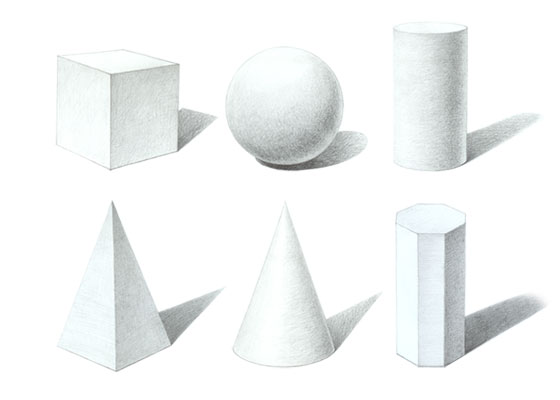
Today we will be looking into the basics of forming these techniques by learning how to highlight and shade simple 3D shapes, which will set you up for success with more complex shapes.
Task
By the end of this WebQuest, the student should be able to
- Identify where highlights and shadows are to be placed on a basic shape
- Use various grades of pencil to create fluid gradients to create dimension
- Produce a realistic drawing of a shaded 3D geometric shape
Students will then submit 3 practice drawings consisting of a square, a sphere, and a cone with accurate, smooth shading and highlights.
Process
Complete this guided art exercise for practicing gradients:
Next, watch this 20 minute video from Circle Line Art School:
tip: try to draw alongside him while he creates these basic shapes
Evaluation
Give it a try!
- Using various grades of pencil ranging from 6b to 6h, practice creating flat gradients on empty rectangles in order to hone your ability to create smooth transition between light and dark
- Review the different techniques necessary to shade each shape, following the curvature and edges of each one.
- Apply these techniques to a square, a sphere, and a cone as demonstrated in the previous video. Rewind and replay as needed, paying close attention to how layers of shadow are carefully and slowly built up
Don't be afraid if it doesn't look quite right or if you end up making more than one-it will take practice!
Conclusion
By producing these three geometric shapes and gradually applying shadows and highlights, students will begin to build a foundation for shading more complicated forms, such as multiple light sources or odd shapes. Accurate shading greatly enhances the look of a realistic art piece, and such foundations can be applied to any art style, such as the way a cartoon uses block shading, following the same base principles.
Credits
Works Cited
"Art Exercise Creating a Pencil Gradient." Created by Art ala Carte. YouTube, 26 Apr. 2014, www.youtube.com/watch?v=JDV8DlL6EBM
"Drawing faces An introduction." Artists & Illustrators, Sept. 2024, p. 54. Gale In Context: High School, www.link.gale.com/apps/doc/A807033770/SUIC?u=psulib&sid=bookmark-SUIC&xid=1da3be61
"Drawing faces: Eyes." Artists & Illustrators, Oct. 2024, p. 52. Gale In Context: High School, www.link.gale.com/apps/doc/A810324038/SUIC?u=psulib&sid=bookmark-SUIC&xid=b209c60d
"How to Draw Basic 3D Shapes for Beginners: Narrated Step-by-Step." Created by Circle Line Art School. YouTube, 9 Sept. 2023, www.youtube.com/watch?v=9hz_GX0eD5w
Portraiture and Life Drawing Masterclass Course with Jake Spicer. Created by Jake Spicer, video 4, derwentpencils, 15 Nov. 2021. YouTube, uploaded by derwentpencils, 2021, www.youtube.com/watch?v=KMZIFTqk18Q&t=29s.
Three Dimensional Shapes Drawing Examples. Pencil Drawing. Easy Drawing Tips, www.easydrawingtips.com/shading-basic-3d-shape-drawings-tutorial/#google_vignette.
Additional Resources

the Biology of Seeing
Livingstone, Margaret

Secrets to Drawing Realistic Faces
Parks, Carrie-Stuart