
Introduction
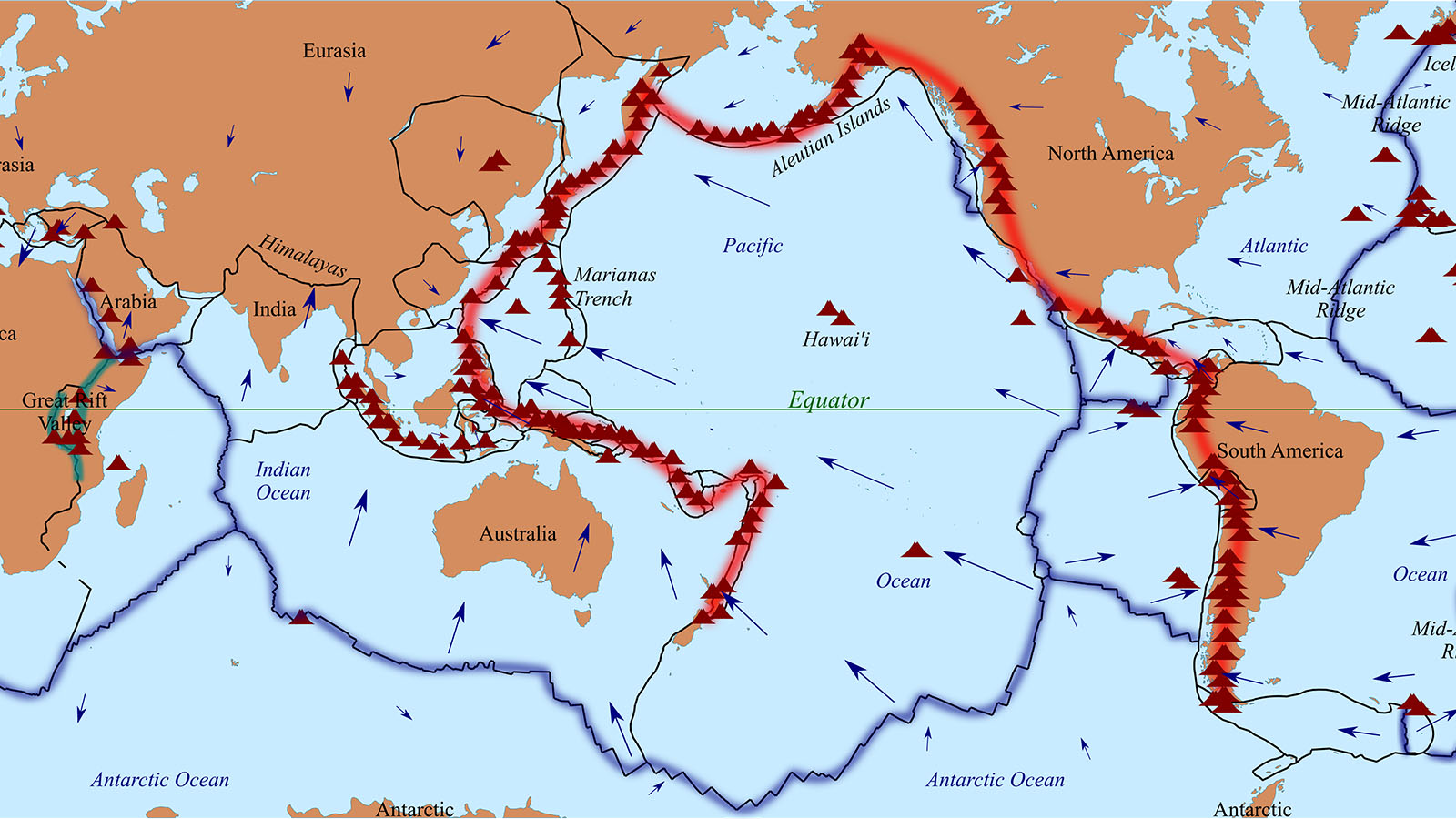
The Ring of Fire, also referred to as the Circum-Pacific Belt, is a path along the Pacific Ocean characterized by active volcanoes and frequent earthquakes. The majority of Earth’s volcanoes and earthquakes take place along the Ring of Fire.
Your quest is to find out....
Why are there so many volcanoes around the Ring of Fire?
Task
This quest contains a number of tasks which require you to visit a website and answer some questions. As you progress through this quest, you will need to record your answers in Teams.
Task 1
Ring of Fire
Visit this website and answer the questions below. https://education.nationalgeographic.org/resource/ring-fire
A) What percentage of the Earth’s volcanoes are in the Ring of Fire?
B) Name the tectonic plates that are involved in the Ring of Fire?
C) What causes most volcanoes along the majority of the Ring of Fire?
D) Where is there a transform boundary in the Ring of Fire?
Task 2
Plate movements around the Ring of Fire.
Study this chart.

Identify the type of plate movements in the locations below (Plate movements: convergent, divergent, transform).
A) Between the Pacific plate and the Nazca plate.
B) Between the Indo-Australian plate and the Pacific plate.
C) Between the North American Plate and the Pacific plate.
D) What do the yellow dots represent?
E) What type of tectonic plate boundaries are common in the Ring of Fire?
Task 3
Volcanoes in Australia.
Visit this page and read through the information on it. https://www.volcanocafe.org/australian-volcanoes/
A) Which direction is Australia drifting?
B) How many centimetres is Australia moving each year?
C) Why are there lava fields and volcanoes stretching across eastern Australia but not Western Australia?
D) How long ago were the volcanoes and lava fields in the northern most part of Australia?
E) Where in Australia have the most recent eruptions occurred?
F) 15 million years ago there was a shield volcano in Warrumbungles National Park, New South Wales. What caused it to erode?
Task 4
Mount Fox
Using the information from this site https://parks.des.qld.gov.au/parks/girringun-mount-fox/about/culture and other website of your own choosing to:
A) Explain in your own words how we know that Mount Fox was a volcano. Your response should be around 100 words.
B) Describe what is Mount Fox used for today.
Task 5
When are volcanoes not created?
Interactive Slip, Slide and Collide Activity.
Head to this link and click on the "slip, slide & Collide" tab at the top of the screen. https://www.learner.org/series/interactive-dynamic-earth/
Complete the interactive activities and answer these questions.
A) What happens when two continental plates collide?
B) Provide at least two reasons for your answer to A.
Task 6
Earthquakes
Learn about how earthquakes are measured using this site. https://www.earthquakeauthority.com/Blog/2020/Earthquake-Measurements-Magnitude-vs-Intensity#:~:text=A%20seismograph%20is%20the%20primary,duration%20of%20the%20earthquake's%20waves.
A) What instrument is used to measure earthquakes?
B) What is the name given to a digital recording of an earthquake?
C) What is the name of the scale used today to measure earthquakes?
D) Explain how this scale works.
E) Who was the first person to develop a method of measuring earthquakes?
F) When did this person create the method and what was it called?
G) Describe the limitations of the initial method of measuring earthquakes.
H) What method is used to forecast future earthquakes or earthquake hazards?
Using the data from this website and the “recent earthquakes” tab at the top to answer the questions below. https://earthquakes.ga.gov.au/
A) Were there any earthquakes in Australia in the last 7 days?
B) If so, where were they located?
C) Order them from lowest magnitude to highest magnitude.
D) Order them from lowest depth to most shallow depth.
Evaluation
You will get 5 points for every task that you have given a decent attempt.
You get 1 bonus point for every answer that you get correct.
If all students get at least 20 points, we will do a Kahoot! quiz in our next lesson.
The person with the highest number of points at the end of the lesson gets to select a sticker to cherish forever!