
Introduction
Students will learn about and display different types of shelters.
Introduction
Welcome students! Your mission is to learn about different types of shelters. Shelter is one of the five basic needs humans need to survive. Shelter is what keeps us safe from danger. All over the world people live in different types of shelters like houses, igloos, and huts! You will research different types of shelters. You will use this information to create a diorama of a type of shelter you find interesting and would find intriguing to live in!
You will follow the links, gather information, and create a shelter you find exciting. You may even get to eat some of your supplies, depending on what you use to creat your diorama!


Task
Task:
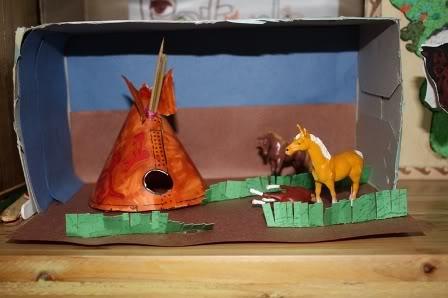
The student will be creating a diorama of a type of shelter they find interesting. They will imagine themselves living in a shelter they find interesting and would find interesting to build. They will then create a diorama and present a paragraph on where the type of shelter they chose belongs.
For example igloos belong in somewhere cold, so a student who chose a igloo would write a paragraph about how it belongs there.
Process
Process
Step 1. Use these resources to determine what type of shelter you want to choose.
Step 2. Decide what type of shelter you are going to create.
Step 3. Assemble the supplies you need to create your diorama.
*You can find some supplies needed outside like, sticks, mud, and leaves depending on the type of shelter you choose. You can also use food like marshmellows or sugar cubes to make igloos, yummy!
Step 4. Once you have assemble your supplies you can now create your diorama. Remember to make it as realistic as possible!
Step 5. After you have created your diorama you need to write your paragraph. Think about why your type of shelter belongs in certain regions of the world and why you had to use certain materials to make it.
Step 6. Be prepared to demonstrate your diorama and read your paragraph to the class.
Evaluation
|
|
3
|
2
|
1
|
Score
|
|
Effort
|
Looks really good in design, layout, and neatness.
|
Is acceptable though it maybe a little messy.
|
Is messy and poorly designed. Seems no time was taken to complete the task.
|
|
|
Content-Accuracy
|
All the content is correct.
|
All content is correct with a few minor errors.
|
Most of the content is incorrect.
|
|
|
Presentation
|
Presented diorama with confidence.
|
Presented diorama but difficult to understand.
|
Did not present.
|
|
|
Spelling Grammar
|
No spelling or grammatical errors in the paragraph.
|
One or two errors in the paragraph.
|
More than one or two errors in the paragraph.
|
|
Total Points: ___________
Conclusion
Conclusion:
Congratulations! You have learned about different shelters from all over the world and successfully created a interesting diorama to display that. You have also used your mind a lot to think of why certain shelters belong in specific regions and why they are made of certain things!
Credits
Author Biography
Haley Garrett I am a college student persuing a career in teaching. The use of technology is very important to me because of how many resources you can use to educate yourself and others. I hope using this WebQuest will help my others want to learn more about the types of homes people live in around our world.
Permissions We all benefit by being sharing our knowledge. Permission is granted for others to use and modify this WebQuest for educational, non-commerical purposes as long as the original authorship is credited. The modified WebQuest may be shared only under the same conditions. See the Creative Commons Attribution • Non-Commercial• Share-Alike license for details.
Teacher Page
by Haley Garrett
Students will research different types of shelters around the world then choose one to make a diorama about. After students have completed their diorama they will write a paragraph about why the shelter they chose belongs to a certain region. The paragraph should tell why certain shelters belong in certain regions because of climate, resources, and etc.